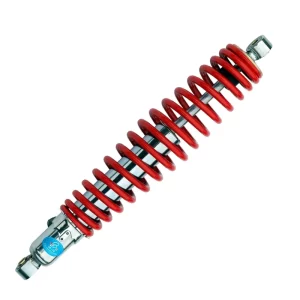
Shock absorber fade is not simply a matter of heat. In my experience testing dampers that failed after aggressive off-road sessions, the root cause often traces back to how precisely the internal hard parts were made and assembled. When a damper loses its bite mid-trail, the immediate culprit might be hot oil, but the real issues are usually set during manufacturing: bore finish imperfections, seal material selection, and inconsistent gas charge pressure. This article breaks down the chain from design choice to fade event, so you can spot the weak points before a shock ever leaves the parts shelf.
How Heat Triggers Shock Absorber Fade
Heat is the most visible trigger, but it only becomes a problem when the damper’s design can’t manage it. In any hydraulic shock, oil is forced through small orifices in the piston, and the restriction creates damping force. The wasted energy converts to heat. If the oil temperature climbs past roughly 120°C, most standard hydraulic fluids begin to lose viscosity. Lower viscosity means less resistance through the shim stack, and damping force drops.
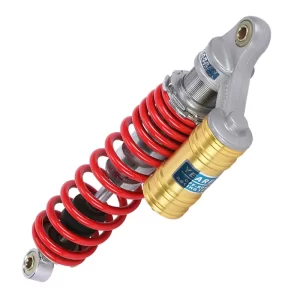
The speed of this heat buildup depends on the damper body surface area, piston stroke velocity, and gas charge design. Monotube dampers, with their larger working-surface-to-oil ratio, shed heat faster than twin-tube designs. I have watched oil temperature climb 40°C in under fifteen minutes on a dyno cycle that simulates a high-speed sand wash. If the damper body was a twin-tube with a thick outer tube and an air gap acting as an insulator, the fade onset was quicker and deeper.
Why Gas Pressure Loss Causes Shock Fade
Gas charge does more than prevent aeration. It provides a baseline static pressure that keeps the oil in contact with the piston during the rebound stroke and influences the damping curve at high shaft speeds. When gas pressure bleeds out, the damper’s damping characteristic shifts. On a compression stroke, reduced gas pressure means less resistance to cavitation behind the piston. Cavitation creates vapor voids that collapse violently, and the damping force becomes erratic.
I’ve seen instances where a shock came back from field testing with nearly zero nitrogen charge because the IFP (internal floating piston) O-ring groove had a tool mark that slowly extruded the seal. The driver complained that the vehicle felt “loose and unpredictable” after 30 minutes. That loss of ride control wasn’t wear and tear; it was a manufacturing defect that skipped detection because the factory’s nitrogen charge check wasn’t rigorous.
Design Factors That Make Shocks Prone to Fade
Design plays a huge role. The biggest difference I track is between monotube and twin-tube construction. A twin-tube damper routes fluid through a base valve and a piston valve, with an outer reservoir for thermal expansion. It’s cost-friendly and robust against side loads, but it traps heat. A monotube, with a floating piston separating gas and oil, has a direct thermal path to the outer wall. It sheds heat more effectively and resists fade longer, but it’s intolerant of sloppy bore finish because any surface ripple wears the piston band quickly.
Piston design matters too. A linear-flow piston with narrow, sharply defined ports creates higher fluid velocities and more predictable damping, but it’s also more sensitive to oil contamination and viscosity change. Deflected-disc valving with high-flow ports can be more forgiving as oil degrades, but it tends to produce a softer knee point that some drivers dislike. The table below compares design approaches and their fade-related trade-offs.
| Design Element | Monotube | Twin-tube |
|---|---|---|
| Heat dissipation | Direct path to outer wall; faster cooling | Insulating air gap; slower cooling |
| Susceptibility to oil aeration | Low (gas/oil separated by floating piston) | Higher (oil can mix with gas in the outer chamber) |
| Manufacturing precision required | Very high; small bore deviations cause seal wear | Moderate; more forgiving |
| Typical fade resistance | Superior for sustained high-load use | Adequate for intermittent use |
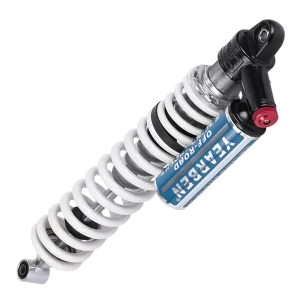
Manufacturing Precision and Fade Prevention
A damper design can be flawless on paper, but manufacturing repeatability is what delivers fade resistance in the real world. I’ll focus on two areas we treat as non-negotiable: bore finish and gas charge stability.
Bore Finish and Seal Wear
The inner bore surface is the sealing partner for the piston band or ring. If the bore has chatter marks or an inconsistent cross-hatch pattern, the band wears non-uniformly. As the band wears, bypass leakage around the piston increases, reducing damping force even before the oil degrades. We specify a surface roughness of Ra 0.2 to 0.4 microns for most off-road monotube dampers and verify it with profilometry on every production batch. I’ve inspected returned shocks that faded after just 20 hours of use; the bore measured Ra 0.8 with distinct chatter, and the piston band had a deep groove on one side. That’s a fade cause that no oil change will fix.
Nitrogen Charge Consistency
Nitrogen pressure directly affects the damping curve, but also influences aeration resistance. Our target charge tolerance is ±5 psi on a production dyno-verified unit. If a shock leaves the factory at 200 psi but is supposed to be 250 psi due to a fill manifold error, the damping curve shifts soft and the driver will perceive that as fade when the shock is simply under-tuned. Worse, low charge allows cavitation at lower shaft velocities, accelerating fluid degradation and genuine fade onset.
Preventing this comes down to process control. At our facility, every monotube shock is dyno-tested after charging with a fully automated gas manifold that logs pressure and reject rate by batch. If a batch shows a standard deviation above 3 psi, we pause and recalibrate. That’s an internal discipline, not a customer-facing spec, but it directly affects whether a shock will hold damping ten minutes into a race-run.
If your program involves aggressive off-road racing or heavy-duty commercial use, it is worth confirming the factory’s bore finish spec and nitrogen charge tolerance before committing to an order. Ask for the specific Ra range they guarantee and whether production dyno data is available. A factory that hesitates on this likely doesn’t control what matters for fade resistance.
Choosing Shocks That Resist Fade
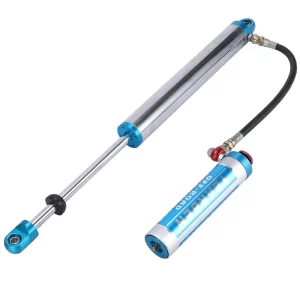
The spec sheet rarely tells the full story, but you can ask targeted questions to filter out designs and manufacturers that will produce early-fading dampers. Consider body construction first. For any vehicle that sees sustained high-speed travel over rough ground, I recommend monotube construction with a remote or piggyback reservoir. The reservoir adds oil capacity and external cooling surface, directly pushing fade onset further into the ride.
Seal material is another factor. Nitrile rubber is common and adequate for standard automotive use, but it hardens past 140°C and loses sealing force. For off-road applications, we use HNBR or Viton seals that maintain elasticity above 180°C, preserving both gas charge and oil containment under prolonged heat. This isn’t a marketing upgrade; it’s a fade-fighting necessity for Baja-style or desert endurance driving.
On the purchasing side, ask the manufacturer for a fade-cycle dyno strip chart. A shock that produces 90% of its initial damping force after a continuous 100 km/h equivalent simulation cycle is a serious unit. If the chart shows more than 20% force loss, that damper will disappoint in the real world.
A final point: don’t assume thicker oil solves fade. A higher viscosity can increase initial damping but also raises fluid friction and heat, accelerating the problem. The right match is a shock that holds consistent viscosity across temperature, which comes down to oil quality and baseline design, not band-aid solutions.
Common Questions About Shock Absorber Fade
What exactly is shock absorber fade?
Shock fade is a measurable reduction in damping force under sustained or repeated use, typically from heat-induced fluid viscosity loss, gas pressure decrease, or internal bypass leakage. In practical terms, the vehicle begins to float over terrain it previously tracked precisely, and the driver feels a loss of chassis stability.
How do I know if my shocks are fading, not just bottoming out?
Fade feels different from bottoming. Bottoming is a sharp, hard stop at the end of travel, often accompanied by a harsh jolt. Fade causes a gradual loss of body control: the vehicle starts to wallow, the steering feels loose, and you find yourself adding more steering corrections. If you can jump out and feel the shock body temperature, a unit at fade temperature will be too hot to touch.
Can faded shocks be repaired, or do they need replacement?
Most standard mechanic shops won’t rebuild a monotube or reservoir shock. It requires disassembly on a clean bench, replacement of seals and often the piston band, plus re-charging with nitrogen. Salvageable if the bore is undamaged and the hard parts aren’t scored. If the shaft is nicked or the bore is scratched, the cost of repair often exceeds replacement.
Do remote reservoirs really prevent fade?
Remote reservoirs help by adding fluid volume and increasing surface area for cooling, delaying fade significantly. They don’t “prevent” it if the base damper design is deficient. But a monotube with a properly sized reservoir and adequate gas charge will run cooler and longer than any non-reservoir twin-tube in sustained hard use.
How does Yearben validate fade resistance during production?
We dyno test every monotube assembly on a hydraulic dynamometer that records force-velocity curves before and after a heat-soak cycle. Only units that maintain damping force within 5% of initial values across a full temperature sweep are cleared for shipping. Our engineering team reviews batch averages weekly to catch any process drift. If you’re sourcing custom shocks and need documented fade resistance data, send your application parameters and we’ll confirm the appropriate spec — reach us at info@yearbenshocks.com.
If you’re interested, check out these related articles:
Best-Shocks-And-Springs-For-Trucks
Triple-Bypass-Remote-Reservoir-Shock
Lawn-Mower-Damper-Shock-Absorber
Twin-Tube-Hydraulic-Seat-Damper-28MM