Shock absorber suspension for ATV and UTV OEM procurement is a decision that shapes vehicle performance, durability, and rider confidence. Whether you’re an off-road vehicle builder or a procurement manager, selecting the right shock absorber supplier goes beyond comparing catalog specs. It involves verifying manufacturing capability, testing rigor, and after-sales support. Over twenty years of suspension engineering experience has shown that the difference between a dependable OEM partnership and a costly sourcing mistake often lies in the details most guides overlook.
What Specs Define a Quality ATV and UTV Shock Absorber?
A shock absorber that performs consistently across trail, utility, and racing scenarios starts with the right technical foundation. The damping system must balance compression and rebound forces accurately. For most ATV and UTV applications, a monotube design with a nitrogen gas charge provides better heat dissipation and cavitation resistance than twin-tube alternatives, especially during prolonged high-speed runs.
Spring rate selection is just as critical. A spring that’s too stiff causes harsh ride and reduced traction; too soft leads to bottoming and loss of control. The ideal rate accounts for the vehicle’s corner weight, intended use, and any additional cargo. We typically match spring rates within a 50 lb/in window during custom builds to keep the damping curve predictable.
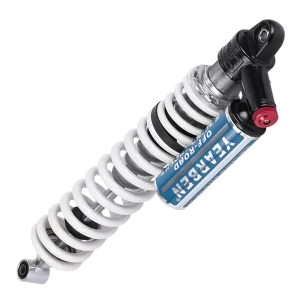
Key dimensional specs include extended and collapsed lengths, eyelet diameter, and mounting width. These measurements must match the vehicle’s suspension geometry exactly. I’ve seen OEM orders delayed because a 2 mm difference in bushing width was overlooked at the drawing stage.
| Specification | What to Verify | Impact on Performance |
|---|---|---|
| Damping type | Monotube vs twin-tube | Heat management and fade resistance |
| Spring rate | lb/in matched to vehicle weight | Ride height and bottom-out control |
| Travel length | Extended and collapsed dimensions | Full articulation without binding |
| End fittings | Eyelet or stud type, bushing material | Mounting reliability and NVH |
| Adjustment | Fixed, threaded preload, or clicker | Tuneability for terrain and load |
Adjustable damping adds another layer of flexibility. A well-executed compression clicker lets the operator fine-tune ride stiffness without disassembly, which matters for multi-purpose fleets.
Why does nitrogen charging matter for off-road shock absorbers?
Nitrogen is inert and resists foaming longer than air-charged emulsions. When the piston moves rapidly, it shears the oil. Air bubbles compress unpredictably and cause damping fade. A consistent nitrogen charge behind the floating piston maintains consistent oil pressure and keeps the shock predictable during repeated impacts.
How does spring rate interact with damping adjustment?
Spring rate determines the force needed to compress the suspension, while damping controls the speed of compression and rebound. If the spring is too stiff, no amount of damping adjustment will make the ride compliant. I always recommend finalizing spring rate through vehicle testing before tuning the valving stack, because a mismatched spring masks the true damping behavior.
How Can You Evaluate a Shock Absorber OEM Manufacturer?
Assessing a potential supplier requires looking past marketing claims and into the production environment. A serious OEM manufacturer will have in-house CNC machining, welding cells, and a shock dynamometer. That last point matters: if a factory cannot generate a dyno curve for its own product, it cannot control damping consistency between batches.
I’ve visited factories that assemble shocks from outsourced components without any feedback loop on piston and shim tolerances. The result is unit-to-unit variation that shows up as uneven ride quality in the field. A quality-focused manufacturer invests in its own component machining and testing, not just final assembly.
Certifications are a baseline, not a guarantee. ISO 9001 confirms a quality management system, but for off-road shock absorbers, the relevant tests are endurance cycling, seal life under side load, and nitrogen retention over time. Ask for validation reports that cover these specific parameters, not just a generic certificate.
Yearben, for instance, runs each production batch through a nitrogen-charging station and a cycle-test rig before release. This catches seal defects and charging inconsistencies early, before the shock ever reaches a customer’s vehicle.
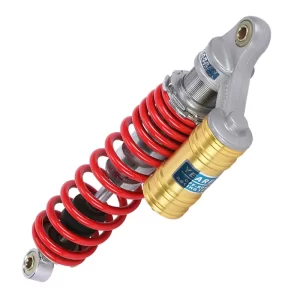
An evaluation checklist should cover the manufacturer’s capability to produce the exact shock type needed, whether that’s a piggyback reservoir unit, a coilover, or an emulsion-type damper. The product library must include multiple diameters and stroke lengths to support different vehicle platforms.
What OEM Customization Options Improve ATV and UTV Shock Performance?
Customization separates a generic shock from one purpose-built for a specific machine. At the core, the damping curve is the most valuable variable. A shim stack can be tuned to prioritize initial plushness for trail comfort or mid-stroke support for desert racing. Providing the manufacturer with vehicle weight, travel length, and primary terrain allows them to generate a dyno-proven valving specification.
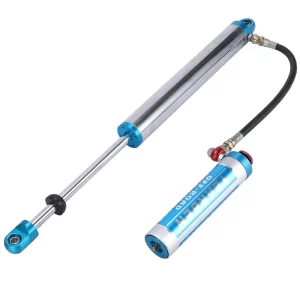
Spring rate and preload adjustment come next. Threaded-body coilover shocks permit ride-height adjustment without changing spring, which is useful when vehicle loads vary. Remote reservoir shocks add oil volume and cooling area, extending fade-free operation on long runs. For builders who require quick tuning, compression clickers with a defined number of positions give repeatable adjustments.
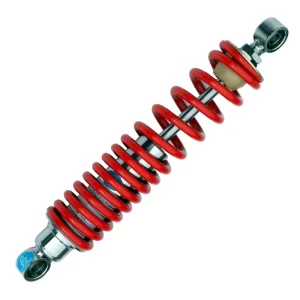
Steering dampers for ATV and UTV applications are another common customization. The damping force required for a 250 cc trail quad differs markedly from a 1000 cc side-by-side used in desert terrain. Specifying bore size, mounting length, and damping characteristic at the outset prevents the under-damped steering that causes rider fatigue.
If your project involves variable payloads or aggressive trail riding, it is worth confirming the oil volume and cooling strategy with the manufacturer before finalizing the bill of materials. Reach out at info@yearbenshocks.com with your vehicle details and expected conditions.
What are the benefits of remote reservoir shocks for an OEM build?
A remote reservoir separates the nitrogen charge from the main shock body, increasing oil capacity and reducing heat buildup. For high-duty-cycle applications like dune riding or rally racing, that extra oil volume prevents damping fade. It also allows finer valving options because the reservoir can house additional adjustability mechanisms.
Can one shock absorber design cover both ATV and UTV platforms?
Rarely. ATVs weigh significantly less than UTVs and have different motion ratios. A shock valved for a 400 lb ATV will be dangerously soft on a 1500 lb UTV. Each platform benefits from a dedicated damping curve and spring rate. That said, a factory with broad platform experience can often adapt the same body diameter and end-fitting design while changing internal valving.
How Do Suppliers Test and Assure Shock Absorber Quality?
A rigorous testing protocol is non-negotiable for OEM shock absorber supply. A basic dyno curve at multiple shaft speeds verifies damping force at the design points. Endurance testing on a hydraulic actuator simulates thousands of kilometers of trail riding, exposing seal wear, shaft scoring, and oil degradation before the first production unit ships.
We require every batch to pass a nitrogen retention test. A shock that loses even 5% of its charge over a 72-hour period is rejected. This is a pass-fail gate, not a statistical sampling. Combined with salt-spray testing on external coatings and bushing durability under side load, these checks build the reliability OEM buyers depend on.
Documentation matters. Each production lot should ship with a dyno summary and a certificate of conformance that lists the tests performed. Suppliers that hesitate to share this data typically lack the process control or the equipment to produce it.
What does a complete shock dyno report include?
A useful dyno report graphs force versus velocity for both compression and rebound across the full stroke speed range. It also includes peak forces at specified speeds, hysteresis values, and gas pressure before and after testing. Comparing these values to the approved golden sample confirms batch consistency.
How often should off-road shocks be batch-tested?
I recommend 100% functional testing for custom OEM orders where spec conformance is critical. Standard production runs can adopt a statistically valid sampling plan with a 4% AQL, but temperature rise and seal life should be validated on every new batch of seals or production-run change.
What Is the Order Process and Lead Time for Custom ATV and UTV Shocks?
The typical OEM order workflow begins with a technical specification sheet. The buyer provides vehicle make, model, weight, suspension travel, and intended use. The manufacturer reviews the specs, proposes a preliminary damping curve and spring rate, and builds a pair of sample units.
These samples undergo dyno testing and, ideally, real-vehicle validation. Once the samples are approved and the specification is locked, mass production can begin. Lead time for a standard production run of 100 to 500 units usually ranges from 35 to 55 days, depending on component availability and current production load.
MOQ varies by product complexity. A full coilover shock with remote reservoir may carry a higher minimum order than a non-adjustable emulsion shock. Clarifying these thresholds early avoids surprises later.
Packaging and logistics are part of the commitment. Shocks should be individually sealed with a desiccant pack if shipped by sea freight to prevent surface corrosion. The factory’s willingness to handle these details reflects their overall operation quality.
How Do You Build a Long-Term OEM Partnership for Shock Absorber Supply?
A reliable supply relationship grows from clear communication and shared engineering goals. The most efficient partnerships involve direct access to the factory’s technical team, not just a sales representative. When a design change arises due to a vehicle update, the manufacturer who can turn a revised valving specification into a new sample within two weeks adds strategic value.
Exclusivity agreements can protect custom-developed specifications. If a buyer pays for tooling and testing, we document that investment and prevent the same design from being offered to competitors without written consent. This builds trust and justifies the collaboration.
Consistent quality reports, proactive notification of raw material changes, and a willingness to support smaller innovation runs all signal a supplier that sees the relationship beyond order volume. In the long run, that stability is worth more than the lowest piece price.
For procurement teams evaluating their next suspension supplier, we recommend starting with a clear spec and a sample request. Send your part number and quantity to info@yearbenshocks.com or call +86-523-86566899. We’ll review the damping requirements and deliver a technical proposal with dyno projections within 24 hours.
Common Questions About Sourcing OEM Shock Absorbers for ATVs and UTVs
What is the minimum order quantity for custom ATV and UTV shocks?
It depends on the shock type. Simple non-adjustable emulsion shocks can often be ordered in quantities as low as 50 units. More complex products like threaded-body coilovers with remote reservoirs typically require a minimum of 100 to 200 units due to component procurement economics. We work with new programs to find a balance between development investment and initial batch size.
How long does it take from sample approval to production delivery?
After sample sign-off, a production run of 100 to 300 units normally takes 35 to 45 days. Additional time is needed if unique anodizing colors, custom stickers, or special packaging are involved. Unexpected raw material shortages can extend the timeline by two to three weeks, so early order placement helps keep the project on schedule.
Can you supply shock absorbers for other off-road vehicles like buggies or side-by-sides?
Yes. The same manufacturing platform that produces ATV and UTV shocks can adapt to buggies, go-karts, and even 4×4 trucks. We have supplied coilover shocks for sand rail builders and heavy-duty units for rock crawlers. Each new platform requires its own dimension and damping validation, but the engineering process is identical.
What documentation is provided with each production batch?
Every order ships with a production test report that includes dyno curves for a sample from that batch, nitrogen pressure logs, and dimensional inspection results. We also include a certificate of conformance and, when requested, surface treatment certifications. This documentation helps buyers maintain their own quality records and satisfy end-customer requirements.
Do you offer shock absorbers with adjustable damping for multi-terrain use?
Absolutely. Threaded-body coilovers with compression clickers allow riders to switch from soft trail settings to firm dune settings without tools. We also build remote reservoir shocks with high- and low-speed compression adjustment for professional race teams. For a sample dyno sheet calibrated to your vehicle type, share your requirements and we’ll confirm the damping range that fits your performance envelope.
If you’re interested, check out these related articles:
Remote-Reservoir-Shocks-Manufacturer
Off-Road-Coil-Over-Shocks-Manufacturer
Off-Road-Coilover-Shocks
Ride-on Mower Shock Absorbers 38mm, Shock Absorber Manufacturer
2-0-Air-Shock