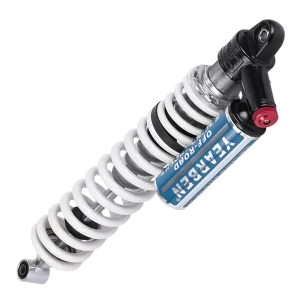
An adjustable shock absorber gives you the ability to alter damping force without revalving the unit, but a 20-click knob does not mean the shock is correctly matched to your application. Over twenty years of custom damper development have taught me that the adjuster’s useful range must land inside the real operating conditions of the vehicle or seat, not bracket every possible scenario at the expense of precision in the one that matters. Racing and truck seating place fundamentally different demands on the valve stack, and a single adjustable platform will only perform well in both if the base valving is specified for the narrower of the two envelopes.
Inside the Adjustable Shock Absorber: What the Knob Actually Changes
Adjustment methods vary by platform, but every adjustable damper alters either the flow path of hydraulic fluid or the preload on a spring-loaded valve. In a needle-and-seat compression adjuster, turning the knob moves a tapered needle into or away from an orifice, restricting or opening the bleed circuit. This shifts the low-speed portion of the damping curve before the main shim stack deflects. Rebound adjustment works on the opposite stroke, often through a separate check-valve port on the piston or base valve.
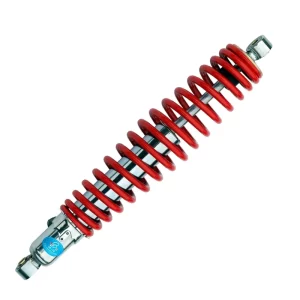
Many shocks labeled “adjustable” only give you a single combined circuit that affects both compression and rebound, which limits tuning precision. We prefer independent circuits when an application requires separating body control from wheel response, though this adds cost and packaging. The key point is that the adjuster operates on a fixed pre-existing valve profile. The knob changes where on that profile you sit; it does not rewrite the shape of the curve. If the baseline curve misses the target load and velocity range, no amount of knob rotation fixes it.
Racing Damping Requirements: Transient Response and Heat Management
Racing generates rapid, high-speed shaft movements from track irregularities, curbing, and jump landings. The damper must control energy over a wide velocity band while resisting fade from heat buildup. In a desert race or stage rally, fluid temperatures routinely exceed 120°C, which thins the oil and lowers damping force if the valve stack cannot compensate with sufficient mechanical restriction. That is why many race shocks use a large-diameter piston and external reservoir: the piston provides the flow control, and the reservoir adds oil volume and a separating gas charge to slow temperature rise.
Compression vs. Rebound Adjusters in Track Use
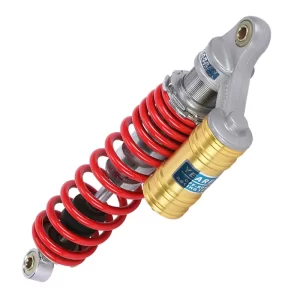
On a circuit car or rally truck, compression adjusters control chassis attitude during braking and cornering. Rebound adjusters manage how quickly the wheel returns to the surface after a bump. A common tuning error is adding compression damping to reduce body roll while neglecting the corresponding stiffness that prevents the tire from tracking small surface imperfections. I have seen lap times worsen after a crew “tightened up” the compression clickers without testing the change on a data acquisition system. We run a three-stage verification on our adjustable race dampers: dyno sweep at multiple clicker positions, on-vehicle accelerometer logging, and post-run teardown to check for cavitation marks inside the piston bore. This catches valving mismatches before they become DNFs.
Why Heat Build-Up Changes Damping Consistency
As oil temperature rises, viscosity drops, and the damping force produced by a given orifice shrinks. A well-designed adjustable shock places the main resistive element in the shim stack rather than the needle orifice, because shim deflection is less temperature-sensitive than fluid shear through a small hole. A dyno graph taken at 30°C should look similar to one at 90°C if the shock uses a digressive piston and a progressive shim stack. We test every new piston and shim combination from 20°C to 100°C and map the force-velocity curve. Shocks that lose more than 15% of their damping force over that range do not leave our shop.
Truck Seat Dampers: Why Low-Speed Damping Controls Comfort
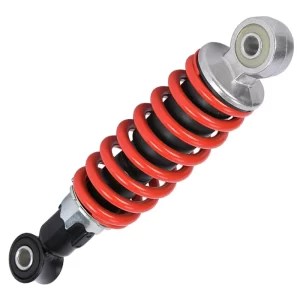
A truck seat damper operates in a different universe of frequencies and loads. The input is typically below 5 Hz, coming from chassis pitch, road undulations, and cab oscillations, not high-speed impact events. The damper’s job is to dissipate energy slowly so the driver does not feel each cycle as a separate jolt. Low-speed bleed is everything here. If the bleed orifice is too restrictive, the seat becomes harsh and transmits high-frequency vibration to the spine, increasing driver fatigue over an eight-hour shift. If it is too open, the seat oscillates and bottoms out repeatedly as the spring rebounds.
Seat Suspension Frequency and Driver Fatigue
Human tolerance to vertical vibration peaks between 4 and 8 Hz, which is precisely where many commercial truck suspensions amplify road energy. The seat damper must attenuate this band without introducing a secondary resonance. We configure the bleed orifice and the initial shim stack opening point to produce a damping ratio between 0.25 and 0.35 at the seat’s natural frequency, which yields fast settling with minimal overshoot. This value must hold under the full claimed weight range of the driver. A seat damper advertised for 50–130 kg drivers but valved only at 75 kg will bottom for a heavy driver and top out for a light one. Adjustable damping helps, but only if the adjuster can shift the whole force-velocity curve upward in proportion to load. Some low-cost adjustable seat dampers only change the high-speed circuit, leaving the low-speed bleed fixed, which makes the adjuster nearly useless for comfort tuning. We never ship an adjustable seat damper without dyno curves at both ends of its load rating, confirmed with actual masses on a test rig.
Valving Priorities: Racing Frequency vs. Seating Load Range
The central engineering conflict between racing and seating is that racing tunes for velocity sensitivity across a broad range, while seating tunes for load sensitivity within a narrow velocity band. A desert racer sees shaft velocities from a few millimeters per second up to several meters per second. The seat damper rarely exceeds 0.3 meters per second. Forcing them into the same base valve means someone loses.
The table below outlines the main specification differences we address when a client asks whether one adjustable platform can serve both segments.
| Parameter | Racing Requirement | Truck Seat Requirement |
|---|---|---|
| Dominant shaft velocity | 0.05–4.0 m/s | 0.02–0.3 m/s |
| Frequency range to control | 2–25 Hz | 1–5 Hz |
| Primary adjuster function | Transient body control | Load-compensated bleed |
| Thermal stability need | Maintain force at 120°C | Stable at 20–80°C |
| Piston diameter typical | 46–60 mm | 24–41.5 mm |
A piston sized for racing will be over-damped at seating velocities, and a seat-optimized bleed will starve the race shock of low-speed control on corner entry. We build adjustable dampers on separate piston architectures for these two categories rather than trying to stretch one design past its mechanical limits.
OEM Customization: Specifying Adjustable Shocks for Production or Retrofit
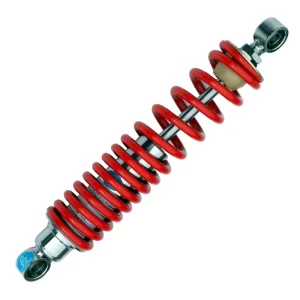
When an OEM approaches us for an adjustable damper program, the conversation that ends badly is the one that starts with “I need adjustable shocks” and stops there. The ones that succeed begin with application data: target vehicle weight, motion ratio, spring rate, expected shaft velocities, and the specific ride quality complaint the adjustable feature is meant to solve. We then select a piston diameter, bleed circuit, and shim stack that center the damping curve inside the adjustment range’s effective window, not at its extreme. A dyno plot with the adjuster at mid-range should show the force level the application actually needs. The outer clicks provide tuning margin for production variation and driver preference, not a bandage for a mis-spec’d valve.
What to Provide Your OEM for Valve Tuning
We ask for four things on every adjustable damper project: corner weight, motion ratio diagram, target damping ratios, and the surface profile or vibration input the vehicle sees. For a seat damper, this means the seat spring rate, installed angle, and driver weight range. For a race shock, it means the max shaft velocity at each corner, sprung mass, and the typical damper motion histogram from a data logger. With these inputs, we build the initial valve profile on a dynamometer before delivering the first sample, which cuts iterations from months to weeks. If your current supplier does not request this data, they are guessing, and the adjustment knob is covering for it.
Common Questions About Adjustable Damper Selection
Can the same adjustable shock work for both racing and truck seats?
It can physically mount and stroke, but the valving will be wrong for one application. A racing shock’s piston and shim stack are designed for high-frequency, high-velocity control. A seat damper needs a fine low-speed bleed circuit that would feel loose and uncontrolled on a track. I have never seen a single adjustable damper platform perform acceptably in both environments without a different internal specification. If you need both, you need two different part numbers.
What adjustable setting is most important for truck seat comfort?
The low-speed compression bleed. This controls how the seat initially absorbs chassis movement before the main damping valve engages. If the bleed is too small, the driver gets a sharp jab from every road seam. If it is too large, the seat floats and oscillates. On our adjustable seat dampers, the adjuster primarily shifts the low-speed curve, leaving the high-speed blow-off fixed to prevent bottoming. Drivers can feel a two-click change in this range, which is why the detent mechanism must be consistent.
How do I know if my adjustable shock is valved correctly for my race application?
Plot the damper’s force-velocity curve at the clicker setting you actually use on track. The curve should sit inside the target force band derived from your sprung mass, motion ratio, and desired damping ratio. If you constantly run the adjuster at one extreme, the base valving is off. We frequently see shocks that are under-damped at their softest setting and over-damped past the mid-point, leaving only a narrow usable clicker band. A correctly valved unit should let you feel a meaningful change across at least 60% of the adjustment range.
Is it cost-effective to use custom-valved adjustable shocks?
For a racing program or a commercial fleet seat application, the custom valving pays for itself by reducing failures, driver fatigue complaints, and re-tuning time. A generic adjustable shock might cost less upfront, but if it doesn’t hit the damping targets, you will spend more time and money trying to mask the mismatch with springs, tire pressures, or additional damping devices. We supply custom-valved adjustable dampers at volumes as low as 50 units, and the per-unit cost difference over an off-the-shelf adjustable shock is typically under 15%.
What maintenance do adjustable shocks need in dusty off-road environments?
The adjuster mechanism itself—whether a knob, clicker, or dial—needs a clean, intact seal to keep grit out of the detent housing. We add an O-ring shield on our off-road adjustable shocks and test after 200 hours of silica dust exposure to confirm zero ingress. The damper internals follow standard rebuild intervals: 1,000 km for desert racing, 5,000 km for rally, and 20,000 km for mixed-use seat applications. If the adjuster becomes hard to turn or loses its detent feel, the seal has failed, and the assembly should be replaced. For fleet operators maintaining seat dampers, we can supply pre-assembled adjuster cartridges with a field-replacement guide. Confirm your dust-ingress spec and send your operating hours log to info@yearbenshocks.com or +86-523-86566899, and we will help you set the right rebuild schedule for your environment.
When One-Size Adjustability Falls Short of the Application
Adjustable shocks carry the promise of tuning versatility, but the real tuning window is only as wide as the base valve calibration permits. Racing and truck seating sit at opposite ends of the frequency and load spectrum. Treating them with the same damper architecture forces one of the two applications into a corner of the adjustment range where precision evaporates. Over the years, we have helped a wide range of OEMs and race teams define separate piston, bleed, and shim specifications that let the adjuster work where the driver or operator actually lives. If your next project involves adjustable damping across different vehicle classes, send your target load, velocity, and frequency data to info@yearbenshocks.com or call +86-523-86566899. We will map the suitable piston range, provide dyno curves at your operating points, and build first-article samples that match the specification, not just the knob count.
If you’re interested, check out these related articles:
Off-Road-Coilovers
Oil-free lawn mower shock absorber 24mm
Lawn mower steering damper 18mm
Best-Off-Road-Coilover