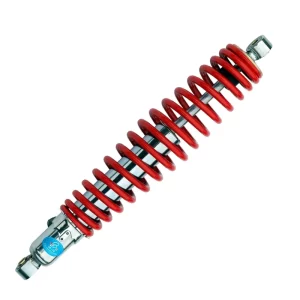
When specifying shock absorbers for off-road vehicles, the first question is rarely about brand. It’s about the front versus rear design. The two ends of the vehicle face entirely different load cases, mounting angles, and dynamic demands, and treating them as interchangeable leads to handling problems that are expensive to unwind. Over twenty years of engineering shock absorbers for ATVs, UTVs, and buggies, I’ve seen that getting the front and rear shock design right determines whether a vehicle tracks predictably through whoops or pushes mid-corner and eats bushings. This article walks through the design differences that matter most when sourcing or upgrading off-road shocks, with details pulled from our production line and test data.
The Core Engineering Differences Between Front and Rear Shock Absorbers
A shock absorber’s job is to convert kinetic energy into heat, but how it does that is shaped by its position on the vehicle. The front axle carries the steering system. That means the shock must accommodate changing camber, castor, and scrub radius as the suspension cycles, while still providing the damping force needed to control the wheel after an impact. Front shocks are almost always shorter than rears because the front suspension envelopes less vertical travel. They also see more rapid directional loading from cornering and braking.
Rear shocks, by contrast, manage a larger share of vehicle weight transfer. In a hard acceleration event on a sand dune or a rock climb, the rear axle squats. The shock absorber’s compression valving has to handle that load without packing down, while rebound valving must control the spring energy release so the rear doesn’t kick. The mounting points on the rear are also further apart in many suspension architectures, which changes the motion ratio and the leverage applied to the damper. These differences mean that even when a front and rear shock share the same piston diameter, the internal shim stacks, gas charge pressure, and bottom-out cushioning will not be identical.
Why Off-Road Vehicles Need Distinct Front and Rear Shock Designs
Passenger car shocks are tuned for a narrow range of spring rates and a known vehicle weight. Off-road vehicles introduce variables that the shock design has to absorb: variable payload, drastically different terrain speeds, and suspension articulation at full droop. In our factory, when we develop a shock for a UTV or a buggy, the front shock often gets a higher gas charge pressure relative to its piston area. That helps resist cavitation when the wheel drops rapidly off a ledge or into a rut. The rear shock, especially on a long-travel desert truck, gets an external reservoir not because it cools better, but because the volume of fluid displaced by the shaft at full compression would otherwise spike internal pressure beyond what the seal can hold repeatedly. I’ve seen shocks returned after one weekend in the dunes with the shaft seal blown simply because the reservoir was sized for the front shock and reused on the rear without recalculating the fluid displacement.
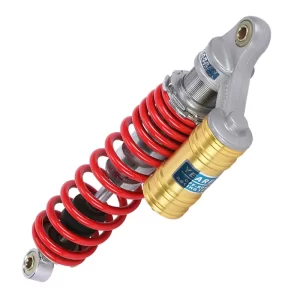
This asymmetry is also why we never recommend standardizing spring rates or damping curves across axles. When a front shock’s compression valving is too stiff relative to the rear, the vehicle pushes through corners; too soft, and it dives into braking zones. Getting the front/rear shock package balanced takes more than a catalog cross-reference. It requires knowing the vehicle’s corner weights, the motion ratio at each corner, and the intended ride frequency.
Critical Components That Vary: Valving, Spring Rates, and Mounting Hardware
On the surface, a front and rear shock absorber may look similar, but several components change in subtle ways that influence durability and feel.
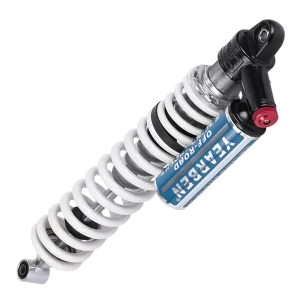
The following table highlights dimensions and features that typically differ between front and rear shocks in off-road applications:
| Parameter | Front Shock Absorber | Rear Shock Absorber |
|---|---|---|
| Extended length | Shorter, typically 350–550 mm | Longer, often 500–800 mm depending on travel |
| Compression valving stack | Bias toward low-speed control for braking/cornering | Stiffer high-speed stack to handle large impacts and weight transfer |
| Spring rate range | Lower rate unless carrying engine weight; often softer initial rate | Higher rate to support rear payload and anti-squat |
| Reservoir type | Piggyback or internal floating piston | Remote reservoir common for fluid volume needs |
| Mount eyelet size | Often 12 mm with spherical bearing | 16 mm or larger for higher load transfer; synthetic bushing common |
Valving differences are where I spend the most time during prototype sign-off. For an ATV that sees aggressive trail use, the front compression shim stack may have one more face shim than the rear to control brake dive without making the front end skittish on small chatter. The rebound side, on the other hand, might be softer on the rear so the wheel can extend quickly after a high-speed compression event, maintaining tire contact. On paper the difference is a shim thickness of 0.15 mm. On the trail, it’s the difference between a controlled line and a series of bucking corrections.
Mounting hardware also follows the load. Front shocks often use spherical bearings because the steering axis movement causes angular misalignment. Rear shocks can use bonded bushings if the suspension link design limits angular movement, which cuts noise and requires less maintenance. But if the rear suspension has a high-articulation multi-link design, we spec spherical bearings there too, just with a wider head and larger shaft tolerance to handle the bending load.
Specifying Front vs Rear Shock Absorbers for OEM Orders
When a customer sends an RFQ with a single damping specification for both front and rear shocks, the first thing our engineering team does is ask for the corner weights and intended travel per axle. That’s not because we want to make the order larger. It’s because we’ve learned that accepting a generic spec leads to a vehicle that either understeers at speed or bottoms the rear on a two-foot jump.
The minimum data we need to produce a matched front/rear shock set:
– Vehicle total weight and static weight at each wheel
– Desired wheel travel front and rear
– Motion ratio at each corner (if known)
– Mount type and eye-to-eye dimensions at ride height
– Preferred spring collar adjustment range
Without the motion ratio, we can still begin with a baseline damping coefficient and adjust through valving iterations, but the prototype cycle adds three to four weeks. If you’re importing from a Chinese factory, that timeline matters for container planning.
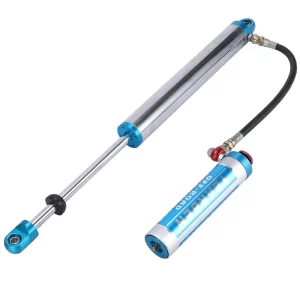
When the front shock travel is constrained by the half-shaft or tie-rod angle, we often recommend a multi-stage compression shim stack with a softer initial knee. This gives compliance over small surface irregularities while ramping up quickly before the suspension reaches the bump zone. For the rear, if the vehicle is set up for high-speed desert running, a remote reservoir with an adjustable compression clicker lets the driver tune for changes in cargo load or terrain, without over-damping when the vehicle is light.
If you are finalizing your front and rear shock specifications and want a production feasibility review before committing to a mold or sample run, send your target travel, corner weights, and mount drawings to info@yearbenshocks.com. Our engineering team checks every submission for motion ratio viability and valving suitability; we respond within one business day. You can also reach us at +86-523-86566899 with technical questions.
Common Questions About Off-Road Shock Absorber Design
Can I use the same shock absorber model for the front and rear of an off-road vehicle?
Physically, the eyelet may fit, but performance will be compromised. The valving is optimized for one set of motion ratios and vehicle dynamics. Using the same shock front and rear typically results in either a harsh front end and a bouncy rear or vice versa. On low-speed utility vehicles, matched damping may work if travel is within 10 mm of each axle, but once you exceed 100 mm of wheel travel, separate tuning is required.
Why do rear shocks commonly use remote reservoirs while front shocks use piggybacks?
The primary reason is fluid displacement. A rear shock often has a longer stroke and a larger diameter piston rod, so the volume of oil displaced during compression is greater. A piggyback reservoir can handle that volume, but the heat exchange area is limited. A remote reservoir mounted on the chassis increases oil volume and cooling surface, which is more important on the rear because the shock is closer to the exhaust or engine heat in many off-road layouts.
What happens if the spring rate is too soft on the rear shock absorber?
The vehicle squats excessively under acceleration, which reduces front-end grip and makes the steering light. Over successive bumps, the rear suspension bottoms repeatedly, the bump rubber deforms, and the shock piston can kiss the bottom cap. I’ve seen pistons cracked from repeated bottoming when the spring preload was set too low for the vehicle’s corner weight with a passenger and gear.
When ordering custom shocks, how do I confirm the factory understands the difference between front and rear requirements?
Ask for the factory’s recommended valving split per axle and ask why they chose it. If they can explain the motion ratio and intended ride frequency without a pause, they understand the vehicle dynamics. At Yearben, we provide a damping force chart and a motion ratio calculation sheet with every prototype batch. If your existing supplier can’t offer that, it’s worth shifting the conversation to a facility that builds shocks for specific platforms, not just catalog orders.
If your program involves mixed-axle configurations or a revised suspension geometry, share your requirements with us at info@yearbenshocks.com. We can confirm whether your existing valving baseline is safe for the new setup or needs revision.
If you’re interested, check out these related articles:
Best-Off-Road-Shocks
Steering-Damper-18MM
4X4-Heavy-Duty-Suspension