Off road coilover shocks for ATV, UTV, and buggy platforms provide tunable damping and ride height that standard shock and spring setups cannot match. The integrated coil spring allows precise preload and valving to suit vehicle weight, terrain, and riding style. But choosing the right shock is not just about catalog specs; it requires understanding how spring rates, damping curves, and reservoir designs interact with your chassis. From two decades of suspension engineering, I know that the biggest performance improvements arise when buyers work directly with a manufacturer to define these parameters early, instead of accepting an off-the-shelf shock that only approximates the need.
Off Road Coilover Shock Design and Components
A coilover shock combines a damper and a coil spring into a single unit around the shock body. The spring sits between two perches, at least one of which is adjustable for ride height and preload. Inside the body, a piston moves through hydraulic oil, with valving shims controlling compression and rebound flow. Most off road coilovers use monotube construction with a gas charge, typically nitrogen, to prevent cavitation and maintain consistent damping under sustained use.
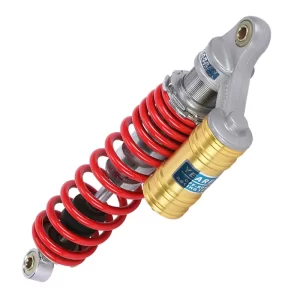
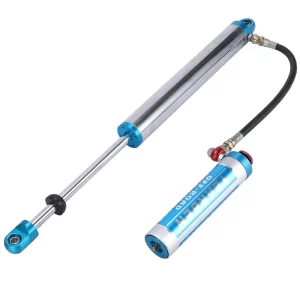
The reservoir configuration significantly influences thermal performance. Emulsion shocks mix gas and oil within the body, which is simpler but can aerate the fluid during aggressive use. Piggyback reservoirs mount a separator piston beside the main body, increasing oil volume and separating gas from oil. Remote reservoirs go further, using a flexible hose to position the reservoir away from the shock for maximum cooling. For ATVs and lighter UTVs, a piggyback design often balances cooling and packaging, while desert buggies running sustained high speeds typically need remote reservoirs.
| Feature | Emulsion / Smooth Body | Piggyback Reservoir | Remote Reservoir |
|---|---|---|---|
| Gas separation | None, gas and oil mix | Separator piston, gas behind it | Separator piston, gas in remote can |
| Heat dissipation | Limited by shock body surface | Moderate, close to shock body | Best, reservoir can be placed in airflow |
| Mounting complexity | Simple, no extra brackets | Slightly more, compact bracket | Requires hose routing and mounting |
| Typical use | Light trail riding, budget builds | Trail and dune riding, moderate speed | High-speed desert, racing, long travel |
Vehicle-Specific Coilover Requirements for ATV, UTV, and Buggy
Each platform imposes different demands on shock valving, spring rate, and travel. Tuning must account for vehicle weight, power, typical speed, and the types of impacts the suspension absorbs.
ATV Coilover Travel and Spring Rate Considerations
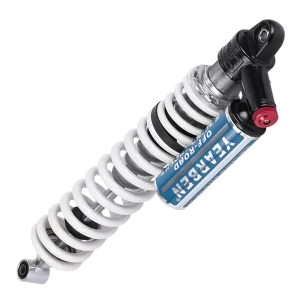
ATVs weigh less than UTVs, typically 180 kg to 360 kg, so spring rates can be lower while still resisting bottoming. However, the shorter wheelbase and high center of gravity demand responsive rebound control to prevent bucking after hitting a whoop. In our OEM projects, we often specify progressive wound springs on ATV shocks so the initial stroke absorbs small chatter while the stiffer end of the coil catches harder landings.
UTV Coilover Specs for High-Horsepower Applications
Modern UTVs can exceed 200 hp and weigh over 900 kg when fully loaded. That mass and speed generate significant heat in the shock oil. A piggyback or remote reservoir becomes essential not only for damping consistency but for seal longevity. Spring rates must be calculated per corner, accounting for cargo and passenger loads. A common mistake is fitting springs that are too soft in an effort to keep the ride comfortable; this leads to excessive bottoming and premature shock damage.
Buggy Coilover Shock Requirements for Sand and Desert
Sand rails and desert buggies built for heavy choppy terrain need long travel, usually 300 mm to 450 mm of shaft movement. Here, remote reservoirs with large oil capacity and aggressive valving for both compression and rebound are standard. We often build these shocks with thicker piston rods and external bypass zones for fine-tuning high-speed damping. The chassis mounting points must also be reinforced to handle the increased leverage from long-travel arms.
Customization Options for Off Road Coilover Shocks
Factory customization allows buyers to avoid the compromises that come with universal fit shocks. The key areas where a manufacturer can tailor a shock include valving, spring setup, and reservoir choice.
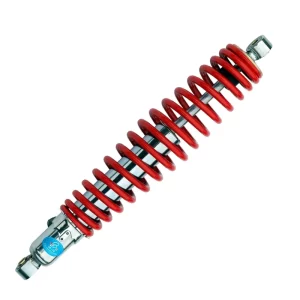
Damping valving is the core of shock performance. By adjusting the shim stack thickness, diameter, and arrangement, we can bias the shock toward faster compression absorption or firmer platform support. For example, a rock crawling buggy benefits from slow-speed compression and rebound that keep the tires in contact, while a dune runner needs high-speed compression to swallow impacts without harshness. If your program involves vehicles that will see vastly different terrain, specifying a dual-adjustable or clicker-adjustable mechanism provides end-user tunability without requiring a full revalve. It is worth confirming the valving range with your manufacturer before finalizing your BOM, reach out at info@yearbenshocks.com.
Spring preload adjustment allows ride height changes and corner balancing. A threaded body shock provides infinite preload adjustment over a set range. We also supply different spring lengths and rates, often Eibach or custom-wound springs, matched to the exact corner weight of the vehicle. When ordering, providing the exact motion ratio of your suspension arms enables the factory to calculate the correct spring rate and free length.
Manufacturing and Quality Testing of Off Road Coilover Shocks
A factory’s production and testing protocols directly affect how a coilover performs after hundreds of hours of use. At Yearben, every shock begins with cold-drawn seamless tubing, honed to a precise surface finish to minimize seal friction. Pistons are machined from billet aluminum or sintered alloy, depending on the application, and the shim stack is assembled in a clean room to prevent contamination.
Shock Dyno Testing and Damping Verification
After assembly, each production batch undergoes dynamometer testing to verify the force-velocity curve matches the design specification. We run the shock at multiple shaft speeds, typically from 0.05 m/s to 1.0 m/s, and compare the generated damping force against the target band. This catches any assembly errors or piston ring binding before the shock leaves the factory.
Fatigue and Seal Life Testing
Longevity testing simulates thousands of kilometers of off-road use. A fatigue test rig cycles the shock through its full stroke under load while monitoring gas pressure loss and seal leakage. We test seals with multiple oil types and temperature ranges because a seal that holds at 20°C can harden and leak after sustained 100°C operation. A properly manufactured monotube coilover should maintain gas pressure within 5% of its charge for over 500,000 cycles at rated travel.
Sourcing Off Road Coilover Shocks: What to Look for in a Manufacturer
Choosing a manufacturer goes beyond price per unit. I advise buyers to evaluate technical capability, customization willingness, minimum order quantities, and lead time consistency.
A serious coilover factory will have in-house CNC machining, a dyno, and a fatigue test bench. Ask to see dyno graphs of a recent batch, not just a catalog image. Confirm that the factory stocks multiple piston and shim configurations to match different vehicle applications. For OEM buyers, MOQ can range from 50 to 200 sets depending on the level of customization required. Fully custom valving and custom spring rates will usually have a higher MOQ than picking from an existing shelf spec. At Yearben, we typically ship sample orders within four to six weeks and full production within eight to twelve weeks, but this depends on material availability and the complexity of the specification. Clear communication about your required stroke, extended length, compressed length, and mounting type at the quotation stage prevents delays.
Common Off Road Coilover Shock Issues and How Factory Support Resolves Them
Even high-quality coilovers can develop problems if the specification does not match the actual use. Three complaints surface frequently, and each has a clear resolution path.
Bottoming out indicates either insufficient spring rate, inadequate compression damping, or a shock that allows too much travel for the bump stop setup. In these cases, we work with the buyer to recalculate spring rate using the vehicle’s actual corner weight and motion ratio, and if necessary, adjust the internal spacer to limit stroke.
Fade during long runs points to oil overheating. Switching from an emulsion design to a remote reservoir increases oil volume and improves cooling. For already remote-reservoir shocks, increasing the hose diameter or adding a larger reservoir can help. The valving may also need more bleed to reduce heat generation.
Seal leaks often result from bent shafts or poor surface finish on the rod. Our factory inspects every rod for runout below 0.03 mm and polishes to a surface roughness below Ra 0.2 µm. If a shock leaks early, we investigate whether the seal material was matched to the operating temperature and fluid compatibility; sometimes a switch from nitrile to PTFE seals solves the issue.
When builders face persistent problems, sharing log data or video of the issue with the factory engineering team can lead to a revised specification that eliminates the root cause rather than replacing parts repeatedly.
Common Questions About Off Road Coilover Shocks for ATV, UTV, and Buggy
What is the difference between piggyback and remote reservoir coilover shocks?
The functional difference lies in where the gas/oil separating piston sits. A piggyback reservoir attaches directly to the shock body, keeping the separator close but limiting oil volume and thermal isolation. A remote reservoir moves the separator into a separate canister connected by a hose, adding oil capacity and allowing the reservoir to be placed in cooler air or a protected location. For most ATV and trail UTV applications, piggyback offers a good balance of performance and simplicity. For high-speed desert use where shock oil can reach over 120°C, remote reservoir is the better choice because it maintains more consistent damping over long runs.
How do I determine the right spring rate for my ATV coilover?
Spring rate selection starts with corner weight and motion ratio. The formula combines the vehicle’s sprung mass at each corner with the leverage the suspension arm applies to the shock. A factory with suspension engineering experience will ask for your fully loaded vehicle weight and pictures of the suspension linkage, then calculate the effective wheel rate and match a spring length and rate. Guessing a spring rate from a generic chart often results in a shock that rides harsh on small bumps or bottoms on moderate jumps. Share your requirements and we can calculate the correct specification.
Can off road coilover shocks be custom-built for my specific buggy?
Yes, a factory like ours regularly produces coilovers to custom lengths, valving curves, and reservoir configurations. You provide the extended and compressed measurements, mounting type, and the terrain you ride. We select the body length, shaft length, spring rate, and valving stack accordingly. MOQ is typically higher for fully custom dimensions than for catalog-size shocks with custom valving, but for a one-off buggy build, a low-volume production slot is often negotiable. If your build requires unique mounting eyes or spherical bearings, sending a drawing or sample ensures the coilover fits directly without adapters.
Why does my UTV shock bottom out and what is the fix?
Bottoming occurs when the shock absorber uses all its travel too easily. The most common causes are a spring rate that is too low for the vehicle weight, insufficient compression damping, or excessive ride height preload that reduces the available compression stroke. The fix starts with obtaining accurate corner weight measurements and checking that the spring length allows full compression before coil bind. If the spring rate is correct, increasing compression shim stack stiffness or adding a hydraulic bottom-out cup can prevent metal-to-metal contact. Often, a combination of a stiffer secondary spring and a revalve resolves it without sacrificing small-bump compliance.
How are off-road coilover shocks tested before leaving the factory?
A proper quality system includes dimensional inspection, pressure decay testing for gas leaks, and dynamometer verification of damping force at multiple velocities. At Yearben, we sample each production lot and run a full force-velocity curve against the design target. Shocks that fall outside the tolerance band are disassembled and rechecked. Additionally, fatigue cycling on a dedicated test rig confirms seal and gas charge stability over thousands of strokes. This layered testing catches manufacturing defects that would otherwise surface as early field failures. If your procurement requires specific test documentation like full dyno reports per batch, requesting that early in the sourcing process ensures the manufacturer can deliver it.
If you’re interested, check out these related articles:
Adjustable-Gas-Shock-Absorbers
Monotube-Shock-For-Off-Road
Customized Lawn Mower damper 24mm
Damping-Adjustable-Shock-Absorber