
Every UTV shock absorber you bolt onto a side-by-side has to make a choice between three competing demands: bottom-out resistance on hard landings, small-bump compliance across chatter, and fade resistance when heat builds over a long run. The problem is that a damping curve optimized for one terrain type almost always makes another terrain worse, and most spec guides stop at listing travel numbers without explaining that tradeoff. What you need instead is a way to read the physical design of the shock body, the valving logic, and the type of adjustability you are buying so you can match it to the surface conditions and driving pace the machine will actually see. This spec guide sorts UTV shocks by trail, dune, and race use, with the damping characteristics, reservoir options, and spring decisions that matter at each level.
What Changes Between a Trail Shock and a Race Shock
Most riders feel the difference in travel first — more travel means the suspension can take bigger hits before bottoming out — but the structural differences that drive longevity and consistency are deeper. A trail shock usually runs a smaller piston diameter, often 1.5 to 2.0 inches, and relies on a single-stage or mildly digressive valve stack. That design keeps the hydraulic pressure manageable at lower shaft speeds so the response stays soft and compliant over roots and rock ledges. The piston band and seal materials are typically standard nitrile compounds, and the body is often a twin-tube construction because the oil volume is adequate for intermittent use and the cost stays within OEM replacement budgets.
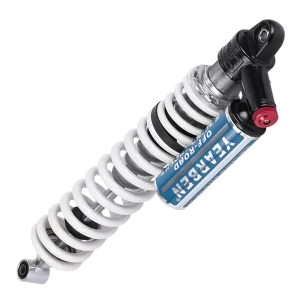
A race-oriented UTV shock makes different choices at nearly every internal component. The piston diameter steps up to 2.0 or 2.5 inches to push more fluid through the valve ports per inch of travel, which generates higher damping force and more tuning resolution. The piston itself is often machined from billet aluminum instead of sintered steel, which holds a tighter OD tolerance and gives a more consistent seal across the stroke. The valving stack is typically a multi-stage shim arrangement — three or more shim thicknesses stacked in a taper — set to produce a digressive knee followed by a linear or slightly progressive ramp at higher shaft speeds. That shape gives initial compliance so small chatter does not stiffen the ride, then a defined ramp when the piston velocity spikes from a G-out or jump landing. Seal materials shift to hydrogenated nitrile or PTFE blends that tolerate higher surface temperatures without swelling or hardening.
The most significant practical difference is in heat management. A UTV run hard across whoops at sustained speeds will push shock oil temperature past 250°F within 20 minutes; at that point, a twin-tube trail shock with no external reservoir will start to cavitate as the oil oxidizes and aerates. Damping force drops unpredictably because the piston is cycling through a frothy mix instead of solid fluid. A race shock addresses this with an external reservoir — either piggyback or remote — that adds oil volume and usually a separating piston or bladder charged with nitrogen. The separating piston keeps the gas from mixing into the oil, and the additional volume spreads the heat load across more fluid, slowing the temperature climb. In our damping dyno comparisons, a piggyback shock with a 40mm internal bore and a remote reservoir holds consistent force within 8% of the cold curve across a 20-minute cyclic test at 12 in/s peak velocity; an emulsion-body trail shock without a reservoir typically degrades 20% or more in the same window.
Trail Riding UTV Shocks: The Spec That Balances Compliance and Load
Trail riding puts the shock through a different demand pattern than any other discipline. You are not hammering repeated whoops at 50 mph. You are crawling over angled rock slabs, dropping the front end into washouts, and carrying uneven loads — two passengers, a full bed, tools, fuel. The damping problem here is managing low-speed shaft motion under high asymmetric load while keeping high-speed events from jarring the chassis hard enough to unsettle the steering.
For this use, I favor an adjustable threaded nitrogen-charged shock body with a compression adjuster that works across the low-speed bleed circuit, not a high-speed flutter stack. The adjustment that matters on trail is the compression bypass that controls how the shock reacts to weight transfer during slow crawling and off-camber transitions. Open the bypass a few clicks, and the shock rolls into the travel more easily, which helps keep the tires on the ground when one side of the vehicle is unloaded. Close it, and you get more roll resistance and less body movement during higher-speed trail cornering. A separate rebound adjuster is worth having because the spring rate needed to support cargo often produces a rebound force that is too strong for the vehicle when empty — dialing the rebound back on the return trip makes a real difference in how the rear end tracks over washboard.
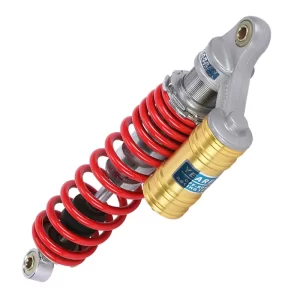
Spring rate selection for trail UTVs needs to account for the range of payload weight, not just the curb weight. A single-rate coil spring is simpler to manufacture and costs less, but it forces a compromise: spring it for the loaded weight and the ride is harsh empty; spring it for the empty weight and the suspension sags hard with passengers and gear. Dual-rate springs with a crossover ring give you a softer initial rate for small trail chatter and a second stiffer rate that engages as the increased weight compresses the suspension further. I have seen customers solve long-term sag complaints by switching from a straight 250 lb/in linear spring to a dual-rate setup with a 200 lb/in tender and a 300 lb/in main, with the crossover set to engage at about 40% of travel from ride height. That combination covers both the unloaded suppleness and the loaded support.
Body diameter for trail shocks does not need to chase the 2.5-inch sizes used in desert racing. A 2.0-inch body with a nitrogen-charged internal floating piston gives enough oil volume for sustained trail use and keeps the weight and packaging manageable. If the vehicle sees extended highway-speed transit between trails, the shock is working at higher sustained shaft speeds, and a piggyback reservoir becomes worth the investment — it adds cooling surface area and oil volume while keeping the overall assembly more compact than a remote hose arrangement.
Dune Shocks: Why Bottom-Out Control Demands a Different Valve Logic
Sand dunes change the priority hierarchy because the terrain surface is soft and constantly shifting. The shock is not processing sharp-edge impacts from rocks and roots. Instead, it manages large-amplitude, long-duration suspension velocities from hard G-outs at the base of dunes, plus the landing control from jumps that can cycle the suspension through its full travel in under a second. The bottom-out zone — roughly the last 25% of the compression stroke — is where a dune shock earns its value.
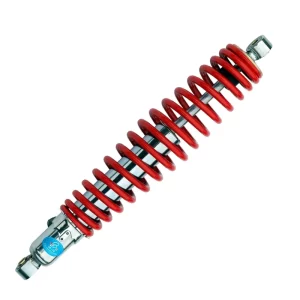
A standard linear piston will build compression force proportionally to shaft speed. That is adequate for general use, but in dune riding the shaft speed at the transition from mid-stroke to bottom-out zone can spike from 15 in/s to 30 in/s almost instantly when the chassis meets a compression face at speed. A linear valve curve means the damping force at that transition is modest, and the shock relies almost entirely on the mechanical bottom-out bumper to arrest the travel. That bumper is a short-travel polyurethane stop — it works for occasional events but repeated full-travel cycles will degrade it and the force spike transmitted to the chassis can crack shock mounts over time.
A digressive piston with a defined high-speed blow-off circuit handles this differently. The digressive knee is positioned around 8–10 in/s; below that, the damping force builds steeply for body control during cornering and braking. Above that knee, the slope flattens so the shock absorbs high-velocity impacts without a sharp force spike. Then, in the last inch of travel, a secondary bottom-out cup or an internal hydraulic stop engages — this works by mechanically restricting the final flow path so the damping pressure ramps progressively over the last portion of the stroke, dissipating the energy as heat through the fluid instead of transmitting it as a chassis jolt. In the UTV shocks we build for dune applications, the bottom-out hydraulic stop is typically calibrated to add 40% to 60% of the peak compression force over the final 0.75 inch of travel, which is enough to cushion a full-travel cycle at 30 in/s without a hard metal-to-metal clank.
Reservoir choice matters for dunes. The nitrogen charge in a remote reservoir or piggyback functions as a spring in addition to its anti-aeration role — it pressurizes the oil column so the piston never sees cavitation. In a dune environment where ambient sand temperature in the Middle East routinely exceeds 120°F and shock body temperature rises quickly, the nitrogen charge pressure increases with temperature. That shifts the force balance across the piston, effectively stiffening the compression damping as the run progresses. A remote reservoir with a larger gas volume than a piggyback reduces the proportional pressure change per degree of temperature rise. For Gulf-region dune riding, we spec remote reservoirs with at least 150ml of additional oil volume beyond what the body holds, not just for cooling but to control that thermal pressure drift.
Racing UTV Shocks: Specs for High-Speed Stability and Heat Management
Racing is the discipline where the shock’s ability to maintain consistent damping force across temperature matters as much as its baseline valve curve. A UTV race can run 200 miles or more with few pauses; during the critical sections, the shocks are cycling at 20 in/s and higher for minutes at a stretch. The oil temperature inside the body can stabilize above 280°F, and if the fluid breaks down at that temperature, the damping force degrades and the vehicle’s handling changes mid-stage.
The core specs for a race UTV shock start with the body. A 2.5-inch diameter monotube body is the practical minimum for serious desert racing. The larger bore gives a larger piston area for a given pressure change, which produces more damping force at lower internal pressure and reduces the peak pressure the seals must hold. Lower peak pressure means less seal friction and less heat generated from that friction. The body material is typically 6061-T6 aluminum hard-anodized inside the bore to a surface roughness Ra of 0.2 µm or better. That bore finish matters because the piston band rides against it with a small interference fit; if the anodizing is too rough, it accelerates band wear and creates aluminum oxide debris that circulates through the valve ports and sticks shims.
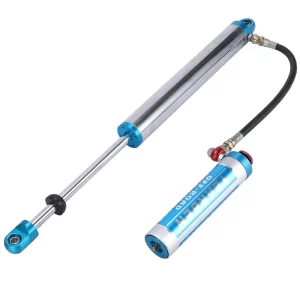
Valving for racing requires a triple-adjustable setup: low-speed compression, high-speed compression, and rebound, each on independent circuits. The low-speed adjuster controls the bleed orifice that bypasses the main shim stack, affecting chassis pitch and roll during driver inputs. The high-speed adjuster preloads a spring that backs the main shim stack, controlling the blow-off point during large impacts. Rebound adjustment must be tuned to match the spring rate and vehicle weight distribution; too much rebound and the suspension packs down over consecutive whoops, reducing available travel and making the rear end kick unpredictably.
A remote reservoir is standard for racing, connected by a high-pressure hose rated for at least 3,000 psi burst strength. Inside the reservoir, a floating piston or bladder separates the nitrogen charge from the oil. The bladder type has a faster nitrogen-to-oil pressure transfer and is more forgiving of small manufacturing variances, but it has a limited temperature range before the bladder material — typically a nitrile or HNBR compound — starts to degrade. Piston-type reservoirs with an O-ring and wear band tolerate wider temperature ranges and are rebuildable, which matters for teams that service shocks between races. Teams running Baja-length events often prefer the piston reservoir because the seal kit can be replaced during prep without replacing the entire reservoir assembly.
The component integration matters more than any individual part choice. A 2.5-inch monotube body, remote piston reservoir, billet piston with replaceable shim stacks, and triple-adjustable compression and rebound is a system. When one element is mismatched — for example, a high-flow piston in a small-bore body with a tiny reservoir — the shock will fade unexpectedly because the fluid cannot shed heat fast enough. In controlled testing at our facility, a properly matched 2.5-inch race shock with a remote reservoir holds peak compression force within 6% over a 30-minute endurance cycle at 15 in/s average shaft speed; a mismatched 2.0-inch body with the same piston and no reservoir degrades more than 15% in the first 10 minutes. That difference directly translates to the vehicle’s handling stability in the final third of a race.
How to Read a Shock Spec Sheet and Match It to Your UTV
Most spec sheets for aftermarket UTV shocks will list a handful of numbers: extended length, compressed length, stroke, body diameter, reservoir type, spring rate, and an adjustment count. Knowing which numbers drive performance and which are just packaging constraints is the filter that separates a useful spec comparison from a spec sheet collection.
Extended length and compressed length define the total travel window; subtract compressed from extended to get stroke. That number must fit within the suspension’s bump-stop and droop-stop limits or you will either bottom the shock mechanically or pull the CV joints apart at full droop. For most trail UTVs with stock A-arms, the front shock stroke runs between 5.5 and 7.0 inches; rear stroke can be 7.0 to 9.0 inches depending on the suspension geometry. For long-travel race kits, front stroke pushes 10 inches or more. Do not assume more travel is automatically better — a shock that cycles too far for the CV joint’s plunge limit will destroy the axle on the first hard landing.
Body diameter is listed for a reason beyond just “bigger is stronger.” It tells you the piston area, which multiplies with the pressure difference across the piston to produce damping force. A 2.0-inch bore has roughly 3.14 in² of piston area. A 2.5-inch bore has 4.91 in² — a 56% increase. That means for the same valve stack and shaft speed, the larger piston generates 56% more force, which gives you more tuning headroom at the adjustment range limits. If you see a spec sheet that pairs a 2.5-inch body with a single or non-adjustable piston, the manufacturer is using the bore as a marketing number without the valving sophistication to match.
The shaft diameter is the other dimension that rarely gets discussed but matters for reliability. A 14mm shaft can handle most trail and recreational use. For racing where side loads are higher and the vehicle mass is concentrated onto one corner during hard landings, a 16mm or 5/8-inch shaft reduces the bending stress at the rod guide and cuts the chance of a shaft snapping at the thread root where it mounts to the eyelet.
Spring rates should be listed in lb/in or kg/mm, and you need to know whether the shock uses a tender and main spring with a crossover or one linear spring. A spec sheet that only lists a single rate without clarifying the spring configuration is incomplete. Ask the supplier for the motion ratio of your UTV’s suspension; the effective wheel rate is the spring rate multiplied by the square of the motion ratio. If the motion ratio is 0.7, a 300 lb/in spring produces an effective wheel rate of 147 lb/in. That is the number that determines how the vehicle sits and rides, not the raw spring rate stamped on the coil.
Common Questions About UTV Shock Specs and Selection
Can I use the same shock for trail and dune riding?
Yes, but only within a certain performance band, and you will need to accept a compromise on either the bottom-out firmness or the low-speed compliance. A piggyback shock with adjustable compression and rebound can span both use cases if you are willing to re-valve between seasons. What you cannot do is take a shock set up with a soft linear piston for trail chatter and expect it to survive repeated full-travel cycles in the dunes without fading. The quickest middle-ground setup uses a digressive piston with a hydraulic bottom-out cup — that gives trail compliance below 10 in/s and dune-style bottom-out control in the final inch, with a remote reservoir to manage the heat. If your riding calendar shifts from wooded trails in summer to desert dunes in winter, factor in the cost of a re-valve and spring swap when comparing single-purpose versus dual-purpose shock packages.
Do I really need a remote reservoir on a UTV that does not race?
It depends on the sustained speed you run and the ambient temperature. Running a loaded four-seat UTV at 35 to 45 mph across open desert for more than 20 minutes is enough to push oil temperature past the point where an emulsion-body shock starts to degrade. If your use is primarily technical crawling at under 15 mph with frequent stops, the oil never reaches a temperature where reservoir volume matters, and a nitrogen-charged emulsion shock with an internal floating piston will hold consistent damping all day. The edge case is a vehicle that does both — slow crawling in the morning and faster open runs in the afternoon. In that scenario, a piggyback reservoir adds cooling surface area without the mounting complexity of a remote hose, and the cost difference over a non-reservoir shock is usually smaller than the cost of replacing a faded shock mid-season.
What is the single most common spec mistake when ordering UTV shocks?
Buying shocks based only on the extended and compressed length without confirming the spring rate and valving match the vehicle’s as-run weight. We see a steady stream of inquiries where the customer ordered a shock that physically bolts in but is valved for a two-seat race car while the UTV is a loaded four-seat machine with a full bed, cage, and spare tires. The shock cycles through too much travel on small inputs, the springs sack out, and the damping feels vague because the piston never builds enough pressure at the lower-than-expected shaft speeds. Before ordering, weigh the vehicle as it runs — full of fuel, passengers, and gear — and provide that corner weight to the supplier. A shock that is 20% under-sprung or under-valved for the actual running weight will never feel right, no matter how many clicks of adjustment you turn.
How do I evaluate whether a factory’s spec capabilities match the shock I need?
Look past the catalog photos and ask for three things: the bore finish specification on the body ID, the dyno test protocol the factory uses for damping consistency, and whether they can supply a shim stack diagram for the piston type they propose. A factory that meets the 0.2 µm Ra bore finish standard and runs a cyclic dyno sweep from 2 in/s to 25 in/s at multiple temperatures can demonstrate repeatability. A factory that cannot produce a shim stack drawing does not build its own valving in-house — they are assembling preset units from a third party, which limits your ability to request a specific damping curve. If your program involves custom UTV shock specifications with a defined target damping profile over a multi-temperature operating window, share your shaft speed targets, corner weight, and motion ratio with our engineering team at info@yearbenshocks.com — we will confirm whether the proposed body size and reservoir configuration can meet that profile before any commitment.
If you’re interested, check out these related articles: