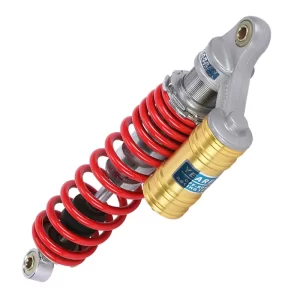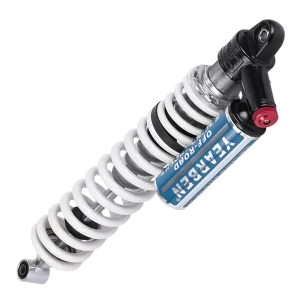
A steering damper that works perfectly on a UTV racing across dunes can seize up in the damp, low-frequency world of a zero-turn mower. Selecting the right unit means matching damping force, stroke length, and mount specifications not just to the vehicle type, but to its actual duty cycle. For engineers, fleet managers, and OEM buyers, this guide breaks down the critical factors that determine steering damper performance across ATV, UTV, and lawn mower platforms. I will walk through the specific demands each vehicle places on a damper, the key dimensions and valving parameters, and how to approach custom sourcing to avoid field failures.
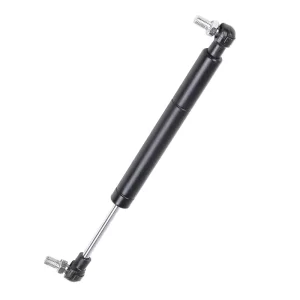
Steering Damper Requirements for ATV, UTV, and Lawn Mowers
Every vehicle platform loads a steering damper differently. Ignoring these differences is the fastest route to premature seal wear, inconsistent damping, or outright mechanical failure.
ATV Steering Damper Needs
ATVs run at moderate speeds over rough, unpredictable terrain. The damper must control rapid, high-force steering inputs from rocks and ruts without making low-speed handling feel heavy. A hydraulic linear damper with a 15–22 mm piston rod and a stroke matched to the steering rack travel works well here. We often spec an eyelet-to-eyelet extended length based on the handlebar stop-to-stop measurement. For desert racing or trail riding, adjustable damping is worth the extra cost because a fixed-rate damper cannot cover the wide force range from slow technical crawling to wide-open sand runs.
UTV Steering Damper Needs
UTVs carry more weight and generate higher steering forces. The damper body diameter needs to be larger to handle the energy without overheating. We design for 24–28 mm cylinder bores and use heavier oil viscosity to keep damping force consistent during extended high-speed runs. Mounting points on the chassis and steering linkage must be rigid because any flex bleeds off damping effectiveness. In our experience, a UTV damper that is directly repurposed from an ATV line will fade after twenty minutes of aggressive driving.
Lawn Mower Steering Damper Needs
Lawn mower dampers operate in a completely different stress regime. Speeds are low, but vibration is continuous and low-amplitude, which demands a near-zero breakout force and excellent seal longevity against grass debris and moisture. We use corrosion-resistant coatings on the rod and specify dust boots that survive constant exposure to clippings. The critical difference is valving: the damper must offer minimal resistance during gentle steering inputs to avoid operator fatigue but still absorb the sharp impacts from hitting hidden obstacles. This is where a one-size-fits-all approach fails.
Key Specifications Defining Steering Damper Performance
When specifying a steering damper, four parameters set the performance envelope. Getting them wrong at the order stage leads to field returns from any fleet.
Bore and Stroke Dimensions
The bore determines oil volume and heat capacity; stroke sets the maximum angular range. For ATVs, a bore of around 20 mm suits most sport machines. UTVs need at least 24 mm. Lawn mowers often use 18–22 mm bores, but the stroke is shorter because the steering arc is smaller. We measure stroke from hard-stop to hard-stop on the steering mechanism, add a few millimeters for margin, and then select the standard damper body length closest to that value.
Mount Configuration and Eyelet Diameter
Eyelet inner diameter, width, and bushing material must match the OEM bracket. A loose fit induces rattle and accelerates bushing wear. Common eyelet IDs are 10 mm for smaller ATV and lawn mower linkages, stepping up to 12 or 14 mm for heavier UTV steering rods. Even a 1 mm mismatch will cause play that the operator feels.
Damping Force and Valving
Damping force is velocity-dependent, and the valving stack sets the force curve. For a UTV, we tune the high-speed circuit to handle sudden rocks; for a lawn mower, the low-speed circuit dominates. Below is a comparison of typical damping force targets for three application categories.
| Vehicle Type | Bore (mm) | Stroke (mm) | Eyelet ID (mm) | Force at 0.3 m/s (N) | Force at 1.0 m/s (N) |
|---|---|---|---|---|---|
| Sport ATV | 20 | 120–150 | 10 | 150–200 | 500–600 |
| Utility UTV | 24 | 160–200 | 12 | 300–400 | 900–1100 |
| Lawn Mower | 18 | 80–110 | 10 | 50–80 | 200–280 |
These values are starting points. Final tuning depends on steering linkage geometry and vehicle weight.
Choosing the Right Damping Type for Your Application
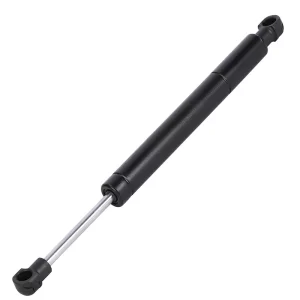
Steering dampers come in two main architectures: linear hydraulic and rotary. Linear dampers dominate the ATV, UTV, and lawn mower space because they package well and offer a straightforward force-velocity curve. A rotary damper, built around a fluid vane or gear pump, provides consistent torque through the entire steering arc and can be more compact, but it is rarely needed for the force levels these vehicles require.
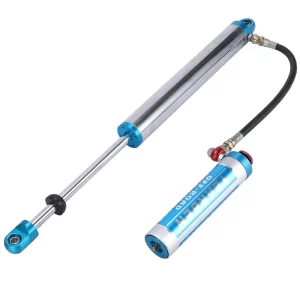
Linear dampers can be fixed or adjustable. Fixed dampers cost less and are entirely adequate for a lawn mower where conditions don’t change drastically. Adjustable dampers, with either a single dial or separate low- and high-speed adjustments, give the user tuning capability when the vehicle plays multiple roles—such as a UTV that tows in the morning and runs dunes in the afternoon. From an OEM standpoint, offering an adjustable variant as an option often satisfies a wider range of end customers without adding a new platform.
If your program involves both high-speed UTV and zero-turn mower platforms, it is worth confirming that the damper valving and seal materials cover the full operating temperature range before finalizing your BOM. Reach out at info@yearbenshocks.com for a technical review of your specification sheet.
OEM Customization Process for Steering Dampers
Most off-the-shelf dampers force a compromise. When your fleet or product line demands a damper that fits exactly, a custom OEM program is the right path. We start by gathering the four required inputs: extended and compressed length, eyelet specifications, damping force targets at two velocities, and the intended duty cycle. A drawing, even a rough sketch with dimensions, is enough to start.
Once we have those, our engineering team selects the closest housing and valving from our existing platform library. For a lawn mower manufacturer, we typically recommend a corrosion-resistant 18 mm damper with a fixed-rate valve tuned for low-speed control. For a side-by-side builder, a 24 mm adjustable unit with an external reservoir can be offered as a tiered feature.
The sample process includes dimensional verification, force testing on a dynamometer at the stated speeds, and a lifecycle test that simulates 100,000 cycles under expected dust and moisture conditions. We send the test report with the samples so the buyer can verify performance against internal targets. Lead time for a new custom steering damper is typically five to seven weeks from drawing approval, depending on tooling requirements.
Quality Testing and Manufacturing Standards
Every steering damper we produce goes through a set of tests as rigid as the suspension components we build. After assembly, each unit is run on a controlled dynamometer where we measure force at 0.3 m/s and 1.0 m/s and check for hysteresis. Units that drift from the target curve by more than the defined tolerance are torn down and re-valved.
We also run batch-level corrosion tests using salt spray per ASTM B-117 for 96 hours, specifically for lawn and construction applications. This is not a luxury; in a commercial mowing fleet, a damper rod pitted by rust will cut the seal within 200 hours. Our production line follows the ISO 9001 quality management system, and we maintain full traceability from raw material batch to outgoing dynamic test.
For any program where dampers are part of a larger suspension package, we recommend auditing the factory. Seeing how rod chrome plating is inspected or how nitrogen charging pressure is verified on a gas-charged damper line reveals more about quality than a certificate alone.
If you are managing steering damper specifications across multiple vehicle platforms, getting the right damping, stroke, and mount dimensions up front saves field failures and warranty claims. Send your application requirements and intended volume to info@yearbenshocks.com or call +86-523-86566899 to discuss a custom steering damper that fits your entire program.
Common Questions About Steering Dampers
What does a steering damper actually do?
A steering damper slows and controls the rotation of the handlebars or steering wheel in response to external forces like rocks, ruts, or bumps. It resists sudden movements that can jerk the wheel out of the operator’s hands. On a motorcycle or ATV, this reduces rider fatigue and prevents tank slap. On a lawn mower, it dampens the constant low-level vibrations that wear out steering linkages and make the machine harder to guide accurately over long shifts.
How do I know if my vehicle needs a steering damper?
If the vehicle exhibits steering kickback on rough terrain, wanders at speed, or requires constant correction to stay straight, a damper will help. In lawn applications, if operators report upper body fatigue after mowing uneven ground, the steering linkage likely needs damping. The test is simple: when the vehicle hits a bump and the steering wheel jerks instantly, the existing system needs improvement.
Is a hydraulic or rotary steering damper better?
Hydraulic linear dampers are better for most ATV, UTV, and lawn mower applications. They are simpler to manufacture, easier to seal, and handle the relatively low forces these vehicles need. Rotary dampers can be useful in tight packaging situations or where a constant torque is desired through the full arc, but they add complexity and cost that usually isn’t justified unless the steering system has very specific packaging constraints.
Can I fit a steering damper myself, or do I need a professional?
Most dampers designed as OEM replacements use the factory mounting points and are a bolt-on installation. The challenge is not the mechanical attachment; it is confirming that the damper stroke matches the steering geometry exactly. If the damper bottoms out before the steering hits the lock, the linkage will bend. We always recommend measuring the actual stroke needed at both ends before ordering, regardless of who installs it.
How long does a steering damper last before it needs replacing?
In normal ATV or UTV use, a hydraulic steering damper should last 500 to 1,500 operating hours before damping force degrades noticeably. Lawn mower units in commercial service often see 1,000 to 2,000 hours because the forces are lower, but environmental contamination is higher. The first signs of age are a dead spot at center or a leaking seal. Catching a seal leak early can save the damper body and just require a seal kit replacement. If your maintenance program includes damper force checks, share your current specs and we can confirm compatible replacement units or advise on expected lifetime before orders are placed.
If you’re interested, check out these related articles: