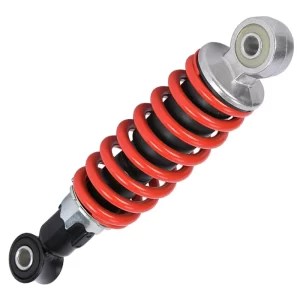
Baja trophy truck and desert racing suspensions demand a shock absorber that can withstand sustained high-speed impacts without fading or breaking. After more than twenty years of developing and manufacturing shock absorbers for off-road platforms, I have seen one truth repeat itself: a shock that performs on a short test loop often falls apart after 200 miles of desert whoops. The difference is not just design, it is the precision of internal valving, the quality of the sealing system, and how heat is managed during continuous high-load cycles. Most racers and team managers spend their time comparing brand names and travel numbers without ever evaluating the manufacturing variables that actually determine whether a long travel shock survives the Baja 1000. This article walks through those variables, from damping architecture and tuning to factory-level quality control, so you can specify, source, and maintain long travel shocks that finish races.
Desert Racing Demands on Long Travel Shocks
A long travel suspension on a trophy truck or Class 1 buggy cycles through its full stroke hundreds of times per minute at race pace. The shock body must handle not just the force of compression but also the rapid extension when the wheel drops into a G-out or catches air. That means the internal piston and valving stack are under extreme hydraulic pressure spikes, and the oil is sheared violently. In a standard street shock, this level of abuse would cause aeration and immediate fade. In a desert shock, the internal design must separate gas from oil effectively, maintain consistent damping even as oil temperature exceeds 120°C, and avoid cavitation during high-speed rebound events. Beyond the oil management, the shock’s external dimensions are equally critical. A longer shock body, typically in the 2.5 to 3.5 inch diameter range for trophy trucks, is needed to provide both the stroke length and the oil volume to dissipate heat. The rod diameter, which on serious race shocks is often 7/8 inch or larger, matters because a thin rod bends under sideload and destroys the seal.
Comparing Shock Designs for Long Travel Racing
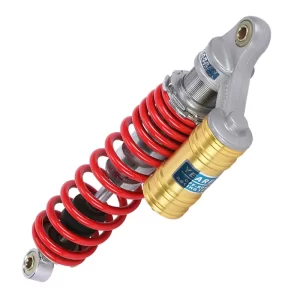
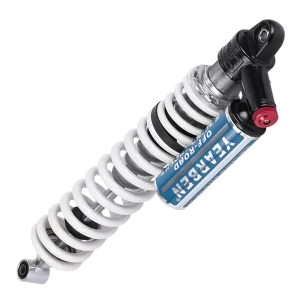
Three primary shock architectures dominate Baja and trophy truck racing: remote reservoir coilovers, piggyback reservoir coilovers, and bypass shocks. Each has a distinct set of trade-offs in packaging, heat dissipation, and adjustability.
| Shock Type | Typical Reservoir Style | Primary Advantage | Common Application |
|---|---|---|---|
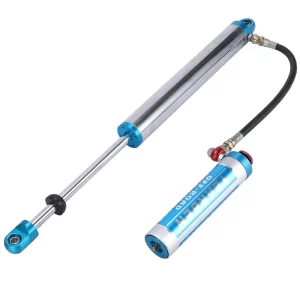
| Remote reservoir coilover | External reservoir with hose | Maximum oil volume, best cooling | Trophy truck primary suspension |
| Piggyback reservoir coilover | Reservoir mounted to body | Simpler packaging, easier installation | Buggy, Class 10, limited-suspension builds |
| Bypass shock (2-tube or 3-tube) | Integrated or piggyback | Multi-zone compression adjustment, position-sensitive damping | Rear suspension on trophy trucks, long-travel buggies |
| Emulsion coilover (non-reservoir) | None, oil and gas mixed | Lightweight, lower cost | Short-course trucks, prerunners |
Bypass shocks are particularly favored in desert racing because the external bypass tubes allow separate damping zones for different parts of the stroke. A 3-tube bypass shock can control bump zone compression separately from mid-stroke and rebound, which is nearly impossible to achieve with a simple valved coilover. The trade-off is complexity and higher manufacturing requirements. Every bypass check valve must open precisely at the intended position, and the tube sealing welds must hold nitrogen pressure under race conditions. For a team sourcing custom shocks, the factory’s ability to tune these zones to your vehicle’s weight and motion ratio is what separates a shock that stays composed and one that kicks unpredictably in rough terrain.
Valving and Spring Tuning for Baja Conditions
Shim stack tuning for desert racing is less about ultimate damping force and more about how the force curve changes with shaft velocity. Over many years of tuning shocks for off-road use, I have learned that most failures in the field are not from outright breakage but from a mismatch between the valving profile and the actual terrain speed. A shock valved for low-speed rock crawling will spike pressure violently at high shaft speeds, generating heat and making the vehicle skate across the top of bumps. Conversely, a shock tuned for high-speed desert hits will feel mushy at low speed, sacrificing steering precision.
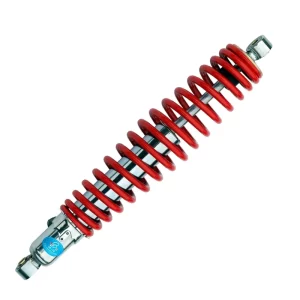
The ideal valving for long travel desert racing provides a digressive or linear damping curve that ramps up force quickly at low to mid speeds for body control but then flattens to avoid harsh bottoming resistance and oil heating. Spring rate selection must also account for the fact that a trophy truck lands hard after a jump; the spring needs enough initial rate to prevent sudden coil bind, but a secondary tender spring or progressive coil setup can help manage the transition to full bump. Dual-rate coilover setups, where a softer primary spring is paired with a stiffer secondary, are common. In our experience, specifying the correct crossover ring position is often the single most overlooked adjustment when teams first receive their custom shocks.
Heat Management and Durability
Heat is the primary killer of damper oil and seals. On a Baja 1000 qualifying run, shock body temperatures can exceed 140°C. At those temperatures, standard mineral oil shears down, and seal materials degrade quickly. This is where the selection of oil type, seal compound, and surface finish of the piston bore and shaft becomes critical. A shock built for desert racing must use a high-viscosity-index oil with strong anti-foam additives and a seal material such as HNBR or FKM that retains elasticity above 120°C. Equally important, the internal bore must have a fine crosshatch finish that holds oil without causing excess friction. A bore that is too smooth will let oil bypass the piston band, while one too rough will chew the seal and generate more heat.
Failure modes I have seen repeatedly in under-built shocks include rod bearing seizure from insufficient clearance in the guide bushing, reservoir hose failures where the crimp was not correctly set at the factory, and seal extrusion at the wiper when positive internal pressure builds and the shaft micro-scratches are not managed. A serious race shock will also feature a hard chrome-plated shaft with a surface roughness below Ra 0.1 µm to minimize seal wear. For complete confidence, we always recommend that a new shock be dyno-tested with the actual spring and vehicle motion ratio before race day; this catches heat-related fade tendencies early.
Factory Sourcing for Custom Long Travel Shocks
Ordering custom long travel shocks from a manufacturer is a different process than buying a catalog part. It requires building a specification sheet that includes eye-to-eye length, stroke, compressed and extended lengths, mounting style, reservoir type, hose length, spring rate, and preload settings. One of the most common mistakes I see is a team supplying only travel and spring rate numbers, leaving the factory to guess at the valving profile—and then blaming the shock when it does not perform as expected.
A competent factory will ask for vehicle weight, motion ratio, and intended terrain type before recommending a piston and shim stack. At our own manufacturing facility, the process starts with a detailed technical questionnaire and often includes a prototype dyno test with adjustable valving. Another critical factor is material traceability: the piston rod should be induction-hardened chrome-plated steel, the shock body made of seamless DOM tubing with pressure-tested welds, and the reservoir hose secured with stainless steel crimped fittings that hold to rated burst pressure. These are the kinds of details that separate a shock that lasts a race season from one that fails on the first day of pre-running.
If your program involves custom valving for a specific vehicle weight and terrain, it is worth confirming the shock’s adjustment range, shim stack compatibility, and the factory’s ability to provide a dyno graph before confirming your build sheet. Contact us at info@yearbenshocks.com with your vehicle specs and we will verify that the proposed shock configuration matches your expected shaft speeds.
Get Long Travel Shocks Built to Your Specification
Desert racing punishes every component, and a shock that fails at mile 300 costs far more than the price difference between a well-made unit and a generic one. The suspension is the single largest factor in keeping the vehicle stable and the driver safe across endless whoops and rough terrain. When you are ready to move beyond catalog parts and specify a long travel shock built for your vehicle, we can translate your motion ratio calculations and terrain requirements into a durable, dyno-tuned assembly. Send your part number and quantity to info@yearbenshocks.com or call +86-523-86566899 to start the spec review.
Common Questions About Long Travel Shocks for Desert Racing
Shock fade after 200 miles, is it always an oil problem?
Not always. While oil degradation is the most common cause, shock fade can also result from insufficient nitrogen pressure in the reservoir, which allows the oil to aerate and foam. Another cause we have encountered is internal leakage past a worn piston band or bypass check valve, which bypasses the valving stack and reduces damping force even though the oil is still in good condition. Check reservoir pressure and inspect valve seals before assuming an oil change will fix it.
Are bypass shocks necessary for trophy truck racing?
They are not absolutely necessary, but for trophy trucks running long courses, the multi-zone control of a 3-tube bypass shock is difficult to replicate with a simple coilover. A bypass shock allows you to isolate bump zone stiffness from mid-stroke and rebound, which keeps the rear end stable during hard acceleration while still absorbing square-edged hits. For shorter races or lighter buggies, a well-tuned remote reservoir coilover with dual-spring setup can perform within an acceptable range.
How often should long travel shocks be rebuilt?
Rebuild intervals depend heavily on race length and conditions, but in my experience a shock that has run a full Baja 1000 should be fully disassembled and inspected regardless of how it feels. For regular weekend racing on moderate terrain, 1,000 to 1,500 race miles is a reasonable interval. The key indicator is not just visible oil leakage; internal seal wear and piston band degradation are progressive and often go unnoticed until damping force drops. Send your rebuild requirements and we will confirm the service schedule and replacement parts availability.
If you’re interested, check out these related articles:
Fixed-Preload-Atv-Shock-Absorbers
Best-Shocks-And-Springs-For-Trucks
Hydraulic-Seat-Damper-Cylinder-Diameter-24MM
Off-Road-Coil-Over-Shocks-Manufacturer