Sourcing off-road shocks from a Chinese factory is not the same exercise as filtering suppliers by unit price on a catalog page. After more than twenty years in shock absorber engineering and manufacturing, the pattern I have seen repeat across dozens of sourcing projects is straightforward: the factories that communicate their bore finish tolerances, damping calibration methods, and batch test data are the ones that deliver consistent performance. Those that lead with price and glossy photos rarely do. This guide covers the specific verification steps, technical checkpoints, and engineering signals that reveal whether a Chinese shock supplier can build to your specification and sustain that quality across production runs.
What the Chinese Off-Road Shock Manufacturing Landscape Actually Looks Like
The off-road shock absorber supply base in China is concentrated but not uniform. Most factories with genuine in-house manufacturing capability cluster in a few industrial regions: Zhejiang, Jiangsu, and to a lesser extent Guangdong. Within those regions, three broad tiers of operation exist, and knowing which one you are speaking with changes the entire sourcing conversation.
The first tier consists of factories that design, engineer, and manufacture shock absorbers as their primary business. These operations typically hold ISO 9001 certification, maintain in-house dynamometer testing, run their own nitrogen charging stations, and can produce technical documentation including damping force curves, fatigue test reports, and material certifications. Their engineering teams can discuss piston design, shim stack configuration, and seal material selection in detail because they have built those systems themselves. This tier represents a small fraction of the visible supplier base, perhaps fifteen to twenty percent of the factories that appear in sourcing searches.
The second tier includes factories that manufacture shocks but operate with narrower technical depth. They can produce to a provided specification when the parameters are clearly documented, but they may outsource processes like chrome plating or nitrogen charging. Their testing capability is typically more limited, often restricted to basic leak checks and dimensional inspection rather than full dynamometer characterization. These factories can be viable partners when the buyer brings strong engineering definition and is willing to manage quality verification independently.
The third tier is where sourcing problems most often originate. These are trading companies that present as manufacturers, assembly-only shops with no machining or valving capability, and low-cost operations where process control is inconsistent. Their catalogs are broad, their prices are aggressive, and their technical depth evaporates the moment a specification question goes beyond basic dimensions.
Understanding which tier a supplier occupies before committing to samples or production is the difference between a reliable supply line and a container of shocks that fade after fifty hours.
How to Verify Whether a Factory Actually Manufactures Shocks
The single most valuable hour in an off-road shock sourcing project is the one spent on the factory floor. Trading companies and resellers can produce convincing websites and responsive sales teams, but physical manufacturing leaves evidence that cannot be faked. I have walked into facilities that looked impressive in photographs and found no honing machines, no welding stations, no charging manifolds, and no test dynamometer. That is not a shock factory. That is a packaging operation with a showroom.
Start with documentation before booking a flight. Ask for the factory’s business license directly. In China, a manufacturing enterprise holds a specific business scope designation that differs from a trading company. If the license lists “manufacturing” in its scope, that is a baseline signal. If it only covers “trading” or “import and export,” you are speaking with an intermediary regardless of what their website claims. Request ISO 9001 certification and verify it against the issuing body’s database. A factory that has maintained certification for multiple years has passed at least some external process audits.
On the factory floor, the indicators are physical. A real shock absorber manufacturer owns honing machines for cylinder bore finishing. Bore finish quality directly determines seal life, and no factory can produce consistent bore geometry without in-house honing capability. Look for CNC machining centers dedicated to piston and valve component production. Check whether welding stations are integrated into the assembly line or relegated to a corner. At Yearben, our assembly process flows from component machining through welding, honing, chrome verification, valving assembly, filling and charging, and into test stations in a continuous sequence. When those operations are scattered, disconnected, or conspicuously absent, the factory’s claim of manufacturing is incomplete.
Ask to see the nitrogen charging station. Off-road shocks pressurized with nitrogen require a controlled charging process with manifold pressure monitoring. A factory that charges shocks with a simple high-pressure bottle and no regulated manifold is not controlling the gas pressure that determines damping consistency. This single checkpoint often reveals more about technical capability than an hour of sales conversation.
Also verify whether chrome plating and shaft grinding are done in-house or outsourced. Neither model is automatically disqualifying, but outsourced plating requires incoming inspection of shaft surface finish and dimensional tolerance. Ask how the factory verifies chrome adhesion and thickness on incoming shafts. If no inspection protocol exists, the factory is accepting unknown shaft quality into its products.
Engineering Signals That Reveal a Factory’s True Technical Depth
A factory tour tells you whether the equipment exists. Technical discussions tell you whether the engineering team understands how to use it. I evaluate factory technical depth across four specific areas that directly determine shock absorber performance and durability.
Bore finish inside the cylinder body governs seal friction and wear rate. The surface roughness specification, typically expressed as Ra value in micrometers, must be controlled within a defined range. Too rough and seals abrade prematurely. Too smooth and oil retention suffers. Ask the factory what Ra range they target for their cylinder bore finish and how they verify it. A factory that cannot answer this question does not control the single most important surface in the shock absorber.
Seal specification and testing represents another engineering gate. Off-road shocks operate in abrasive environments with high shaft velocities, and seal material selection is application-specific. PTFE-based seals with energizing O-rings offer lower friction and better chemical resistance than standard rubber lip seals, but they require tighter shaft surface finish control. Ask which seal materials the factory uses for off-road applications and whether they test seal life on a dedicated test rig. A credible engineering team can show you seal wear data correlated to shaft surface finish and operating cycles.
Welding quality at the mounting eyes, reservoir brackets, and spring perches is both a structural and a cosmetic indicator. Look for consistent bead width, full penetration without undercut, and clean start-stop transitions. Spatter, porosity, or uneven bead profile indicates either inadequate welding procedure control or insufficient welder training. I inspect weld appearance first because it is visible, but I also ask about weld testing: Does the factory section-cut sample welds for penetration verification? Are mounting eyes pull-tested to failure on a regular sampling basis? These are the questions that separate an engineering-led operation from a production-only shop.
Nitrogen charging consistency determines whether two shocks with the same part number will perform identically on the vehicle. A regulated charging manifold with pressure monitoring and automated shutoff produces consistent gas pressure. Manual charging with a bottle and gauge introduces operator variability. Ask to see the charging station during an audit and note whether the pressure is digitally controlled and recorded. Batch pressure data that can be reviewed later is a strong signal of process maturity.
The following table summarizes the capability signals and warning signs I look for during technical assessments:
| Capability Area | Strong Signal | Warning Sign |
|---|---|---|
| Bore finishing | In-house honing with Ra spec documentation | No honing equipment; cannot state Ra target |
| Seal engineering | Application-specific material selection with wear data | Single seal type for all applications |
| Welding quality | Consistent bead profile; section-cut verification | Visible spatter, porosity, uneven beads |
| Nitrogen charging | Regulated manifold, digital pressure recording | Manual bottle charging, no pressure records |
| Damping testing | In-house dynamometer with force-velocity curves | No dyno on site; cannot provide test reports |
Quality Systems and How to Verify Batch-to-Batch Consistency
A shock absorber that performs perfectly on a single prototype tells you almost nothing about what arrives in a production container six months later. Batch consistency is the real test of a factory’s quality system, and it requires process control that goes well beyond final inspection.
The centerpiece of shock absorber quality verification is the dynamometer test. A properly equipped factory runs damping force measurements across a range of shaft velocities, producing force-velocity and force-displacement curves that characterize compression and rebound behavior. These curves should be generated for every production batch, not just for pre-production samples. When I evaluate a factory, I ask to see dyno data from three separate production batches of the same part number. Overlay those curves. If they superimpose within the factory’s stated tolerance band, the process is under control. If they drift or scatter significantly, damping consistency is not being maintained.
Fatigue testing provides durability confidence. A factory that runs accelerated life testing on a sampling basis, cycling shocks through hundreds of thousands of strokes while monitoring for seal leakage and damping force degradation, can speak credibly about expected service life. The test standard matters. Some factories cycle to a few tens of thousands of strokes and declare the product durable. Serious off-road shock manufacturers run tests to 500,000 cycles or beyond, documenting damping force retention throughout.
Pressure retention testing for nitrogen-charged shocks should be part of routine quality control. A shock that loses gas pressure over time will exhibit fading and inconsistent damping. Ask whether the factory performs pressurized hold tests and what the allowable pressure decay rate is over a defined period. If the factory does not have a specification for this, gas-charged shocks are leaving the facility without verified pressure integrity.
ISO 9001 certification provides a quality management framework, but certification alone is not enough. I have visited ISO-certified factories where the audit was treated as an annual paperwork exercise rather than an operational discipline. The real question is whether the quality system lives on the production floor. Are inspection records current and accessible? Are non-conformance reports acted upon with root cause analysis? Does the factory maintain traceability from raw material heats through to finished shock serial numbers? Walk the production line and ask operators about their inspection criteria. If they can explain what they are checking and why, the quality system is real.
If your program involves specific damping force requirements or vehicle-specific valving curves, it is worth confirming the factory’s dyno capability and test documentation practices before finalizing your specification. Reach out at info@yearbenshocks.com with your performance parameters, and our engineering team can discuss what test data we provide with production batches.
From Your Specification to Production Delivery—The Real Timeline
Moving from a sourcing inquiry to a production-ready off-road shock absorber follows a predictable sequence, but the timeline depends on how complete your specification is when you initiate the project and how the factory handles the engineering steps in between.
Minimum order quantities for custom off-road shocks vary by factory and product complexity, but most manufacturers with genuine engineering capability set MOQs between 50 and 200 units per part number for a custom-developed shock. Lower MOQs are possible when the shock design shares significant commonality with an existing platform the factory already produces. A completely bespoke design with unique cylinder dimensions, custom valving, and specific mounting geometry will typically require higher minimums because the engineering and tooling investment must be amortized. Be wary of factories offering very low MOQs on fully custom designs. The economics usually mean corners are being cut somewhere, most often in testing or material quality.
A complete technical package accelerates the process significantly. When you provide detailed drawings with dimensional tolerances, damping force targets at specified velocities, spring rate requirements, mounting eye dimensions, and finish specifications, the factory can move directly to feasibility review and quoting. Incomplete specifications trigger a back-and-forth that adds weeks and introduces miscommunication risk. I recommend including at minimum: extended and compressed length, stroke, mounting configuration with eye inner diameter and width, spring rate or load-at-ride-height, and the primary damping characteristic you need the shock to deliver.
Prototype development typically runs four to eight weeks from drawing approval, depending on whether new tooling is required for pistons, end caps, or mounting hardware. Prototypes should be accompanied by a dimensional inspection report and dyno curves that you can compare against your specification. This is not the time to skip testing. Install the prototypes, run them through your application’s duty cycle, and provide feedback before releasing production. Changes made after production approval are expensive and delay delivery.
Production lead times for custom off-road shocks generally range from eight to fourteen weeks after prototype approval, influenced by raw material availability, production slotting, and the volume of the order. Packaging specification should be discussed early. Off-road shocks are heavy and oddly shaped. Proper individual packaging with shaft protection, mounting hardware isolation, and moisture barriers prevents damage in transit and reduces your receiving inspection workload.
Common Questions About Sourcing Off-Road Shocks from Chinese Factories
The most reliable indicator of a shock factory’s quality is its test data, not its sales claims
A factory that owns a dynamometer and can show you force-velocity curves from multiple production batches has invested in quality infrastructure. Ask for test reports from the last three production runs of a part number similar to yours. Consistency across those reports tells you more than any certification. If the factory does not have in-house dynamometer testing or cannot produce batch test data on request, you are buying on trust rather than evidence. That arrangement works until it does not, and in off-road applications where shock fade can strand a vehicle, the stakes are too high to rely on a supplier’s verbal assurance alone.
Many buyers assume a factory with a large catalog must be a manufacturer, but catalog breadth often signals the opposite
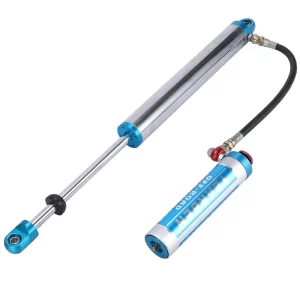
A trading company can list every shock configuration imaginable because they are not constrained by what they can actually build. A real manufacturer’s catalog reflects their specific engineering platforms and machining capabilities. If a factory offers remote reservoir, piggyback, emulsion, bypass, coilover, and air shocks across ATV, UTV, truck, buggy, and agricultural categories at low MOQs, treat that range with skepticism. Real manufacturing depth in off-road shocks typically concentrates around a few related platforms where the factory has invested in the tooling, valving expertise, and test fixtures specific to those configurations.
Whether you should visit the factory before placing an order depends on the order value and the performance criticality of the application
For a trial order of standard-configuration shocks under a few thousand dollars, remote verification through documentation, video calls showing specific production operations, and third-party inspection may be adequate. For custom-developed shocks, orders above ten thousand dollars, or applications where shock failure carries safety consequences, an in-person audit is justified. When you visit, spend more time in the quality lab and on the production floor than in the conference room. The engineering reality of the factory lives where the machines are, not in the presentation slides.
In programs we have supported, the highest-impact document a buyer can provide is a clear damping force specification with tolerance bands
A drawing that defines only physical dimensions leaves the factory to guess at the damping characteristic, and that guess will be based on whatever they built last. Provide compression and rebound force targets at two or three shaft velocities, plus the tolerance you can accept. A serious engineering team will confirm whether those targets are achievable with the shock architecture you have specified and will propose adjustments if the combination of dimensions, spring rate, and damping targets cannot be met within the same unit. That conversation alone often reveals more about factory capability than any pre-sales material.
Instead of asking how long production takes, ask how the factory defines the start and end of its development process
A factory that measures from drawing approval to shipment and excludes engineering review, prototype feedback loops, and testing from its timeline is giving you a partial answer. The full development cycle for a custom off-road shock, from complete drawing package to production shipment, usually spans twelve to eighteen weeks when prototyping, testing, and approval iterations are included. Rush programs can compress this by overlapping engineering and tooling preparation, but testing time should never be sacrificed. A shock that has not been dyno-tested and cycled before shipment is an unknown quantity arriving at your receiving dock. Share your timeline and damping requirements with our team at info@yearbenshocks.com, and we will map the development schedule including testing milestones so you can plan procurement with engineering confidence.
Moving Forward with Engineering Confidence
Sourcing off-road shocks from a Chinese factory rewards technical rigor. When the factory can discuss bore finish tolerances, show you batch dynamometer data, explain their seal material selection logic, and walk you through a production floor where honing, welding, charging, and testing happen under one roof, you are working with a manufacturer that has invested in the processes that produce consistent damping performance. When those conversations cannot happen and the focus stays on price and delivery alone, the risk shifts entirely to the buyer.
The factories worth building a supply relationship with are the ones that welcome technical questions because they have spent years building the answers into their production systems. If your next off-road shock program requires a supplier that can engage at that engineering level, send your specification package and performance requirements to info@yearbenshocks.com or call +86-523-86566899. We will review your damping targets, confirm feasibility against our manufacturing platforms, and provide the test documentation that supports your sourcing decision.
If you’re interested, check out these related articles:
Adjustable-Hydraulic-Shock-Absorbers
Steering-Damper-18MM
Damping-Adjustable-Shock-Absorber
Triple-Bypass-Shock-For-Off-Road