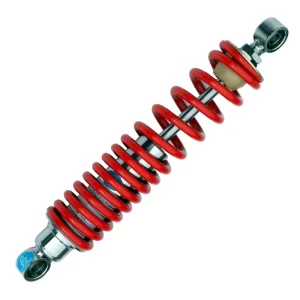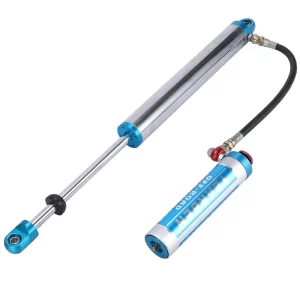
Assembling an off-road vehicle that can handle desert whoops, rock trails, or Baja-style runs comes down to suspension. And suspension, in turn, comes down to the shock absorber. Sourcing these parts from Chinese factories has become the standard move for brands and private-label buyers, yet the gap between finding a supplier on a platform and finding a factory that can actually deliver consistent, race-quality dampers is wider than most first-time buyers expect. I have spent over two decades engineering and manufacturing shock absorbers for ATVs, UTVs, buggies, and 4x4s at Yearben, and I can say that the difference between a catalog listing and a production-ready off-road shock is almost never visible in a photo. The critical factors are inside the tube.
What Separates an Off-Road Shock from a Street Shock
Regular street shocks absorb small, high-frequency pavement imperfections. Off-road shocks deal with a different problem entirely: deep compressions, high shaft speeds, and prolonged heat buildup. When you jump a UTV or crawl over rocks, the damper undergoes rapid oil displacement and extreme internal pressure spikes. The materials, the piston design, the seal stack, and the oil volume must all be built for these loads, not just for a smooth highway ride.
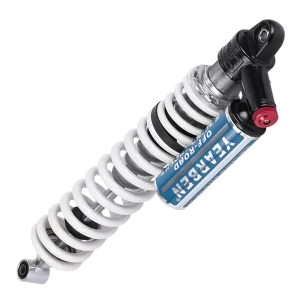
The first thing I check when we analyze a competitor’s off-road shock or a sample from a new factory is the body wall thickness and the rod diameter. For a 2.0-inch coilover meant for an ATV or UTV, I expect a 46mm or larger piston with a hard-chromed rod of at least 14mm diameter. Internal rebound and compression shim stacks need to be tunable, not fixed. If the factory only offers a single non-adjustable valving curve, they are building general-purpose shocks, not off-road dampers. That works for a lawn mower deck, but not for whoops at 80 km/h.
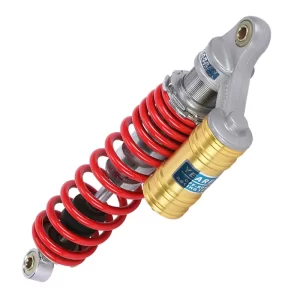
Finding a Chinese Factory with Genuine Off-Road Shock Capability
A factory that can build shocks for a passenger car cannot automatically build for off-road. The production line requirements differ in nitrogen charging, seal installation, and welding precision. I divide potential suppliers into three tiers based on what their facility reveals.
First, a dedicated off-road shock factory will have multi-stage nitrogen charging stations capable of reaching precise pressures, typically 150–250 psi for emulsion coilovers. They will own a shock dyno, not just a spring tester. A shock dynamometer plots force vs. velocity curves, which is non-negotiable for verifying damping consistency. If the factory does not have a dyno and cannot show a sample dyno graph with your requested valving, they are guessing.
Second, look at the welding. Off-road shocks often use piggyback or remote reservoir bodies welded to the main tube. These circumferential welds must be free of porosity and undercut. In our factory, we use TIG welding with argon back-purge on the reservoir ports to ensure no internal oxidation that could later shed particles into the oil. A factory that uses MIG welding without post-weld inspection will have a high rate of hidden pinhole leaks.
Third, examine the seal assembly process. The shaft seal is where off-road shocks eventually fail. A factory that builds for off-road should use a double-lip PTFE seal with a dust wiper, pressed in with a clean-room standard, not installed by hand on an open bench. Even microscopic contamination during assembly will score the rod and cause oil leakage within the first few rides.
Auditing Engineering Depth Beyond the Factory Floor
A factory tour shows the machines; the engineering team shows the thinking. When I evaluate a potential supplier, I ask to speak with the engineer responsible for piston design, not just the sales manager. I want to know how they calculate bleed orifice size for low-speed damping and how they tune the crossover between compression stages. If the answer is “we use a standard piston,” then they are an assembler, not a developer.
For off-road applications, the engineer should understand the effect of rod volume on reservoir pressure. In a remote reservoir shock, the dividing piston position and the nitrogen charge are set based on the exact rod diameter and stroke length. A factory that will be handling your custom order must be able to adjust these parameters, not just ship a pre-made generic unit.
One thing that separates a serious OEM is their ability to match spring rates to damping curves. For coilovers, we typically use dual-rate spring setups. The tender spring rate and main spring rate must be calculated from the vehicle’s sprung mass and motion ratio. If the factory cannot ask for your vehicle’s corner weight and intended use—trail, desert, or racing—they are not providing a true suspension solution, just a shock with a spring on it.
Testing and Quality Control: The Proof Before Production
A sample shock that looks good on the bench is not enough. Off-road shocks must be validated for fatigue life and heat management. In our factory, every new design goes through a cycle test of at least 500,000 strokes at full travel while the outer body temperature is monitored. We look for seal leakage, oil degradation, and nitrogen pressure loss. A factory that does not have a dedicated endurance test rig will ship shocks that may pass initial inspection but fail after 20 hours of actual off-road use.
In addition to fatigue testing, batch consistency is critical. I have seen suppliers who can produce ten perfect samples but then struggle to hold the same damping force on a production run of 500 units. This is where the shock dyno comes in again. We pull random units from each batch and overlay their dyno curves against the golden sample. If the variance exceeds ±10% at any piston speed, the batch is reworked. That is a requirement that must be written into the supplier audit.
Below is a simple comparison of what to look for across common off-road shock types when auditing a factory’s test capability:
| Shock Type | Key Test | What It Verifies |
|---|---|---|
| Emulsion Coilover | Dyno sweep after nitrogen charge | Damping consistency without aeration |
| Piggyback Reservoir | Pressure decay test over 24 hours | Reservoir piston seal integrity |
| Remote Reservoir | Hose burst test at double working pressure | Hose and fitting assembly strength |
| Triple Bypass | Individual tube zone bleed check | Bypass circuit flow and clicker detent repeatability |
| Monotube | High-speed compression cycle at full stroke | Cavitation resistance and IFP stability |
Custom Orders, MOQs, and Protecting Your Specifications
Off-road brands usually need custom valving, specific mounting eyelet dimensions, and sometimes proprietary spring rates or coating colors. When you approach a Chinese factory for custom shocks, the conversation must start with the technical drawing, not the price. A factory that leads with price before asking for your vehicle’s weight, travel, and mounting type will not deliver a product that matches your expectations.
Minimum order quantities (MOQs) for custom off-road shocks typically start at 50 to 100 sets, depending on the complexity. At Yearben, we handle custom projects with MOQs as low as 50 pairs for established buyers with clear specifications in place. Custom colors, spring rates, and valving are standard requests, and we maintain dedicated production files for each client to ensure repeat orders match the original sample.
One risk that I see too often is a brand sending their initial sample to a factory, then finding the same design offered to a competitor six months later. To prevent this, the manufacturing agreement must include a spec exclusivity clause, and it is wise to have unique tooling or a proprietary internal part that the factory cannot easily replicate for others. For critical components like the piston or the adjusting mechanism, we can build using client-supplied molds or dedicated CNC fixtures.
Common Sourcing Mistakes That Cost You Time and Performance
Even experienced buyers make errors that delay programs. The most frequent mistake is not clarifying the vehicle’s actual usage. A shock built for slow rock crawling has different damping requirements than a shock for high-speed desert racing. Without a clear usage profile, the factory will default to a generic middle-ground tune that does neither well.
The second mistake is neglecting bracket and hardware. A shock may be perfect internally, but if the mounting bushings are too soft or the spacers are off by a millimeter, it will rattle and bind. Buyers should always request a complete kit sample including mounting hardware, not just the bare shock.
Third, skipping the batch sample approval step. I recommend ordering a small pre-production run of 5 to 10 sets, installing them on actual vehicles, and riding them hard before authorizing mass production. This catches issues that no bench test will reveal, such as spring coil bind or interference with the chassis at full articulation.
If your program involves custom valving for a specific vehicle platform, it is worth confirming the damping adjustments and spring rates with the factory engineer before finalizing your bill of materials. Share your vehicle weight, travel, and expected terrain, and we can provide a valving recommendation based on similar applications we have already built.
Common Questions About Sourcing Off-Road Shocks from Chinese Factories
Can a Chinese factory build shocks to the same quality as a US or European brand?
In short, yes, if you select the right factory. The difference is not geography—it is the engineering process, the materials, and the quality system. I have seen Chinese factories that build for premium US brands using the same CNC honing, chrome plating, and dyno calibration methods as any Western facility. The challenge is that many low-cost factories cut corners on seal quality, oil specification, and welding inspection. Your job as a buyer is to audit those points directly, not to assume that a low price means low quality or that a high price guarantees performance.
How do I know if a factory is a real manufacturer or a trading company?
Ask to visit their production floor and see the assembly line, the dyno room, and the raw material stock. A trading company will take you to a showroom or a partner factory but cannot show in-process work orders for your product category. During the visit, ask to see a live dyno test of a shock from the current production batch. A manufacturer can do it within minutes; a trading company will stall. Also, request a copy of their ISO 9001 or IATF 16949 certificate and cross-check the audit scope to ensure it specifically covers shock absorber manufacturing.
What is the lead time for a custom off-road shock order?
For a new custom design with tooling and valving development, the standard lead time is 45 to 60 days from drawing approval to shipment of the first batch. For repeat orders, lead times can be as short as 25 to 30 days, assuming all components are in stock. The biggest factors that stretch lead times are special coatings, custom spring manufacturing, and complex reservoir hose assemblies. If your program needs specific delivery milestones, tell the factory early so they can reserve capacity.
Should I request samples, and how many?
Always sample before production. I recommend ordering 4 to 6 pre-production samples. Install two on a vehicle for real-world testing, keep one as a golden reference standard, and return one to the factory with any adjustment notes marked on the shock body. This gives both sides a physical reference. The sample fee is often credited against the production order, but clarify that before you start.
How can I protect my custom shock design from being sold to another buyer?
The most reliable protection is a combination of exclusivity agreement, unique tooling, and proprietary internal components. For critical parts like the main piston or the adjuster mechanism, commission dedicated tooling that only produces your part. This creates a physical barrier: the factory cannot run the same part for another client without investing in new tooling, which they are unlikely to do. Additionally, split your supply across two trusted factories for different component families to reduce the impact if exclusivity is broken. If your project requires this level of protection, share your requirements and we can discuss how to structure the tooling and specification to keep your design yours.
If you’re interested, check out these related articles: