When I first started working with shock absorber procurement twenty years ago, I routinely saw buyers treat MOQ as a simple number—something you negotiate down. But a shock absorber MOQ is actually a direct expression of the manufacturing resources needed to build a batch that performs consistently. For ATV suspension systems, lawn mower dampers, or commercial seat shocks, the choice between a catalog part and a custom design is not just about quantity or price; it’s about whether the necessary tooling, engineering time, and validation steps can be justified by your production volume. Over two decades of developing dampers for global OEMs, I’ve learned that rushing into a custom order without understanding these constraints is the fastest way to blow a budget and a timeline.
What MOQ Means for a Shock Absorber Purchase
MOQ, or minimum order quantity, is the smallest number of shock absorbers a factory will produce in a single production run. For catalog shock absorbers—existing designs that have already passed engineering validation and have dedicated tooling—the MOQ is often lower because the manufacturer can produce them alongside other orders, sharing fixtures and setup time. Custom shock absorbers, on the other hand, require a unique combination of damping curves, spring rates, mounting dimensions, and often specific valving or nitrogen pressure thresholds. Because nothing from the standard product line can be directly reused, every custom order starts from a fresh engineering and tooling setup, which the MOQ must cover.
Catalog vs Custom: Shock Absorber MOQ Ranges
The table below gives practical MOQ ranges I’ve observed across hundreds of sourcing programs. These are not absolute factory rules but reflect the engineering effort and component commonality that drives batch sizing.
| Shock Type | Typical Catalog MOQ | Typical Custom MOQ |
|---|---|---|
| ATV coilover | 100 pcs | 300–500 pcs |
| UTV piggyback shock | 50 pcs | 250–400 pcs |
| Lawn mower damper | 200 pcs | 500–800 pcs |
| Heavy equipment seat damper | 100 pcs | 300 pcs |
| Steering damper | 100 pcs | 300 pcs |
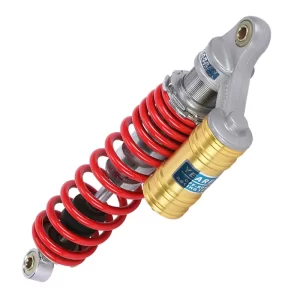
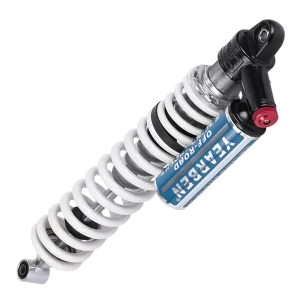
Catalog parts, like the off-road vehicle shocks in our standard line, ship with no minimum when stock is available. But a custom coilover with a unique nitrogen charge profile and nonstandard eyelet diameter will almost always land in the 300-unit range, simply because the production setup is too costly to amortize over a tiny lot.
Why Custom Shock Orders Have Higher MOQs
The primary reason a custom shock absorber MOQ is higher is that the fixed engineering and tooling costs are identical whether you make 50 units or 500. Those fixed costs include the mandrels and jigs that hold the cylinder tube during welding, the dedicated nitrogen charging fixture, and the dynamometer sessions that validate the damping curve.
I recall a program where a buyer wanted a custom steering damper with a nonstandard stroke and valving. The cylinder tube had to be cut to a new length, requiring a production jig that could hold the tube perfectly concentric during welding. That jig cost roughly $800 and a week to fabricate. Spread across 50 units, tooling alone is $16 per shock; across 500 units, it drops to $1.60. The arithmetic is blunt, but it explains why MOQ is not an arbitrary negotiation lever.
Beyond tooling, every new valve design goes onto a shock dyno. A single damping curve validation might run four to six hours, and if the curve doesn’t match the target at low-speed compression, we iterate. Those hours block a test cell that could be running production QC. When you combine jigs, dyno time, and prototype assembly labor, the breakeven point rarely falls below 200–300 pieces.
Costs Beyond the Unit Price: Lead Time and Hidden Fees
Custom shock absorbers also carry costs that don’t appear on a unit price quote. Prototype shipping, sample compliance documentation for export markets, and the engineering communication overhead all add up. If the first prototype fails a field test and the valving needs adjustment, a second prototype round starts the clock over.
Lead time is another lever that flips the economics. Catalog shocks ship within two to four weeks because inventory is already built. A custom order typically requires 8–14 weeks: CAD review, jig fabrication, prototype build, dyno validation, production run, and final inspection. I’ve seen programs where rushed custom orders ended up costing 40% more than planned because the initial design wasn’t fully validated on a dyno and required a second round of tooling adjustments.
If your program involves unique damping requirements and uncertain future volumes, it’s wise to discuss your specific situation before committing. Contact our engineering team at info@yearbenshocks.com for a custom MOQ evaluation. We can separate tooling cost from unit cost so the decision is based on real numbers, not assumptions.
How to Decide Between Catalog and Custom: A Practical Checklist
Over the years, I’ve developed a simple set of questions that separate viable custom projects from those that should start with catalog parts. Run through this before you open a quote request.
- Does an existing catalog model meet your extended and compressed length? If the dimensional fit is within a few millimeters, a custom strut rod or bushing may be unnecessary.
- Can your damping rate be achieved with standard valving? Most applications don’t need a unique curve. If a standard shim stack covers 80% of your target, the remaining 20% can usually be tuned with nitrogen pressure or spring rate.
- What is your projected annual volume? Under 200 units per year points strongly toward catalog—or at least toward a catalog-based modification that doesn’t require new tooling.
- Do you have engineering documentation ready? If you lack CAD models or detailed spec sheets, factor in at least three extra weeks of engineering communication.
- Is your timeline flexible? Rushing a custom order almost always compromises testing depth. A minimum 10-week window from approved drawing to delivery is realistic.
- Consider total landed cost. MOQ is only part of the picture. Include freight, potential rework, and the cost of holding inventory if your usage rate is low.
- Future scalability. If your volume will double in two years, the custom tooling investment pays off quickly. If you’re unsure, start with catalog and collect field data.
Getting a Shock Absorber MOQ Quote You Can Work With
I’ve watched too many projects stall because the MOQ was misunderstood or misquoted at the start. A useful quote separates tooling cost from unit cost, clearly states the delivery window, and includes which validation steps the factory will perform. At Yearben, we provide this level of clarity as standard practice because we know it’s the only way you can make a confident budgeting and scheduling decision. Send your part number, target quantity, and key specs to info@yearbenshocks.com or call +86-523-86566899, and we’ll outline the exact MOQ and customization path for your shock absorbers within two working days.
Common Questions About Shock Absorber MOQ
It depends on the design. If the custom shock uses mostly standard components, a prototype is feasible
Yes, but at a price. When a custom shock is largely built around existing piston and cylinder subassemblies, we can produce one or two samples for bench and field testing. However, the per-unit cost of a prototype is typically three to five times the eventual production price because setup labor and dyno time are not amortized.
In our shipping department, we consolidate orders all the time
Catalog and custom parts ship together without issue. Because custom parts run on their own production schedule, the full container’s readiness date is driven by the custom batch. We flag this in the quotation so your logistics team knows when to book a forwarder.
Before reaching out, prepare a specification sheet with at least these parameters
You’ll need extended and compressed length, mounting eye inside diameter, stroke, spring rate, and the axle or corner weight of your vehicle. For damping-adjustable designs, also share your target force at two or three piston speeds. A clear drawing or a reference OEM part number accelerates the quote significantly.
Lead time is determined by how much new tooling is required, not by the quantity alone
A simple modification—such as a different spring perch or bushing—can ship in six to eight weeks. A full custom damper with new piston design, unique valving, and dedicated dyno validation typically needs 10–14 weeks. Rush orders are possible but often skip a round of testing, which is a risk you should weigh carefully.
MOQ isn’t always an absolute wall, especially for orders that reuse standard internal components
If the engineering investment is modest—for instance, changing only the extended length on an existing damper body—we can sometimes accept a smaller batch at a higher per-unit cost. The key factor is whether the setup labor and fixture changes can be absorbed without disrupting the production schedule. I’ve seen programs start at 150 pieces with a premium and then scale to 500+ once field performance was proven. Share your requirements with info@yearbenshocks.com and we’ll confirm feasibility without obligation.
If you’re interested, check out these related articles:
Off-Road-Coilovers
Adjustable Seat Damper 41.5mm
Best-Shocks-And-Springs-For-Trucks
Lawn mower steering damper 18mm