
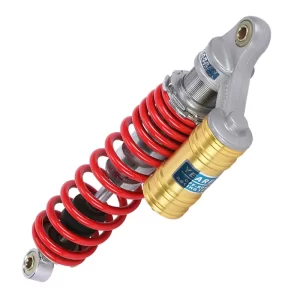
Monotube shocks fail in the field when factories cut corners on three operations: welding, nitrogen charging, and pressure testing. I have seen shocks returned from desert racing programs with weld cracks at the reservoir mount, gas leakage after 50 hours, and inconsistent damping that the end user blamed on “defective valving” when the root cause was a poorly sealed piston assembly. These failures trace back to manufacturing decisions made before the shock ever left the production floor. Understanding how monotube shocks are welded, charged, and tested gives procurement engineers the vocabulary to audit suppliers and the technical criteria to separate serious OEM partners from assemblers who cannot hold tolerances.
Why Monotube Construction Demands Tighter Manufacturing Control
Monotube shocks operate on a single pressure chamber separated by a floating piston. Unlike twin-tube designs where the outer tube provides a secondary containment layer, monotube construction places every weld, seal, and charge directly in the load path. A pinhole in a twin-tube reservoir bleeds into the outer chamber and may go unnoticed for hundreds of cycles. The same defect in a monotube causes immediate pressure loss and damping fade.
The floating piston itself creates additional manufacturing constraints. It must slide freely under nitrogen pressure while maintaining a gas-tight seal against the bore wall. Bore finish, piston ring material, and the dimensional relationship between piston OD and tube ID all interact. A factory that welds the end caps before verifying bore concentricity locks in a defect that no amount of post-assembly testing can correct.
High-performance monotube shocks for ATV, UTV, and off-road applications typically run nitrogen pressures between 150 and 250 psi. At these pressures, weld porosity that would be cosmetically acceptable on a structural tube becomes a leak path. The manufacturing sequence matters: welding before charging allows thermal distortion to be measured and corrected, while charging before final weld inspection risks trapping defects inside a pressurized assembly.
How Monotube Shock Bodies Are Welded at the Factory
Welding a monotube shock body involves joining the cylinder tube to the end caps, mounting eyes, and reservoir fittings. Each joint type presents different challenges.
Cylinder-to-end-cap welds are circumferential and must be gas-tight. Most factories use TIG welding for aluminum bodies and MIG or robotic TIG for steel. The weld bead penetration depth determines pressure rating. Shallow penetration creates a stress riser that cracks under repeated compression cycles. Full penetration welds require precise fit-up tolerances, typically 0.05 mm or less gap between tube and cap.
Mounting eye welds carry the full suspension load. A 2.5-inch body shock on a trophy truck may see 8,000 lbs of instantaneous load on a G-out. The weld between the mounting eye and the body must handle this load in shear without cracking. Factories that weld eyes to flat end caps distribute stress poorly. Better designs use a machined boss that increases weld surface area and moves the stress concentration away from the pressure boundary.
Reservoir and hose fitting welds on remote reservoir shocks add complexity. The fitting must seal against nitrogen pressure while also providing a leak-free path for oil flow. AN-style fittings welded to aluminum reservoirs require careful heat management to avoid warping the sealing surface.
| Weld Location | Typical Method | Critical Tolerance | Failure Mode if Missed |
|---|---|---|---|
| Cylinder to end cap | TIG (aluminum) / MIG (steel) | Gap < 0.05 mm | Pressure leak, fatigue crack |
| Mounting eye to body | MIG with preheat | Penetration > 80% wall | Shear failure under load |
| Reservoir fitting | TIG with backing gas | Flatness < 0.02 mm | Seal leak at AN fitting |
| Piggyback mount | Robotic MIG | Angular alignment ± 0.5° | Hose stress, premature wear |
Weld inspection at serious factories includes visual examination, dye penetrant testing on critical joints, and dimensional checks for distortion. X-ray inspection is rare outside aerospace applications but some racing shock manufacturers use it on prototype runs.
Nitrogen Charging: Pressure, Purity, and Process Sequence
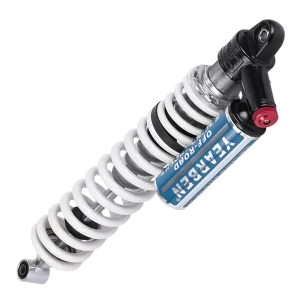
Nitrogen charging sets the baseline pressure that supports the floating piston and prevents cavitation during high-speed damping events. The charge pressure, gas purity, and charging sequence all affect shock performance and longevity.
Charge pressure selection depends on application. A shock running 150 psi will cavitate earlier under rapid compression than one running 225 psi, but higher pressure increases breakaway friction and harshens ride quality at low speeds. Most off-road monotube shocks ship between 175 and 225 psi. Racing shocks may run higher. The factory must document the target pressure and hold it within ± 5 psi across production.
Gas purity matters because moisture in the nitrogen accelerates seal degradation and causes pressure drift with temperature. Industrial-grade nitrogen (99.5% purity) is acceptable for most applications. Racing and military shocks often specify 99.99% purity. The charging station must include a moisture trap and pressure regulator capable of holding stable output during the fill cycle.
Charging sequence interacts with assembly order. Some factories charge through a Schrader valve in the end cap after final assembly. Others charge before installing the floating piston, then seal the assembly. The first method allows pressure adjustment after testing but requires a reliable Schrader seal. The second method eliminates the Schrader as a potential leak point but makes pressure adjustment impossible without disassembly.
I have seen factories lose 10 psi overnight on freshly charged shocks because the Schrader valve cores were reused from a previous batch. A $0.15 valve core caused a $150 shock to fail incoming inspection at the customer’s facility. Serious OEMs replace Schrader cores on every unit and verify seal integrity with a leak-down test before shipping.
Temperature compensation is often overlooked. A shock charged to 200 psi at 25°C will read 215 psi at 40°C and 185 psi at 10°C. Factories in hot climates must charge in temperature-controlled rooms or apply a correction factor. Shipping shocks from a 35°C factory floor to a 5°C winter warehouse creates apparent “low charge” complaints that are actually physics, not defects.
Pressure Testing and Leak Detection Methods
Pressure testing verifies that the assembled shock holds its charge and that all welds and seals are gas-tight. The test method, duration, and acceptance criteria separate factories that ship reliable product from those that ship problems.
Hydrostatic testing pressurizes the shock body with oil or water to a multiple of working pressure, typically 1.5x to 2x. This test verifies weld integrity and body strength before nitrogen is introduced. A shock rated for 250 psi operating pressure should survive 500 psi hydrostatic without permanent deformation. Factories that skip hydrostatic testing rely entirely on gas leak-down tests, which may not catch weld defects that fail only under high static load.
Gas leak-down testing measures pressure loss over time after nitrogen charging. A common standard is less than 2 psi loss over 24 hours at room temperature. More stringent programs require less than 1 psi over 48 hours. The test must be conducted in a temperature-stable environment because thermal drift masks real leaks.
Bubble testing submerges the charged shock in water and watches for bubbles at weld joints, Schrader valves, and seal interfaces. This method is fast and visual but only catches gross leaks. Micro-leaks that cause field failures over weeks or months may not produce visible bubbles in a 30-second dunk test.
Helium leak testing offers the highest sensitivity and is used on aerospace and military shock programs. Helium’s small molecular size allows it to escape through leak paths that hold nitrogen. A mass spectrometer detects helium concentration in the test chamber. This method adds cost but catches defects that other tests miss.
| Test Method | Sensitivity | Cost | Typical Application |
|---|---|---|---|
| Hydrostatic | Weld integrity only | Low | All production |
| Gas leak-down (24 hr) | > 2 psi/day leaks | Medium | Standard OEM |
| Gas leak-down (48 hr) | > 1 psi/day leaks | Medium-High | Racing, premium |
| Bubble test | Gross leaks only | Low | Quick screening |
| Helium mass spec | < 0.1 psi/year equivalent | High | Aerospace, military |
Functional Testing: Damping Curves and Cycle Validation
Pressure testing confirms the shock holds gas. Functional testing confirms it actually damps correctly. These are different tests with different equipment and different failure modes.
Dyno testing measures damping force across a range of shaft velocities. A servo-hydraulic dyno cycles the shock through its stroke at controlled speeds, typically from 0.1 in/sec to 60 in/sec or higher. The resulting force-velocity curve shows compression and rebound damping at each speed. Deviations from the target curve indicate valving errors, oil viscosity problems, or internal assembly defects.
Cycle testing runs the shock through thousands or hundreds of thousands of cycles to verify durability. A shock that passes pressure and dyno tests may still fail in the field if internal components fatigue. Cycle testing at elevated temperature accelerates wear and exposes seal materials that degrade under heat.
Fade testing heats the shock through sustained high-speed cycling and measures damping force as temperature rises. A shock that produces 800 lbs of compression damping at 25°C may drop to 600 lbs at 80°C. The fade curve tells engineers whether the shock will maintain control during extended desert runs or high-speed trail sections.
Factories that lack dyno equipment often substitute “feel tests” where a technician compresses the shock by hand and judges resistance. This catches gross assembly errors but misses valving inconsistencies that only appear at specific velocities. If your supplier cannot provide dyno data, they cannot verify that the shock meets spec.
What Factory Audit Questions Reveal About Manufacturing Quality
When evaluating a monotube shock supplier, the questions you ask about welding, charging, and testing reveal whether the factory understands their own process or just follows a checklist.
Welding questions: Ask what weld inspection method they use on cylinder-to-cap joints. If the answer is “visual only,” probe further. Ask about weld penetration standards and how they verify penetration depth. A factory that cannot explain their weld qualification process probably does not have one.
Charging questions: Ask what nitrogen purity they use and how they verify it. Ask about temperature compensation during charging. Ask whether they replace Schrader cores on every unit or reuse them. The answers reveal whether they understand gas behavior or just fill to a number.
Testing questions: Ask for their leak-down test duration and acceptance criteria. Ask whether they hydrostatic test before gas charging. Ask if they have dyno capability and whether they dyno every unit or sample test. A factory that dynos 100% of production has confidence in their process. A factory that dynos 1 in 50 is hoping defects do not land in your shipment.
If your program requires monotube shocks that survive demanding off-road conditions, the manufacturing details matter as much as the design specifications. Share your application requirements and target volumes with our engineering team at info@yearbenshocks.com or +86-523-86566899, and we can walk through the specific welding, charging, and testing protocols that match your performance expectations.
Common Questions About Monotube Shock Manufacturing
What causes a monotube shock to lose nitrogen pressure after shipping?
The most common cause is a marginal Schrader valve seal that passed a quick bubble test but leaks slowly over days. Temperature cycling during shipping accelerates this failure. Less common causes include micro-porosity in welds that only opens under repeated thermal expansion, or floating piston seals that were nicked during assembly. A factory with proper leak-down testing catches these before shipment. If you receive shocks with low pressure, ask your supplier for their leak-down test records and duration.
How can I tell if a shock was properly welded without destructive testing?
Visual inspection catches obvious defects like undercut, porosity, and incomplete fusion at the weld surface. Dye penetrant testing reveals surface cracks invisible to the eye. For critical applications, ask whether the factory performed dye penetrant on a sample from your batch. Dimensional checks for roundness and straightness after welding indicate whether thermal distortion was controlled. A shock body that measures 0.1 mm out of round after welding will cause premature seal wear regardless of how clean the weld looks.
Why do some factories charge monotube shocks to different pressures for the same model?
Legitimate reasons include customer-specific tuning requests or regional climate compensation. Illegitimate reasons include poor process control where operators charge to whatever pressure they remember. Ask your supplier whether charge pressure is documented on a per-unit basis and whether they have a tolerance band. A factory that cannot tell you the target pressure and tolerance for your specific part number is not controlling their process.
What is the difference between a leak-down test and a pressure decay test?
These terms are often used interchangeably, but technically a leak-down test measures the rate of pressure loss over time, while a pressure decay test measures the absolute pressure drop over a fixed period. Both accomplish the same goal of detecting leaks. The meaningful difference is test duration and acceptance criteria. A 30-minute decay test may miss slow leaks that a 48-hour leak-down test catches. Ask your supplier for their test duration, not just whether they “pressure test.”
Should I specify helium leak testing for off-road shock absorbers?
For most ATV, UTV, and recreational off-road applications, a properly conducted 24 to 48 hour nitrogen leak-down test is sufficient. Helium testing adds significant cost and is typically reserved for aerospace, military, or racing applications where field failure has severe consequences. If your shocks will operate in extreme temperature ranges or cannot be serviced in the field, helium testing may be justified. Share your operating conditions with your supplier to determine the appropriate test level.
If you’re interested, check out these related articles:
4X4-Shock-Absorber-Supplier
Remote-Reservoir-Shocks-Manufacturer
Coilover-Shock-Absorber
Adjustable-Shock-Absorber-For-Car