
Reservoir shocks solve a specific problem that standard monotube dampers cannot hide in sustained off-road use: heat driven damping fade. I have spent more than twenty years developing shock absorbers for ATVs, UTVs, and off-road vehicles, and the pattern repeats across programs. A standard shock loses damping consistency as oil heats and aerates; a remote reservoir separates hot oil from pressurized gas, increases oil volume, and keeps force delivery stable over long runs. The difference shows up most in sand, hardpack braking bumps, and any loop where the shock never gets a cooling pause.
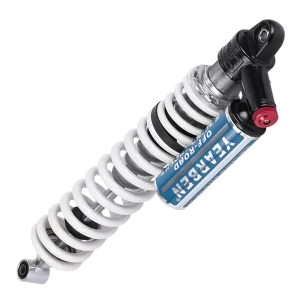
What Is a Reservoir Shock Absorber?
A reservoir shock absorber is a hydraulic damper that moves the gas charge to a separate cylinder connected to the main body by a high pressure hose or a piggyback mount. In a standard monotube, nitrogen sits in the same tube as the oil and is separated by a dividing piston. That packaging works until oil temperature climbs. The reservoir version adds oil volume and surface area, so the damper can absorb more heat before the fluid thins and begins to aerate. On ATVs and UTVs, the remote reservoir also lets a manufacturer move the gas chamber off the shock body when space around the spring and control arm is tight.
How Does a Remote Reservoir Reduce Shock Fade?
Shock fade is not usually a seal failure. It is a fluid problem. As the piston cycles through the oil, kinetic energy converts to heat. When oil temperature reaches the point where it thins, the same shim stack flows more fluid at lower resistance, so compression and rebound forces drop. In a conventional monotube the gas charge sits close to the oil; hard use can mix oil and gas into foam, and foam passes through the piston far too easily. Damping becomes inconsistent.
A remote reservoir attacks this problem in two ways. The floating piston or bladder keeps nitrogen and oil apart, which slows aeration. The extra oil volume and the external canister also give heat more surface area to leave the shock. I have seen this pattern in long sand sessions where a standard monotube loses rebound control after the body gets too hot to hold, while a correctly sized reservoir shock keeps the adjuster settings meaningful for the rest of the loop.
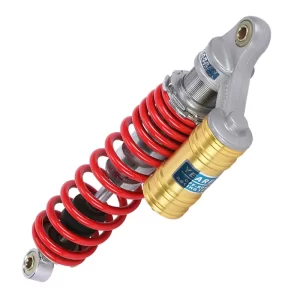
When Should You Choose Reservoir Shocks Over Standard Shocks?
Choose a reservoir shock when the damper is asked to cycle hard for minutes at a time rather than seconds. That covers desert racing, dune running, long rock crawls, and fast trail use. A utility ATV that spends most of its time at low speed on graded trails rarely needs the extra oil capacity. The stock shock stays inside its working temperature range and the added cost buys little. There is a second case where a remote reservoir justifies itself even without racing: packaging. On some UTVs and buggies, spring diameter or frame layout leaves no room for a larger bore monotube, and moving the gas chamber away from the shock body makes room for a longer stroke without forcing a taller eye to eye length.
| Operating Condition | Standard Monotube | Remote Reservoir Shock |
|---|---|---|
| Low speed utility trail riding | Adequate | Not required |
| High speed desert or dune running | Fades after sustained runs | Maintains damping longer |
| Tight packaging with long stroke | Space limited | Gas chamber can be relocated |
| Repeated braking bumps | Loses rebound control earlier | Keeps adjuster changes effective |
If your ATV or UTV runs sustained high speed desert or hardpack sections, it is worth confirming the reservoir oil volume, gas pressure, and hose routing against your vehicle weight before finalizing the specification. A remote reservoir that is too small still fades. Send the duty cycle and mounting photos to info@yearbenshocks.com and I will review the numbers with you.
What Specs Matter When Ordering Reservoir Shocks?
Reservoir shocks are not a single specification. The first number to pin down is oil volume because that determines how much heat the damper can absorb before fade. Hose length and fitting angle decide whether the reservoir can be mounted away from the exhaust or close to the frame. Gas pressure is set to prevent cavitation under rapid rebound; too low a charge lets the oil pull gas past the floating piston, and too high a charge adds harshness. Bore size and stroke still determine travel and baseline force, so the reservoir is a thermal addition rather than a substitute for the correct damper size.
At Yearben we build reservoir shocks in adjustable, piggyback, and remote configurations for ATV, UTV, and buggy platforms. The catalog covers more than 200 models, and annual production capacity reaches 1.5 million units. That scale matters when a buyer needs repeatable batch quality instead of one off samples.
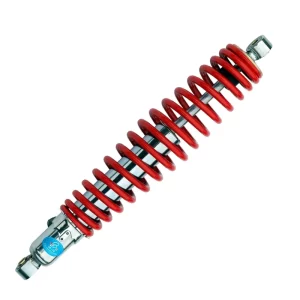
How Do You Specify and Source Reservoir Shocks?
Getting the reservoir specification wrong usually shows up as a shock that still fades or a hose that kinks at full droop. The fix is to confirm the complete package before ordering: vehicle weight, eye to eye length, stroke, mounting points, and the available reservoir mounting location. Yearben builds remote reservoir shocks in piggyback and remote layouts, and the development work should start with a clear specification sheet rather than a catalog guess. If your platform runs sustained heat, send the part number, quantity, and mounting photos to info@yearbenshocks.com or call +86-523-86566899. I will check the oil volume, gas pressure, and hose routing against your target use before the quote is finalized.
What Questions Should You Ask Before Ordering Reservoir Shocks?
Are remote reservoir shocks the same as piggyback reservoir shocks?
They perform the same thermal job, but the packaging differs. A piggyback reservoir mounts directly to the shock body with a short port, while a remote reservoir connects through a high pressure hose and can be mounted away from the shock. Remote units add hose surface area and mounting flexibility, but the hose is an additional failure point. Piggybacks package more compactly and reduce hose routing risk. If the chassis has room for the canister near the spring, a piggyback may be simpler. If heat sources or frame rails crowd that area, a remote unit makes sense.
Do I need a reservoir shock for trail riding?
It depends on how long the shock runs under load. A stock monotube is often enough for low speed utility trail riding, short climbs, and occasional creek crossings because the oil never reaches fade temperature. If you ride fast hardpack, sand, or long rocky descents where the damper cycles continuously for ten minutes or more, a reservoir shock holds damping more consistently. The upgrade is a thermal solution rather than a magic increase in travel or vehicle capability.
What causes a remote reservoir shock to leak pressure?
Pressure loss usually points to a fitting or seal issue, not the reservoir body itself. The common failure points are the Schrader valve, the hose crimp, or the floating piston O-ring. When the gas charge drops, the oil can cavitate under rapid rebound and the shock feels soft and inconsistent. Check the hose fittings for oil mist and confirm the reservoir body is not dented. Repressurizing a leaking shock without replacing the failed seal simply repeats the failure.
How much additional oil do remote reservoir shocks hold?
In builds we have worked on, the usable oil volume gain matters more than the published canister size. A compact remote reservoir may add only a modest amount of fluid, but moving the gas chamber out of the shock body still reduces oil aeration. The actual requirement is enough oil to keep damping stable through your target duty cycle. We confirm that by working through vehicle weight, travel, and speed rather than assuming any reservoir automatically solves fade. Share your vehicle weight, stroke, and riding environment at info@yearbenshocks.com and we can confirm the correct oil volume for your application.
If you’re interested, check out these related articles:
Aluminum-Utv-Shock-Absorber
Gas Charged Dual Rate Coilover Shock Absorber
Adjustable-Shock-Absorber-For-Car
Custom-Shocks-And-Struts
Adjustable Seat Damper 41.5mm