ATV shocks factory sourcing usually gets reduced to two questions: what is the MOQ, and can the supplier hold the price. That shortcut is where most expensive mistakes start. A factory can pass both filters and still ship progressive valving that feels dead after twenty ride hours, or chrome plating that fails salt spray testing after one wet season. I am a suspension engineer at TaiZhou Yearben Shock Absorber Tech, and the audits that matter most are about process control, tooling ownership, and how a supplier handles specification changes, not first unit cost alone.
What Changes When You Order From an ATV Shocks Factory Instead of a Trading Company
A trading company usually cannot tell you why the factory sets nitrogen pressure at a specific bar value for a given spring rate. We can. The real shift when you order from an ATV shocks factory is that specification changes become engineering decisions instead of order notes. A catalog ATV shock absorber keeps its basic damping curve no matter who sells it, but the factory controls piston port size, shim stack arrangement, and final pressure charge. When a buyer asks to change only the spring rate, we check whether the rebound stack still matches the new spring energy. If it does not, the vehicle packs over repeated bumps because the shock cannot return fast enough before the next impact. That linkage stays invisible in a trader’s quote sheet because the trader never sat down with the valving chart.
Which MOQ Structure Actually Fits Your ATV Shock Order
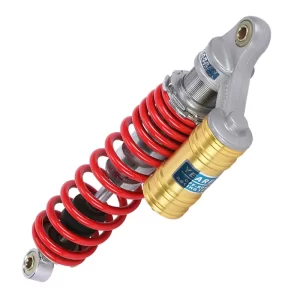
MOQ should not be treated as a single number. It breaks into catalog, modified, and full custom. At TaiZhou Yearben, catalog ATV shock absorbers carry a lower starting quantity because the cylinder, piston rod, and spring tooling already exist. Modified orders, where we change valving or spring rate but keep production tooling, add a small batch setup cost. Full custom orders, where eyelet center distance, stroke, or damping direction changes, call for new fixtures or CNC programs, so the minimum rises.
| Order Type | Typical MOQ | Tooling | Sample Step |
|---|---|---|---|
| Catalog ATV shock absorber | 100 pieces per model | Existing | Existing sample confirmed |
| Modified valving or spring rate | 100 to 200 pieces | Setup only | Bench test before production |
| Custom stroke or eyelet | 200 to 500 pieces | New fixture or CNC program | Drawing approval plus sample |
| Private label finish | 300 to 500 pieces | Packaging tooling | Artwork sign off |
One point worth checking is who owns the custom fixture. If a buyer pays for a new piston rod size and later moves the order, tooling ownership decides whether the production history can follow. We keep custom drawing revision records tied to the part number, not to the sales contact. That matters more than the first quote price because a repeat order six months later should not start from zero. Some factories count a modified spring rate as full custom even when all metal parts remain stock, so ask for the breakpoint before approving a deposit.
Why Do ISO and Factory Audit Evidence Matter Before You Send a Deposit
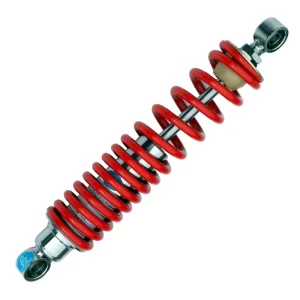
ISO 9001 tells you the factory has a quality system. It does not tell you whether that system reaches the weld joint and the seal groove. During an ATV shock factory evaluation, I ask to see the control plan for piston rod chrome plating and the incoming inspection record for seal compounds. Those two points account for most early warranty claims I have investigated. A monotube body can have perfectly straight threads and still leak if tube finishing leaves a spiral lead that wears the seal lip. The audit evidence that counts is therefore not the certificate on the wall but the frequency of surface finish checks, the calibration log for nitrogen charging, and the traceability code that links a batch to its pressure test data.
TaiZhou Yearben operates an annual production capacity of 1.5 million units across more than 200 models, but scale alone does not move an ATV shock order forward. What matters is whether the line holds a specific damping curve across a 500 piece run. We test sampled units on the dynamometer at the start, middle, and end of the batch, and we hold the force velocity curve within tolerance rather than checking only eye to eye length.
If your program involves mixed stroke lengths or non standard spring rates across ATV, UTV, and buggy platforms, it is worth confirming the damping curve tolerance and fixture plan before finalizing your BOM. Send your part number, drawing, and expected annual volume to info@yearbenshocks.com.
What Custom Options Should You Lock Before Quoting an ATV Shocks Factory
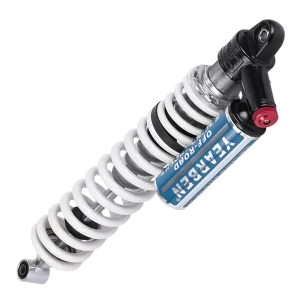
Most buyers start by asking for a different spring rate or a different color. Those are valid requests, but the options that actually change ride performance are piston port sizing, shim stack tuning, nitrogen pressure, and stroke travel. If a factory only offers preload and paint changes, you are not buying custom damping. You are buying a cosmetic variation of a stock shock. We set preload after confirming rider weight, vehicle weight, and intended terrain. For a desert racing ATV, we may run lower gas pressure and a digressive valving profile to keep the tire on sand without the shock packing. For a utility ATV carrying a rack load, we shift the compression stack firmer and keep rebound slowed so the rear does not kick back over the next rut.
Before requesting a quote, lock the extended and collapsed lengths, bushing inner diameter, spring length and rate, rod diameter, and whether the unit is emulsion, piggyback, or remote reservoir. On custom reservoir shocks, we also confirm hose length and bracket angle because a hose that rubs the frame wears faster than any seal. We have seen a small bracket angle error destroy an otherwise correct shock within a few ride hours because the hose worked against the mount on every compression stroke.
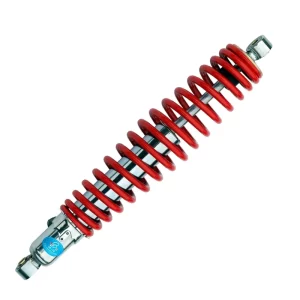
High quality ATV shock sourcing is less about finding the lowest MOQ and more about matching a factory’s process control to the way your vehicle loads the damper. If your current sample passed on appearance but failed on ride performance, the next step is to send the existing unit or drawing. We will confirm whether the damping curve can be matched, what tooling must change, and the real MOQ for your platform. Send the part number, target quantity, and installation photos to info@yearbenshocks.com or call +86-523-86566899.
What Else Should Buyers Ask Before Signing an ATV Shock Factory Order
How long does a custom ATV shock sample take?
A custom ATV shock sample typically takes 30 to 45 days in our shop when new fixtures are involved, assuming the drawing is complete on day one. The sample timeline depends mainly on whether the piston rod diameter, stroke, and spring platform already exist. If we start from a catalog body and change only valving, the sample can move in two to three weeks. If the eyelet center distance changes, the fixture time dominates. I advise buyers to put drawing revision control in place before sample approval so that a small change does not restart the entire timing.
Does ISO 9001 mean every shock is tested?
ISO 9001 certifies the system, not that every unit receives a complete dynamometer sweep. We test samples at the start, middle, and end of a production batch and keep the force velocity record tied to the batch code. Every unit still passes a pressure retention check and a dimensional check, but full curve verification is a sampling activity. If your application cannot tolerate curve drift, ask for 100 percent output testing as a separate line item. That adds cost, but it is the only way to catch a valve stack assembly error before the units leave the factory.
Can I order a small batch to test before committing to annual volume?
It depends on the order type. Catalog ATV shock absorbers can often be sampled in smaller quantities because production tooling is already available. A full custom shock is different because the fixture and CNC program are part of the first batch cost. In some projects, we split the first order into a preproduction run of 20 to 50 pieces for field testing, then hold the agreed annual price after the design is frozen. That approach works better than trying to negotiate a tiny MOQ while the drawing is still changing.
Who keeps the tooling for a custom ATV shock absorber?
In our OEM projects, custom tooling drawings are tied to the customer part number, and ownership is agreed before sample approval. If the customer pays for new piston rod tooling, the production history and revision records stay with their part number. If the tooling is Yearben funded, the customer usually receives a right to use the tooling for the life of the program rather than ownership of the physical fixture. Share your drawing and target quantity, and we will confirm tooling ownership, sample lead time, and the compliance documentation available for your market.
If you’re interested, check out these related articles:
Custom-Shocks-And-Struts
4X4-Shock-Absorber-Supplier
Hydraulic-Shock-Absorber-24MM