
Choosing between coil and leaf spring off-road suspension isn’t simply about comfort versus load capacity. The real difference lies in how each spring type interacts with the shock absorber, a factor most comparisons overlook. In over twenty years of suspension engineering and custom shock manufacturing at Yearben, we’ve seen that a well-tuned coilover shock can transform a leaf-spring vehicle’s handling, while a poorly matched damper can make coil springs feel harsh. The coil vs leaf spring off-road suspension decision ultimately depends on your vehicle’s weight, intended terrain, and the damping precision of the shocks you pair with it.
How Coil and Leaf Springs Work Off-Road
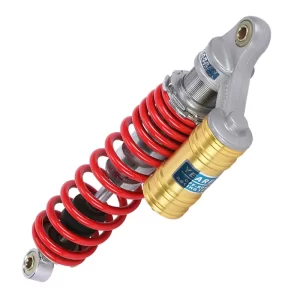
Coil springs compress along a uniform axis and can be wound to provide a linear or progressive spring rate. Off-road, this compact design leaves room for independent suspension links, long control arms, and high articulation without binding. Leaf springs are constructed from stacked steel leaves clamped together at the center. The multi-leaf pack naturally produces a progressive rate and adds inter-leaf friction that acts as a primitive damping force, which helps control axle movement on simple solid-axle setups.
| Property | Coil Spring | Leaf Spring |
|---|---|---|
| Rate type | Linear or progressive (via wire diameter and pitch) | Progressive (via leaf count and thickness) |
| Weight capacity | Requires separate load-bearing design; best for lighter, high-speed applications | Naturally supports heavy, constant loads |
| Axle location | Needs link bars, panhard rod, or control arms | Locates axle fore-aft and laterally by itself |
| Damping reliance | All motion energy must be managed by the shock | Inter-leaf friction absorbs some low-amplitude energy |
This mechanical difference explains why coil spring vehicles demand precise shock valving right out of the gate, while leaf springs can mask minor damping deficiencies at low speeds. At higher speeds, however, the energy stored in leaf packs can overwhelm a basic shock, a point many overlook.
Key Performance Differences: Articulation, Load, and Comfort
On rough trails, suspension articulation is where coil springs separate themselves. A coil-sprung independent suspension can cycle more travel without spring bind, keeping tires on the ground longer. Leaf springs, especially thick multi-leaf packs, resist twist and limit droop on one side when the opposite side compresses. That said, for vehicles carrying constant cargo, like overland trucks, leaf springs distribute weight across the chassis without requiring progressive-rate coilover springs that would need heavy preload adjustment.
Ride comfort is often cited as a coil spring advantage, and that holds true if shock valving is correctly matched. A coil spring stores and releases energy rapidly, so the shock must control both compression and rebound with enough damping force to prevent oscillation. Leaf springs, with their internal friction, dampen small inputs naturally, giving a muted ride at street speeds. Off-road at higher velocities, that friction turns into inconsistent response as leaves stick and slip, sometimes causing axle wrap that alters pinion angle and steering feedback mid-corner.
How Shock Damping Needs Change with Spring Type
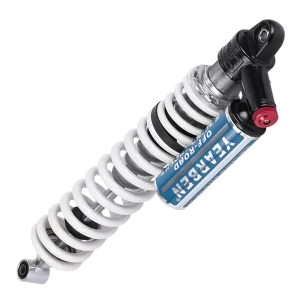
This is where the coil vs leaf spring off-road suspension conversation gets real. Leaf springs have built-in Coulomb damping from inter-leaf friction. That means at low piston speeds, the shock absorber doesn’t need to do as much work. We often valve leaf-spring shocks with a softer low-speed compression setting to let the leaves move freely, then ramp up high-speed damping to catch hard hits. Coil springs have negligible internal friction. Every bit of motion energy goes straight into the shock, so the damper must handle both low-speed body control and high-speed spike absorption with more linear damping curves.
For coilover setups, nitrogen-charged monotube shocks with remote reservoirs become necessary when speeds rise, because the continuous damping work generates heat faster than a twin-tube can dissipate. In our testing at Yearben, a coilover desert buggy running high-rate coils can push oil temperatures past 140°C on a two-minute whoop section; a remote reservoir with sufficient oil volume drops that by 20°C or more. Leaf-spring rigs on the same terrain run cooler, but the shock still needs adequate compression force to control the axle wrap that leaf packs create under torque.
If your off-road build combines leaf springs with high horsepower or you are converting to coils and need a damping curve that matches the new spring rate, it’s worth confirming the shock valving specification before finalizing your BOM. Send your spring data and vehicle weight to info@yearbenshocks.com and we can cross-check the damping profile.
Vehicle Compatibility and Conversion Considerations
Leaf-to-coil conversions are popular on 4×4 trucks and SUVs, but they are not bolt-on swaps. Adding coil springs means fabricating coil buckets, installing link suspension components, and often relocating the fuel tank or exhaust to clear the new control arms. The axle itself may need a panhard bar or a Watts link to stay centered. For vehicles with solid axles, a coilover conversion can dramatically improve articulation and ride, but the fabrication cost and engineering time rise quickly.
On the other hand, many off-road vehicles, from ATVs and UTVs to buggies, come with coilover shocks from the factory. Here, the choice isn’t conversion but replacement. When upgrading, it is critical to match the eyelet dimensions, compressed and extended lengths, and spring preload range exactly. Our catalog of ATV and UTV coilover shocks, for example, includes adjustable preload and damping options designed to drop into popular models without rework.
Get the Right Shock for Your Spring Setup
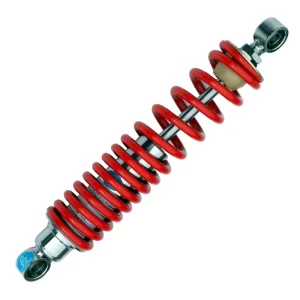
A suspension system is only as capable as its shock absorber. We’ve seen too many desert trucks and rock crawlers fitted with premium coil or leaf springs that still bottom out or fade because the dampers were chosen by price rather than matching the spring’s actual energy profile. The problem shows up as oil cavitation, seal blowout, and inconsistent damping after only a few hard runs.
Yearben builds shocks around the spring parameters you provide: spring rate, motion ratio, unsprung weight, and intended terrain. Each unit is dyno-tested to confirm the damping curve before it leaves the factory. Whether you run a leaf-sprung overland vehicle and need a high-volume twin-tube with durable seals, or a coilover buggy requiring a remote reservoir with external compression adjusters, we can supply the correct configuration. Tell us your vehicle platform and spring setup at info@yearbenshocks.com or call +86-523-86566899 to review your specification.
Common Questions About Coil vs Leaf Spring Off-Road Suspension
Is a coil spring suspension always better for off-road use?
Not always. Coil springs deliver more suspension travel and better compliance at speed, making them the preferred choice for desert racing, rock crawling, and fast trail riding. But for vehicles that carry heavy loads over long distances at moderate pace, leaf springs remain simpler, more durable, and more cost-effective. The real limitation of leaf springs isn’t the spring itself, it’s the lack of a properly tuned shock to control axle wrap at higher speeds.
Can I convert a leaf-sprung truck to coil springs?
It depends on the truck’s frame design and your budget. Most solid-axle trucks can be converted to coil springs with a link suspension kit, but the project requires welding link mounts, fabricating coil towers, and possibly modifying the steering geometry. For earlier-generation 4x4s without factory coil options, the conversion may require custom crossmembers. It is feasible for dedicated off-road builds but usually overkill for a daily driver.
What shock absorber works best with leaf springs for off-road?
A gas-charged monotube shock with adjustable compression damping is ideal for leaf-spring off-road applications. The gas charge prevents oil cavitation under rapid cycling, while compression adjustment lets you tune the shock to control axle wrap without making the ride needlessly harsh over small chop. Standard hydraulic shocks can work for light trail use, but they fade quickly when speeds increase and the leaf pack cycles hard.
Why do coilover shocks need remote reservoirs?
Remote reservoirs aren’t mandatory for every coilover, but they become important when the shock cycles rapidly for extended periods. Hard off-road use converts kinetic energy into heat within the shock oil faster than a smooth body can shed it. As oil temperature rises, viscosity drops and damping force fades. A remote reservoir increases total oil volume and separates the gas charge via a floating piston, helping maintain consistent damping even under race conditions.
How do I know if my shock valving matches my springs?
The most common mismatch we see is a shock with rebound damping set too low for the spring rate. The vehicle feels bouncy after a compression event, as if it’s riding on undamped springs. The opposite problem, too much rebound, causes the suspension to pack down over consecutive bumps. If your ride height and spring rate are correct but the vehicle doesn’t settle quickly after a hit or feels harsh over small chatter, the valving needs attention. Share your spring part numbers and vehicle details with us and we’ll confirm the proper damping configuration.
If you’re interested, check out these related articles:
Truck-Seat-Damper-38MM-Shock-Absorber-Manufacturer
Monotube-Shock-For-Off-Road
Piggyback-2-0-Coilover-Shock
Heavy Equipment Seat Shock Absorber 38mm