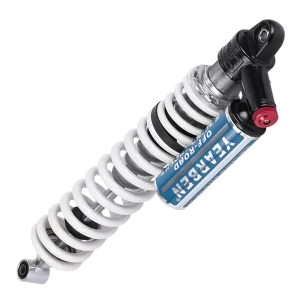
UTV shock absorbers for Polaris RZR and Joyner 800cc are not universal components — the mounting points, travel requirements, and load characteristics differ enough that a generic shock often delivers mediocre performance. In over twenty years of suspension engineering, I’ve observed that the real difference between a shock that transforms handling and one that disappoints isn’t the brand printed on the body; it’s whether the valving, build quality, and spring specifications were engineered for the specific vehicle and its intended use. This article examines the fitment details, damping technologies, and manufacturing quality indicators you should evaluate when upgrading or replacing shocks on these two popular UTV platforms.
What Shock Absorber Specs Fit a Polaris RZR or Joyner 800cc?
Before ordering any shock, you need the extended and compressed lengths, eye-to-eye measurement, and bushing inner diameter. For a Polaris RZR 800, the front shocks typically measure around 17.5 inches extended and 11.5 inches compressed, with a 12 mm bushing. The Joyner 800cc uses a different mounting geometry — often closer to 19 inches extended in the rear and a wider bushing. I’ve seen too many UTV owners purchase shocks based on brand confidence alone and then discover the mounting hardware doesn’t line up. The quickest way to avoid this is to remove one OEM shock and measure its center-to-center length at full droop and full compression, then cross-reference those numbers with the supplier’s spec sheet. Even 5 mm of extra compressed length can cause coil bind or limit arm clearance.
Piggyback vs Remote Reservoir vs Standard Coilover: Which Damping Setup Suits Your Terrain?
The damping architecture you choose affects how heat is managed, how the shock packages on the vehicle, and how much adjustment you have. Here is a quick comparison based on what we see in the factory across hundreds of UTV builds:
| Damping Type | Cooling Efficiency | Weight | Packaging | Best For |
|---|---|---|---|---|
| Standard Emulsion Coilover | Low (foam risk at high speeds) | Lightest | Simple, bolt-on | Recreation, light trail |
| Piggyback Reservoir | Medium (limited airflow) | Moderate | Integrated can | Desert runs, occasional bottoming |
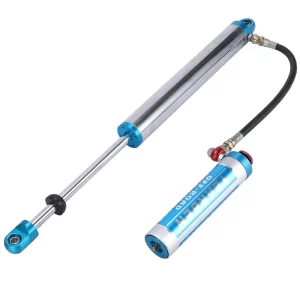
| Remote Reservoir | High (separate body cools fast) | Heavier, plus hose and bracket | Requires remote mount | Racing, long summer rides, high-HP builds |
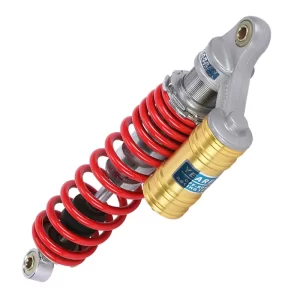
A standard coilover works fine for casual trail riding because the shock never sustains high cycle rates long enough to fade. But if you are running Polaris RZR at speed through sand or rocks, the oil thins quickly and damping drops off — that is when a reservoir starts to matter. The extra volume and nitrogen charge keep the oil cooler and delay fade. Remote reservoirs add another degree of cooling by separating the nitrogen can away from the shock body, but they require a mounting point on the chassis and careful hose routing. In our production, we pressure-test every reservoir hose to double the operating burst pressure before it ships, because a blown line is a race-ender.
How to Identify a High-Quality UTV Shock Absorber from a Cheap Unit
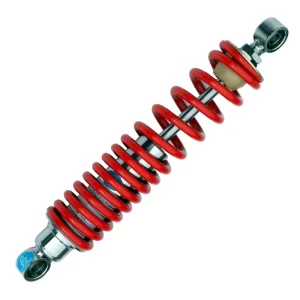
The visual difference between a well-made shock and a marginal one isn’t obvious from a catalog photo, but a few clues separate them.
Chrome rod quality is the first checkpoint. A rod with insufficient chrome thickness or poor surface finish will pit and leak within a riding season. We measure every rod with a profilometer and reject anything below a 10 µm coating. Next, look at the seal head. PTFE seals handle heat far better than standard rubber compounds, and they don’t swell when the fluid thins. In our assembly line, seal installation is followed by a nitrogen pressure hold test for at least four hours — a shock that can’t hold pressure after four hours will be down on damping the first time it’s pushed hard.
Weld consistency on the mounting eyes matters more than it first appears. A cold weld or undercut can crack under repeated impact, especially on a heavy Joyner 800cc with a full cage. We inspect every eyelet with a dye penetrant before it goes to final assembly. Finally, dyno testing matters. I’ve seen shocks that look identical on the outside but produce damping forces 15 percent apart because the piston bleed was mismatched. A factory that can supply a dyno plot along with the shock is a factory that controls its valving, not just its machining.
Factory Direct vs Brand-Name Sourcing: Which Delivers Better UTV Shocks?
When you buy a shock with a well-known brand, you pay for marketing, distribution layers, and a dealer margin. When you source from a factory with engineering capability, you pay for materials, machining, and assembly — and you can influence the specification directly. That doesn’t mean every factory is equal. A serious OEM will have its own test equipment, documented quality logs, and a willingness to share batch data. We regularly ship UTV shocks to customers who started with a consumer brand but needed a specific extended length or a stiffer valving curve that the catalog didn’t offer.
If your application involves a modified suspension arm or a fully built cage, a standard-length shock won’t perform correctly — and stretching a short shock to fit damages the top-out washer. In those situations, going factory-direct lets you spec a custom eye-to-eye and travel stroke without paying for a third-party rebuild. Send your measured dimensions and terrain description to info@yearbenshocks.com and we can confirm whether an existing production shock matches or if a custom build is necessary.
How to Choose Spring Rates and Custom Valving for Your Driving Style
Spring rate selection ties directly to the corner weight of your UTV and the speed you carry into the rough stuff. A Polaris RZR 800 with a passenger, roof, and gear may put 400 pounds on a front corner. That requires a primary spring rate in the 250–300 lb/in range. The Joyner 800cc, with its wider stance, often benefits from a dual-rate spring setup — a softer tender spring for small chatter and a firmer main spring for hard landings.
Valving is the second half of the equation. Compression damping needs to ramp up quickly to resist bottoming, but not so quickly that the shock feels harsh on small rocks. Rebound damping must return the wheel to the ground without kicking the chassis upward — too fast and the vehicle feels bouncy, too slow and the suspension packs down over repeated hits. We build compression and rebound shim stacks tuned to the customer’s weight and terrain, and we test each variant on a dyno to verify that the force-velocity curve matches the design target. If you are unsure which setup to run, share a video of your riding style — even a phone clip gives us enough context to start the tune.
What Installation and Maintenance Practices Extend Shock Absorber Life?
Torque the mounting bolts to the manufacturer’s spec; overtightening can deform the bushing and restrict free movement. Check nitrogen pressure every 30 running hours. A drop of 50 psi is enough to cause cavitation and sudden damping loss on high-speed compression hits. Wipe the shafts after every ride with a clean cloth and inspect for nicks. Even a small scratch can tear the seal lip and start a slow leak that doesn’t appear until the shock is hot. If you ride in salt or deep mud, flush the spring perches and threads with fresh water after cleaning; rust on the perch threads will seize the adjuster rings over time.
Upgrading UTV shocks should be a precise engineering decision, not a guessing game. The right shock for your Polaris RZR or Joyner 800cc is the one built with correct dimensions, a valving curve matched to your weight and speed, and manufacturing processes that catch defects before the shock is mounted. At Taizhou Yearben Shock Absorber Technology, we manufacture coilover and reservoir shocks engineered for specific UTV platforms, with dyno testing and batch traceability as standard practice. If you need shocks that fit your machine and perform as designed from the first ride, send your shock length and riding style to info@yearbenshocks.com or call +86-523-86566899, and we will help you work out a configuration that holds up.
Common Questions When Sourcing UTV Shock Absorbers
Can I run a shock designed for a Polaris RZR on a Joyner 800cc?
In most cases, no. The Joyner 800cc uses a different mounting eyelet width and often a longer stroke, so a shock built for a Polaris RZR will either bind at the mounting points or limit suspension travel. Even if the length seems close, the valving will be off because the Joyner is heavier and carries its weight differently in the rear. The safer approach is to measure both ends and have the shock assembled to those exact dimensions. If you already have a set of RZR shocks and want to know if they can be serviced to fit, send us the current extended and compressed lengths — we can evaluate whether a re-valve and eyelet change is feasible.
How often should I rebuild my UTV shock absorbers?
With average trail use and clean shafts, a rebuild interval of 800–1,200 miles is realistic. The seal and bushing wear are gradual; you will notice the ride getting harsh before a full failure. Heavy racing or sand use cuts that interval in half because fine dust embeds in the seal lip and wears the rod. During a rebuild, we replace the seal pack, bushings, and nitrogen charge, and we run the shock back on the dyno to verify the damping curve hasn’t drifted from the original build sheet. That consistent post-rebuild check is something a casual service shop rarely performs.
Are adjustable damping knobs worth it for recreational trail riding?
For most recreational riders who travel at moderate speeds over varied terrain, a fixed-valve shock tuned to the vehicle weight works well enough. The adjustment becomes useful when the same machine does double duty — slow rock crawling one weekend and fast open trails the next. High-speed compression adjustment, in particular, lets you soften the hit without losing the bottom-out resistance that a stiffer spring provides. If you ride in that mixed-use category, a dual-speed adjustment is a better investment than swapping springs between seasons.
What makes a factory-built custom shock different from a re-valved off-the-shelf shock?
A factory-built custom shock starts with the correct body length and travel stroke for your vehicle, then layers on valving and spring rate exactly as specified. An off-the-shelf shock that is re-valved later still carries the original damper length and canister fit, which often limits how much the tune can be shifted. At our facility, we assemble the shock with the correct shim stack, spring rate, and gas pressure from the start, then dyno-test it as a complete unit. That process eliminates the performance compromises that come from adjusting a shock that was originally designed for an average platform, not your specific UTV. If you are planning a build and want to ensure the dampers match from day one, send your corner weights and intended tire size to info@yearbenshocks.com — we will specify the configuration and provide dyno plots before shipping.
If you’re interested, check out these related articles: