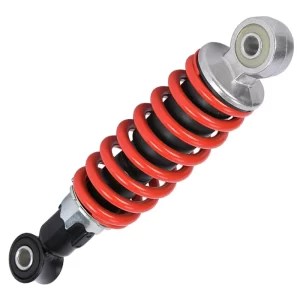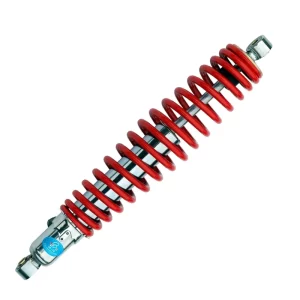
When we at Yearben sit down to design an off-road shock, we start from a different set of requirements than we would for a street shock. The goal is not just a stiffer spring or a longer shaft. Off-road shocks are built around aggressive valving, robust piston construction, and sealing that holds up under repeated high-speed impacts and prolonged washboard vibrations—conditions a street shock never sees. Choosing the right shock means understanding these internal differences, not just comparing price tags. Here is how an off-road shock really differs from a street shock.
Design Goals Differ for On-Road Comfort Versus Off-Road Durability
A street shock absorber prioritizes ride plushness and noise isolation. Its damping curve is typically linear, and spring rates stay moderate to keep the chassis composed on uneven pavement without transmitting harshness to the cabin. An off-road shock has a fundamentally different mission. It must control the unsprung mass during high-velocity events—landing from a jump, hitting a rock ledge at speed, or running miles of washboard—without fading or bottoming out.
To do that, the spring rate increases, and the damping profile becomes more progressive or even digressive. The shock must build force quickly at low shaft speeds to resist body roll, then blow off pressure at high speeds to prevent harsh topping or skeletal loads on the chassis. A street shock never faces that kind of speed range in a single run.
Valving and Piston Construction Are Engineered Differently
The most consequential differences live inside the shock body. Street shock valving relies on thin, tightly stacked shims and fixed orifices to deliver a smooth, predictable feel at low-to-moderate shaft velocities. Off‑road valving uses thicker shims and multi‑stage piston ports engineered to pass a much larger volume of oil during sudden, high‑velocity strokes. Many off‑road pistons are machined from steel rather than lightweight aluminum. Steel holds its flatness under cyclic pressure spikes that would deform an aluminum piston over a few hundred hard miles.
At Yearben, we validate valve stack tuning on a proprietary crank-driven dyno that cycles from 0.05 to 1.5 meters per second. The dyno data lets us map compression and rebound forces across the speed range the shock will actually see on the trail. That level of upfront testing separates a serious off-road shock from a catalog unit with a generic tune.
| Specification | Street Shock | Off-Road Shock |
|---|---|---|
| Valve stack | Thin linear shims | Thick progressive/digressive shims |
| Piston material | Sintered or cast aluminum | Forged or CNC-machined steel |
| Piston port area | Smaller, low-flow | Larger, high-volume |
| Oil volume | Minimal for weight savings | Maximized for cooling |
| Rod diameter | 11–12 mm | 14–16 mm |
| Seal design | Single lip, nitrile | Double lip + wiper, PTFE/Viton |
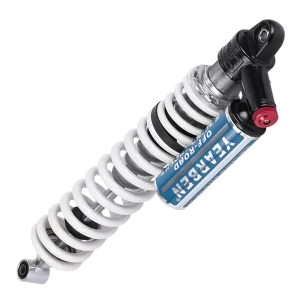
A monotube shock for off-road also separates the oil and gas chambers with a floating piston, which prevents aeration even when the shock is cycled rapidly. Street shocks often remain twin-tube, trading some fade resistance for lower manufacturing cost.
Structural Durability: Rods, Seals, and Mounting Strengthened for Off-Road
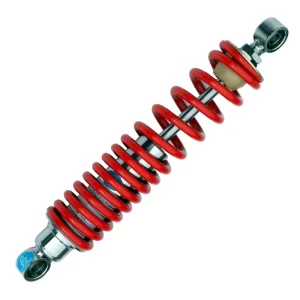
Road shocks rarely see side loads beyond minor cornering forces. An off‑road shock must survive severe articulation angles, bending moments, and impact striations from kicked-up rocks. That starts with the piston rod. Off‑road units use induction‑hardened or chrome‑plated rods at least 14 mm in diameter; street rods are thinner and carry a lower Rockwell hardness on the surface.
Seal heads in an off‑road shock include a primary pressure seal, a secondary dust wiper, and often a scraper ring to prevent grit migration. We specify a PTFE-backed Viton compound for thermal stability past 200 °C, which is common during a hard desert run. Mounting eyes get spherical bearings with a PTFE liner to handle misalignment without binding.
If you are building a vehicle that splits time between pavement and trail, confirming rod strength and seal materials for your exact vehicle weight and travel is worth doing before finalizing the BOM. Reach out at info@yearbenshocks.com if your application pushes beyond standard catalog ratings.
Reservoir Systems Manage Heat and Oil Volume in Off-Road Shocks
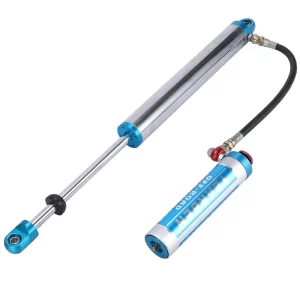
Heat kills damping. As oil shears through the piston repeatedly, temperature climbs and viscosity drops, eroding the damping force exactly when you need it most. A remote or piggyback reservoir addresses this by adding roughly 30–50 % more oil volume and moving the gas charge out of the working shock body. The result is cooler running and consistent fade resistance across long off-road stages.
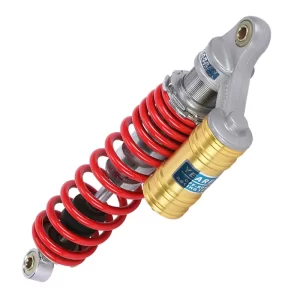
A piggyback 2.0 coilover shock packages the reservoir directly on the shock body, which saves space in tight wheel wells. A remote reservoir shock routes oil through a high‑pressure hose to a separate canister, which can be mounted on the frame for improved airflow and easier tuning access. For racing applications that demand independent control of multiple damping zones, a triple bypass shock adds external adjusters that let the driver fine‑tune compression and rebound without disassembling the unit.
Balancing Ride Quality and Durability in Mixed-Use Applications
No single shock does everything well. A coilover valved for rock crawling will feel harsh on the highway; a plush street‑oriented damper will fade and bottom out within minutes on a rutted fire road. For mixed‑use rigs that see both daily driving and weekend trails, an adjustable shock absorber offers the best compromise. A simple clicker detent or a dual‑speed compression adjuster lets the driver soften the damping for pavement and firm it up for dirt, within a predefined range.
We often steer customers toward a bypass or reservoir design with external rebound adjustment when the vehicle sees more than 50% off‑road duty. The extra oil volume and adjustment range give the shock a wider operating window. If the vehicle is built primarily for high‑speed desert work, we default to a 2.5‑inch‑body off‑road coilover shock with a remote reservoir and digressive valving to handle repeated square‑edge hits without fade.
Ready to Spec Your Off-Road Shocks?
Catalog numbers rarely capture the full picture. Vehicle weight, motion ratio, target shaft speed, and packaging constraints all influence the final shock spec. We see programs where off‑the‑shelf lengths and valving cause premature seal failure or inconsistent damping within the first season. The shock ends up getting blamed, but the real issue is a mismatch between the catalog tune and how the vehicle is actually used.
We can develop a custom valving profile based on your corner weights and expected travel, share dyno plots before production, and supply a pre‑production sample for on‑vehicle validation. Our facility runs over 200 shock models and ships 1.5 million units a year to global ATV, UTV, and 4×4 brands, so everything from material sourcing to final nitrogen charge is handled under a single quality system.
For a specific quote with your travel, spring rate, and reservoir configuration, send your part number or drawing to info@yearbenshocks.com or call +86-523-86566899. We can provide lead time and MOQ within a business day.
Common Questions About Off-Road and Street Shocks
Can I just install a stiffer spring to convert a street shock for off-road use?
Stiffening the spring changes the ride frequency but does nothing to the damping characteristics. The valving inside a street shock is not designed to manage the high flow rates that a stiff spring generates on rebound. You will end up with an under‑damped, pogo‑stick ride that quickly overheats the oil. The shock body itself may also lack the structural reinforcement needed for off‑road loads, leading to bent rods or blown seals long before the spring becomes the limiting factor.
Do I need a reservoir if I only drive fire roads and light trails?
Fire roads and washboard sections still build heat through continuous low‑amplitude cycling. A reservoir is not always mandatory for light use, but if your routes include sustained bumpy terrain at anything above crawling speed, the additional oil volume and gas separation will noticeably extend fade resistance. In programs we have supported, even moderate‑speed fire‑road testing showed a 15–20 °C lower peak oil temperature with a piggyback reservoir compared to the same shock in emulsion form.
Are off-road shocks too stiff for daily driving?
Yes, in many cases. A shock with aggressive compression valving transmits more of the road surface into the cabin and can make the steering feel nervous on rutted pavement. The trade‑off is unavoidable; the question is where you want the compromise. If the vehicle sees daily pavement but also weekend trails, a multi‑adjustable shock lets you dial the damping back for street use while retaining the structural durability of an off‑road unit.
How do I know if a shock is truly built for off‑road, and not just marketed that way?
Look for the spec sheet, not the sidewall graphics. Ask the supplier for piston material, rod diameter, seal temperature rating, and a dyno graph showing force‑velocity curves at multiple stroke speeds. A legitimate off‑road shock will carry a steel piston, a rod of at least 14 mm, Viton or PTFE seal specifications, and a dyno plot that shows consistent damping force up to at least 1.0 m/s without hysteresis. If you are evaluating multiple sources, share your target vehicle weight and travel with our team and we can walk you through what our dyno data looks like for a comparable application.
If you’re interested, check out these related articles:
Off-Road-Coil-Over-Shocks-Manufacturer
Triple-Bypass-Remote-Reservoir-Shock