Sourcing a front shock absorber that meets your vehicle’s performance requirements involves more than matching length and eyelet diameters. Consistent damping curves, validated fatigue life, and the supplier’s ability to replicate those results across production batches are what separate a catalog part from an OEM-grade unit. Over twenty years of developing shocks for ATVs, UTVs, buggies, and seat systems has shown me that the most common procurement failures happen when buyers focus solely on price and published dimensions without interrogating how the supplier certifies performance. This guide covers the specifications that matter, how to evaluate a shock absorber factory’s capabilities, and the steps that turn a sample into a reliable supply stream.
What Specifications Define a Front Shock Absorber
Every procurement conversation begins with the data sheet. For a front shock, the fundamental numbers are extended length, compressed length, and stroke. These determine fitment, but they do not describe how the shock behaves under load. The damping force at a given piston speed is what controls pitch, dive, and impact harshness on the front axle. Instead of accepting a supplier’s generic “rebound firm” description, request a force-velocity graph recorded on a shock dynamometer at three or more velocities, typically 0.1, 0.3, and 0.52 m/s. The trace should be smooth, with no sudden inflection points that indicate valving stack instability. A factory that cannot produce this data for a sample you hold is guessing.
How Are Compression and Rebound Damping Measured
A dyno graph splits damping into compression and rebound quadrants. For front applications, the compression side dictates how the wheel moves upward after a bump, while rebound controls how quickly the spring pushes the shock back to ride height. Too much high-speed compression and the tire loses contact on washboard terrain; too little rebound and the front end floats after a whoop section. Ask for graphs produced on the specific shock you receive as a pre-production sample, not a “representative” curve from a batch file. I have seen suppliers deliver samples that dyno within 3% of the requested curve, only to find production units 15% away because the valving stack was hand-tuned for the sample. The dyno must become a production-line checkpoint, not just a development tool.
What Travel and Mounting Options Are Standard
Extended and compressed lengths define the shock’s operating window. For off-road vehicles with long-travel suspension, you may need upwards of 200 mm stroke, while a utility ATV might operate in the 100–140 mm range. Mounting hardware is equally critical: eyelet inner diameters must match your bolt size, and bushing material selection (rubber, polyurethane, spherical bearing) changes NVH and steering feel. A stem mount versus eyelet mount configuration can restrict installation options if the chassis demands a specific type. Confirm the shock body and spring perch do not interfere with suspension links at full compression. A simple CAD clearance check during the design review avoids tooling changes later.
How to Evaluate a Shock Absorber OEM Supplier
Beyond the spec sheet, the supplier’s internal processes determine whether you receive 200 identical shocks or 200 shocks with a performance spread wide enough to affect handling. Begin by asking for a factory tour or a detailed audit report. The areas that matter most are the welding station, the nitrogen charging and sealing area, and the dynamometer test bay. A supplier that welds shock eyes with inconsistent penetration will have units that leak or crack at the body-to-endcap weld. I have rejected entire shipment lots after discovering that the factory’s welding jig allowed angular misalignment of 0.5°, which caused seal side-loading and friction spikes.
What Factory Certifications and In-House Testing Matter
ISO 9001 is a baseline. For shocks used in higher-stress applications, look for evidence of in-house tensile testing of welds, salt-spray exposure testing for surface coatings, and cyclic durability rigs that run shocks through thousands of cycles while monitoring gas pressure decay. A supplier that outsources fatigue testing loses the feedback loop needed to improve design. Ask how many cycles constitute a full durability test and request a sample fatigue report. In our own facility, each new damper design undergoes a 1-million-cycle endurance run before it is released for mass production, and we sample test off the line every four hours.
How to Read a Shock Dyno Graph from a Supplier
A dyno sheet should show multiple runs at different adjustment settings if the shock offers clicker adjustments. Overlay the curves and check for repeatability: the spread between runs should be under 5% of peak force. If the graph shows hysteresis (force differs significantly between the compression and rebound stroke at the same velocity), that can indicate excessive seal friction or nitrogen pressure loss during the run. Smooth, repeatable curves are the fingerprint of controlled valving and consistent assembly; erratic traces are an early warning of production variability.
Testing and Validation: What to Ask Before Ordering
Before committing to a production order, request a pre-production sample that is built on the same line and by the same operators who will build your order. The sample cycle should include static dimension inspection, a full dyno map, nitrogen pressure verification, and a leak-down test. For front shocks that will see high lateral loads on off-camber terrain, ask for a side-load fixture test that simulates bending moments on the shaft. A shaft that passes a straight axial dyno test may still bend under real-world cornering loads if the guide bushing is too short or the rod diameter is undersized.
A point that frequently gets lost in sourcing discussions: the dyno report you receive with the pre-production sample must be traceable to a specific serial number, and that same serial-numbered unit should be shipped to you. If the supplier ships a different unit “by mistake,” it often means the dyno’d unit was prepared with extra care not replicated in normal production. Insist on documentation that links the test report, the serial number, and the physical sample in your hands.
Customization and OEM Design: Matching Your Application
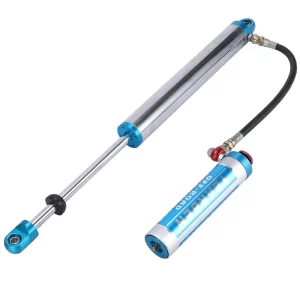
Custom shock development moves beyond catalog parts when your vehicle has a specific sprung weight, motion ratio, or packaging constraint. Provide the supplier with your vehicle’s corner weight with rider and fuel, the suspension motion ratio, and the desired wheel travel. From these inputs, the engineering team calculates the target spring rate and damping forces. At Yearben, we typically model the front suspension kinematics and then iterate through three to five valving configurations during the sample stage until the dyno curve aligns with the target envelope. That process uncovers whether a single-rate or dual-rate spring platform is needed, and whether a piggyback reservoir is required for additional oil volume to manage heat.
If your program involves vehicles that will operate in extreme cold, the shock fluid viscosity at low temperature becomes a critical parameter. Standard mineral oil can thicken below -20°C and cause harsh damping. We have developed low-viscosity-index fluids for customers in northern markets, which maintains damping consistency across a wider temperature window. Communicating the operating environment early avoids field complaints that surface months after delivery.
Managing MOQ, Lead Time, and Batch Consistency
Minimum order quantities fluctuate with the level of customization. A fully custom shock body with a unique piston and valving stack may require 200–300 units to amortize setup costs, while a standard coilover with an adjusted spring rate might be feasible at 50 units. Lead time also stretches when specialty coatings, such as e-coat or anodizing with specific color matching, are specified. Plan for 60–90 days from drawing approval to production release for a new front shock design. Batch consistency is validated through a control plan that includes in-process dyno sampling: for example, one shock pulled for testing out of every 100 produced. Ask the supplier to include conformance certificates with each shipment that record the actual test values against the agreed limits. This creates traceability and protects you if a later quality dispute arises.
If you need to manage multiple vehicle platforms under one supply agreement, it is worth confirming whether the factory can run separate production cells for each part number. Mixing assembly lines for different products often leads to component mix-ups unless the workflow is segregated. At our plant, dedicated tooling and color-coded part bins reduce that risk.
Common Questions About Front Shock Absorber OEM Sourcing
What is the typical lead time for a custom front shock absorber order?
For a new design, the timeline from drawing approval to first shipment usually spans 8–12 weeks. This includes tooling preparation, initial sample build, internal dyno validation, and surface treatment. Repeat orders with no engineering changes ship in 4–6 weeks. Rush schedules can compress this, but sacrificing the heat treatment or plating quality to save time often shows up as premature corrosion or spring fatigue later. Share your timeline and we will confirm which processes can safely overlap.
How can I verify shock absorber quality without visiting the factory?
Request a third-party inspection report for the dimensional checks, weld integrity, and surface finish on the first production lot. Simultaneously, ask the factory to ship one randomly selected unit from that lot to an independent dynamometer lab of your choice. The dyno trace should fall within 5–7% of the approved pre-production sample across all tested velocities. If the supplier hesitates to ship for third-party dyno testing, it is usually because they know their production spread is wider than advertised. If your project timeline is tight, we can arrange a live video walkthrough of the test bay with the serial-numbered unit.
Can low MOQs still deliver consistent performance?
Fifty-unit runs for a modified standard shock can maintain consistency if the factory uses production-line jigs and the same operator team that runs larger batches. The main challenge with small quantities is that component suppliers often ship a wider tolerance spread when order volumes drop. In those cases, we tighten incoming inspection on seals, piston bands, and shim stacks and discard any components outside the top quarter of the allowed tolerance band. The added inspection cost is trivial compared to a field return. Send your part number and quantity targets and we can confirm whether a low-MOQ path fits your specification without sacrificing batch control.
How do I protect my custom shock design from being sold to someone else?
Exclusivity starts with a written agreement that treats your shock’s valving specification, spring rate, and dimensional pack as proprietary data. The factory should maintain separate part-number repositories and restrict access within the engineering team. At Yearben, customer-specific designs are filed under blind codes that do not reference the original vehicle model, and we do not offer identical damping curves to competing brands without explicit authorization. Before signing, verify that the supplier does not list units identical to yours on open B2B platforms under a generic description. If you would like to discuss a non-disclosure agreement covering your damping data and packaging envelope, send an email to info@yearbenshocks.com and we will walk you through our confidentiality framework.
For a front shock absorber sourcing decision, the durability and consistency of the shock under real-world conditions matter more than any catalog rating. We supply OEM customers across ATV, UTV, and off-road segments with front coilovers and dampers that are dyno-tested, serial-number-tracked, and backed by a documented batch control plan. Send your front shock requirements—extended/compressed lengths, target spring rate, and vehicle corner weight—to info@yearbenshocks.com or call +86-523-86566899, and we will prepare a technical proposal with a pre-production sample timeline.
If you’re interested, check out these related articles:
Triple-Bypass-Shock-For-Off-Road
Ride-on Mower Shock Absorbers 38mm, Shock Absorber Manufacturer
Hydraulic-Steering-Damper