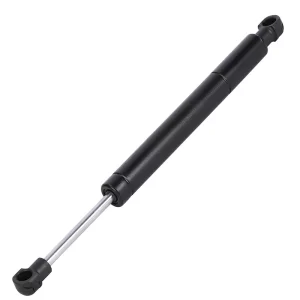
Most aftermarket dampers built for gas-engine buggies and UTVs were never designed to handle the mass and torque delivery of a 500 kg battery-electric drivetrain. As more NEV platforms enter off-road competition and commercial work, the damping envelope shifts in ways that require deliberate specification changes, not just stiffer springs. I have spent twenty years developing shock absorbers across ATV, UTV, and light vehicle programs, and the electric off-road segment is the first category I have seen where copying existing internal combustion engine (ICE) valving leads to damper failure within the first test session.
Why NEV Off-Road Puts Different Loads on Suspension Dampers
An electric off-road vehicle carries its battery pack low in the chassis. The center of gravity drops, which helps stability, but the total mass on the axles often increases by 15 to 30 percent over a comparable ICE buggy. More mass means the damper must control larger inertia during compression and rebound, and it does so while the vehicle delivers peak torque from zero rpm. A gas engine builds torque across a curve; an electric motor hits full twist at the first throttle input. This instant torque spike compresses the suspension faster than a conventional valving stack can react, creating a harsh initial stroke that drivers feel as judder through the chassis.
We have seen this directly when adapting our 2.0-inch piggyback coilover platform for an 800 cc electric UTV prototype. The original compression shim stack, developed for 110 hp turbocharged gas UTVs, opened too late to manage the electric motor’s 0–30 km/h burst. The fix required a softer low-speed bleed combined with a stiffer high-speed crossover to catch the rapid compression without choking small-chatter compliance. This is a typical NEV damper spec shift: the velocity range the shim stack must cover widens at the low end and intensifies at the high end.
Damping Force and Thermal Management: What Changes for NEV Dampers
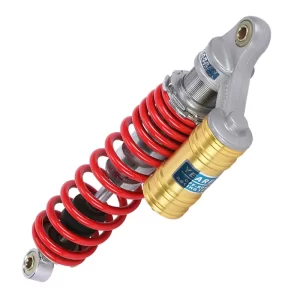
Sustained high torque generates sustained suspension movement. In dune running or rock crawling, an electric drivetrain can maintain wheel slip control that keeps the suspension cycling at frequencies a gas vehicle only sees in whoop sections. This constant stroking drives oil temperature up. Monotube damper bodies with remote reservoirs handle heat better than emulsion twin-tubes, but for NEV applications we have started specifying higher-viscosity-index shock oil as a baseline, not an option. The oil must resist viscosity breakdown above 120°C without thickening at cold startup below zero.
We also moved away from generic nitrile seals toward hydrogenated nitrile (HNBR) across the entire NEV damper range. The combination of higher peak rod speeds and elevated operating temperatures accelerates seal lip wear. When I reviewed teardowns of our first electric UTV prototype dampers after 40 hours of mixed desert use, the shaft seals showed micro-cracking that our ATV dampers do not exhibit until 150 hours. Changing seal compound alone bought us a 2× TBO (time between overhauls) without altering any mechanical dimension.
Another spec change I recommend on NEV off-road builds is the nitrogen charge pressure. We commonly pressurised gas-emulsion and remote-reservoir dampers at 150 psi for ICE off-road applications. For heavy electric platforms, increasing the static charge to 180–200 psi delays cavitation during the high-frequency cycling I described, protecting the piston band and inner tube surface.
![table] A comparison of typical ICE off-road damper specs versus NEV-specific damper specs for a 2.0-inch coilover platform.
| Parameter | ICE Off-Road (2.0 Coilover) | NEV Off-Road (2.0 Coilover) |
|---|---|---|
| Vehicle mass (axle load) | 350–400 kg front | 450–550 kg front |
| Compression damping (high-speed) | Linear shim stack, single stage | Two-stage crossover stack, digressive high-speed |
| Rebound damping | 80% of compression force | 90–100% of compression force (to control heavy unsprung mass) |
| Shock oil viscosity index | 150–180 standard | 200+ high-VI synthetic blend |
| Seal material | Nitrile (NBR) | Hydrogenated nitrile (HNBR) |
| Gas charge (remote reservoir) | 150 psi | 180–200 psi |
| Spring rate (primary) | 250–350 lbs/in | 350–500 lbs/in depending on unsprung weight |
Spring Rate and Preload Adjustments for Electric Off-Road Vehicles
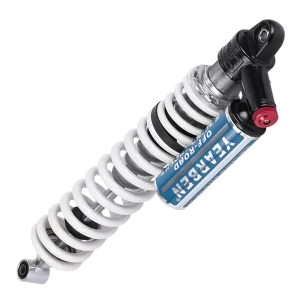
Heavier vehicle mass does not automatically call for a linear spring rate hike. The battery mass is fixed, not live load, so much of the weight is sprung. In practice we see the best results with a progressive dual-rate spring setup: a softer initial coil that absorbs small chatter, transitioning to a stiffer second rate that supports the chassis through large g-outs and landings. The crossover ring position becomes a tuning parameter that matters more on a heavy NEV than on a gas UTV because the transition point determines whether the damper blows through travel during the instant torque spike or holds ride height.
On the electric UTV I mentioned earlier, we settled on a 350/500 lb/in dual-rate front spring with the crossover ring set 3 inches from the top-out position. The 500-pound secondary rate engaged just as the suspension passed 50 percent travel under the torque load, preventing bottom-out without making the initial stroke harsh. This is a spec I would not have chosen for a gas UTV of similar wheelbase because the weight transfer dynamics are fundamentally different.
For OEM programs that require a single-rate spring for cost or packaging reasons, we compensate with a longer progressive bump stop, but this is a compromise. It reduces usable travel by 5–8 mm and introduces a nonlinear force spike at the end of compression that the damper valving cannot mask.
Sealing and Dust Protection for NEV Suspension Dampers
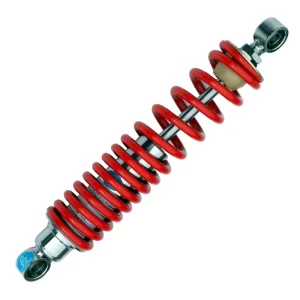
Off-road NEVs expose dampers to the same silt, water, and mud as any desert rig, but the duty cycle often includes longer continuous running because the vehicle does not need to stop for fuel. The additional runtime means dust wipers and shaft seals accumulate more particulate load per outing. I require a dual-lip scraper seal on every NEV damper shaft, regardless of whether the customer orders a piggyback or remote-reservoir layout. The outer lip is a polyurethane wiper with a dust boot interface; the inner lip is a PTFE-lined seal that rides the chrome-plated shaft with minimal stiction.
Chrome plating thickness on the damper shaft also increases. Our standard ATV shafts use 20–25 µm of hard chrome. For NEV applications I specify 30 µm minimum, ground to a surface roughness Ra below 0.05 µm. The thicker chrome layer resists pitting from micro-debris that gets past the wiper during multi-hour desert runs, and the finer surface finish protects the seal lip at the higher shaft speeds typical of electric off-road cycles.
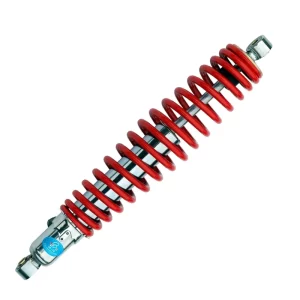
OEM Integration: Specifying NEV Dampers for Production
When an NEV manufacturer approaches us for a damper program, the conversation starts earlier than a typical ATV or UTV inquiry. Most electric vehicle engineers have motor and battery expertise but limited suspension dynamics background. The first data I request is not a damper drawing, it is the corner weight distribution, unsprung mass per wheel, and the motor torque curve across the speed range. From those three inputs I can derive the damping force envelope the vehicle actually needs, which rarely matches what a catalog gas-vehicle damper provides.
We then build a dyno-mapped prototype and have the customer run it on their mule vehicle with data logging. If the vehicle uses regenerative braking, we log damper position during regen events because the weight transfer direction reverses the shock stroke trajectory. This is a variable that gas off-road dampers simply never see, and ignoring it produces a damper that feels fine under acceleration but jacks the chassis during deceleration.
Custom valving, spring kits, and hose lengths for remote reservoirs are all routine at our factory. We keep an annual capacity of 1.5 million units, but the value for an NEV OEM is in the engineering turnaround time, not just volume. Sending your corner weights and torque data starts the process faster than sending a dimensional drawing.
Common Questions About NEV Off-Road Shock Specs
Will standard off-the-shelf UTV coilovers survive on an electric buggy?
They can physically bolt on if the eyelet sizes match, but the valving, spring rate, and seal compound will be wrong. The heavier mass wears the seals faster and the instant torque can cause hydraulic lock if the compression shim stack is not tuned for the rapid initial stroke. I recommend building a valving stack specific to the EV’s torque curve from the start.
Is a remote reservoir always necessary for NEV off-road dampers?
Not always for low-speed rock crawling, but for any desert or dune application where sustained high shaft speeds heat the oil, a remote reservoir is the single most effective upgrade. It increases oil volume by 30–50 percent and provides a large cooling surface. On a heavy NEV, the extra oil capacity also delays viscosity breakdown, which directly protects internal bushings and seals.
How does regenerative braking affect damper tuning?
Regen braking shifts weight forward more abruptly than friction braking because it applies deceleration torque through the drivetrain rather than through brake calipers. The front dampers compress faster during a regen event than during a brake-pedal stop. I typically add a digressive rebound curve on the front dampers to prevent the suspension from extending too slowly and causing a rocking sensation. It is a subtle change but the vehicle feels more planted during deceleration.
What is the right nitrogen charge for an electric off-road vehicle?
I set 180–200 psi for remote-reservoir dampers on NEV applications compared to the 150 psi we use for gas vehicles. The higher charge pressure prevents oil foaming under the rapid, repetitive stroking that electric drivetrains produce. If you hear a chattering noise from the damper during high-frequency use, low nitrogen pressure is the first thing I check.
Does a heavier NEV need a thicker damper shaft?
Yes, in most programs we move from a 14 mm shaft to a 16 mm or even 18 mm shaft for coilover dampers on electric off-road vehicles weighing above 1,800 kg. The thicker shaft resists bending moments generated by the heavier unsprung mass and provides a larger bearing surface for the guide bushing, extending seal life. I also recommend a hard chrome ground finish of 25–30 µm thickness, which gives the seal a consistent mating surface even after thousands of cycles.
If your electric off-road program has torque data and corner weights ready, we can map the damper specs you need before the prototype rolls. Send your part numbers or vehicle specs to info@yearbenshocks.com or call us at +86-523-86566899 and we will confirm availability and custom engineering options.
If you’re interested, check out these related articles:
Customized Steering Dampers 24mm
Off-Road-Coil-Over-Shocks-Manufacturer
Hydraulic-Seat-Damper-Cylinder-Diameter-24MM
Lawn mower steering damper 18mm
Best-Shocks-And-Springs-For-Trucks