Shock absorber piston design affects damping through three mechanisms most shock conversations skip: orifice area, shim stack stiffness, and tolerance control at the piston face. When an ATV customer reports soft low-speed wallow that turns harsh over sharp bumps, I start at the piston. It is not as visible as a spring, but it shapes the damping curve more directly. A minor change in port geometry or shim preload can shift ride quality more than a spring rate adjustment. That is why the piston deserves attention before the vehicle gets a new spring package.
The Piston Face and How Damping Force Originates
Damping force does not originate in the oil. It originates in the pressure difference created across the piston. A shock piston is an obstruction in a pressurized oil column. As the rod moves, oil must pass through the piston ports. The smaller the effective flow area and the stiffer the deflection path, the more pressure builds before the piston can move oil. In monotube and remote reservoir shocks, this pressure difference is the damping force. In emulsion shocks and twin-tube designs the same logic applies, but gas charge and compression of dissolved gas change the feel.
The first point I check is whether the piston is piston limited or shim limited. A fine drilled piston with a thick shim stack is piston limited at low speed. A large port piston with soft shims is shim limited. Both can produce the same peak force on a dyno, but they do not ride the same off road. The piston limited layout builds force early and holds it. The shim limited layout is soft early and rises late. For an ATV crossing whoops, that difference determines bottoming control.
Piston Orifice Area and Low Speed Damping Behavior
Low speed damping is mostly controlled by the fixed orifice in the piston. When rod speed is below roughly 0.05 m/s, the shim stack has barely lifted. Oil takes the path of least resistance through the small bleed passages. Close that passage from 2.0 mm to 1.6 mm and the knee in the damping curve rises. The shock feels firmer in the first part of the stroke. Open it too far and the shock becomes digressive, which suits a steering damper more than a coilover. Fixed orifice selection is the part of shock absorber piston design that most tuners change first.
Piston port area changes the relationship between early force and high speed blow-off. The table below is the rough pattern I use when reviewing a custom shock absorber specification.
| Piston port area | Low speed feel | High speed behavior | Common use |
| Small bleed passages | Firm, controlled | Oil may cavitate earlier | Utility ATV, commercial mower |
| Medium ports | Balanced knee | Progressive with correct shims | Trail and dune UTV |
| Large ports | Softer initial | Shim stack does more work | Desert racing, remote reservoir |
Shim Stack Tuning and the Mid Speed Damping Curve
Once the piston ports are fixed, the shim stack shapes mid speed and high speed behavior. A shim is not a simple check valve. It is a spring whose preload, diameter, thickness, and count determine when the piston begins to blow off pressure. A 0.15 mm shim deflects more than a 0.20 mm shim at the same force. A two-stage stack with a small first-stage shim and a larger second-stage shim opens early, hits a transition, then opens further. This is why a shock can feel compliant on small chatter and still resist bottoming on a hard landing.
The dyno curve tells the story. I have seen two shocks with the same piston body and different stacks produce a roughly one fifth difference in rebound force at the same rod speed. The rider felt the difference immediately, even though both units measured the same on the bench under static load. This is why piston valving cannot be reduced to port size alone.
If your program involves paired shocks on a vehicle with a heavy front axle or an asymmetric load, piston port consistency side to side is worth confirming before finalizing your BOM. Send your piston diameter and damping curve target to info@yearbenshocks.com.
Manufacturing Tolerances That Shift Shock Absorber Piston Performance
Shock absorber piston design does not end on the CAD file. The design that performs on the dyno prototype has to survive edge break, deburring, and port-to-port consistency. In OEM work, a piston whose ports vary by plus or minus 0.05 mm across the part will produce side to side damping differences in a paired set. At Yearben, we inspect port geometry under magnification and verify flow area before assembly. A sharp port edge resists cavitation differently from a polished one. The edge condition controls flow separation, which is most visible at high shaft speeds. If the piston is not held to a stable edge specification, the damping curve will drift between production batches even when the CAD file stays the same.
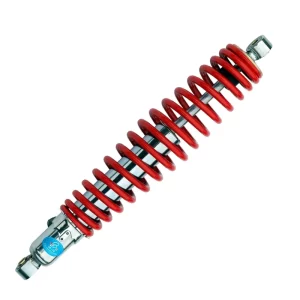
Choosing a Shock Absorber Piston Design for Your Application
Choosing a shock absorber piston design becomes difficult when vehicle weight, travel, and expected shaft speed sit outside catalog ranges. A light trail ATV and a loaded commercial mower need different port area and shim stack even if the shock body length is similar. The wrong piston makes the shock feel vague early and harsh late. Yearben matches piston design to the actual use case before tooling, and we can confirm port geometry, preload, and curve shape with a sample before production. Send your part number, piston diameter, damping targets, and annual quantity to info@yearbenshocks.com or call +86-523-86566899. We will confirm the piston specification and build plan for your application.
Common Questions About Shock Absorber Piston Design
Does a larger piston always deliver more damping force?
No. A larger piston can move more oil, but damping force depends on port area and shim stack. A 46 mm piston with poorly shaped ports can produce less controlled damping than a 40 mm piston with a properly matched stack. More diameter changes packaging, heat capacity, and stroke feel, not force on its own. The relevant equation is pressure differential multiplied by effective piston area. More area multiplies force at a given pressure, but if port area grows too much, the pressure drops and the damping goes soft. Match diameter to vehicle weight and damping target rather than chasing the biggest piston.
Why does the same piston feel different in a monotube and an emulsion shock?
A common assumption is that piston design matters only in coilovers or remote reservoir shocks. It matters just as much in emulsion and twin-tube dampers because the piston controls the rate of controlled motion. A monotube uses a dividing piston to keep gas pressure off the working fluid, so the piston sees a more consistent pressure curve. An emulsion shock mixes gas and oil, so the same piston can cavitate earlier at high shaft speeds. The piston port shape and edge condition become more important in emulsion designs because trapped gas changes compressibility at the piston face.
Will a shim stack change fix harsh high speed compression?
Whether a shim stack change fixes harsh high speed compression depends on the failure mode. If harshness comes from too little piston port area, adding shims will not correct it. If the ports are fine but the first stage shim preload is too high, reducing first stage shim thickness may smooth the spike. Before changing parts, I look at the dyno curve around the shaft speed where the harshness occurs. That points to either flow area or stack control. A customer sometimes asks for more high speed force when the real need is more port area.
How do I specify piston design on a custom shock absorber order?
In custom orders, we ask for piston diameter, port area or bleed size, shim stack layout, and the shaft speeds the vehicle actually sees. I once reviewed a sample shock with the right body length but the wrong piston for the load. Rebuilding the piston specification changed the machine from pitch-sensitive to stable. Share your vehicle weight, travel, and ride priorities, and we will confirm the piston specification before production. If your application involves a heavy payload or uneven side loading, it is worth confirming port consistency and shim preload with a sample before committing the order. Send those details to info@yearbenshocks.com.
If you’re interested, check out these related articles:
Triple-Bypass-Shock-For-Off-Road
Adjustable-Hydraulic-Shock-Absorbers
Monotube-Shock-For-Off-Road
Best-Shocks-And-Springs-For-Trucks