Most remote reservoir shock failures we examine do not start inside the damper. They start at a hose that was routed too short around a suspension pivot or a bracket that flexes under repeated chassis load. Remote reservoir shocks add oil volume and cooling capacity, but only when the hose assembly and mounting bracket are specified as engineered components rather than installation afterthoughts. Before a bill of materials is locked, sourcing teams should resolve hose length, end fitting orientation, bracket load path, sealing method, and production documentation.
Remote Reservoir Shock Hose Length Follows Mounting Position and Suspension Travel
Short hose assemblies are the most common remote reservoir shock specification error we see. A hose that fits at ride height can stretch or pull out of the swivel fitting at full droop, especially on long travel builds where the shock body moves through a wider arc. We set hose length from the full extension position, then add a service loop that keeps the assembly away from the coil spring and any suspension pivot.
Why Measuring Hose Length at Full Droop Is the Only Safe Method
When a shock cycles, the distance between the body port and the reservoir changes. If the hose is cut to ride height, the assembly becomes the travel limiter at full droop. That concentrates load on the crimped fitting instead of the suspension hardware. We check hose length with the shock shaft fully extended and the steering or axle at maximum articulation.
Hose and Bracket Routing Must Leave a Service Loop Without a Kink
The service loop is not extra hose. It is the section that lets the hose flex without exceeding its minimum bend radius. We usually add roughly a quarter to a third of the measured full droop length, depending on fitting orientation and whether the reservoir moves with the body or the chassis.
| Reservoir Location | Key Hose Risk | Specification Input We Use |
|---|---|---|
| Frame rail mount | Pinching between body and rail | Extra service loop plus a standoff clamp |
| Cage or tube mount | Abrasion at clamp edges | Sleeved hose and fixed routing clips |
| Bed or rear cage mount | Pressure drop over long runs | Larger inner diameter on long runs |
| Piggyback replacement | Misrouted thermal load | Use a piggyback body if space is limited |
| UTV tray mount | Pull at full droop | Full extension length plus a service loop |
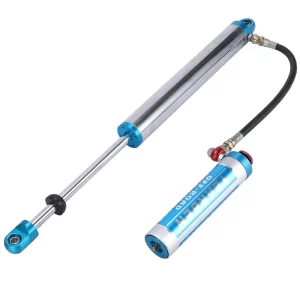
Remote Reservoir Shock Brackets Need a Defined Load Path and Tube Clamp Spec
The bracket looks simple, but it carries the reservoir mass through vibration and chassis twist. A clamp that holds the reservoir steady on a smooth test bench can still work loose on a rock trail. We specify the bracket by mount type first: weld on bracket, billet tube clamp, or frame rail clamp.
Tube Clamp Design Stops Reservoir Rotation Before It Wears the Hose
Reservoir rotation is the hidden cause of many bite style hose failures. If the clamp can rotate around the tube, the hose becomes the anti-rotation device. We prefer a machined bore clamp that matches the tube diameter, not a universal shim stack.
If your program involves a remote reservoir shock mounted on a moving suspension link or a long hose run that changes routing at full droop, it is worth confirming the hose fitting clocking and bracket clamp load before finalizing your BOM. Send the routing sketch and shock travel numbers to info@yearbenshocks.com and we will check the assembly against production test criteria.
Factory Crimping and Seal Testing Catch Remote Reservoir Hose Failures Before Shipment
Leaks happen at the hose fitting because the crimp shell was sized for the wrong hose wall, or because the sealing surface was not checked after crimping. In our factory, hose assemblies are crimped on a controlled die set for the specific hose family, then pressure tested with nitrogen before the reservoir is charged and the shock is assembled.
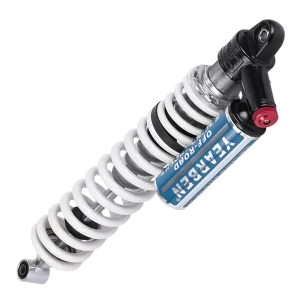
One warranty review taught me that the leak was not always in the hose. The bracket had moved under load and pulled the hose into a suspension link. After that, we started validating bracket position on a cycle test, not just a static fit check. That is why our hose sign off now includes routing photos at full compression and full extension.
OEM Documentation Locks Hose and Bracket Consistency Across Production Runs
The difference between a prototype that works and an OEM program that stays consistent is the drawing package. We keep a separate assembly drawing for each reservoir orientation because a frame rail mount and a cage mount use different hose clocking, even if the shock body is identical.
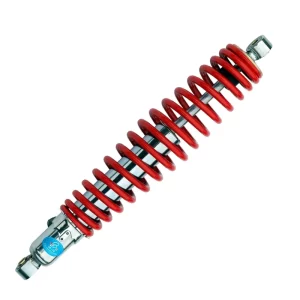
A production drawing should lock the hose clocking angle, the reservoir band orientation, the bracket hole spacing, and the clamp torque. Without that, a factory can build the same shock two different ways across batches. We have seen this show up as intermittent fitment issues on the assembly line, not in the original prototype approval.
When Hose and Bracket Specs Are Unresolved, Yearben Reviews Them Before Production
The most common delay in remote reservoir shock sourcing is missing fitment data, not production lead time. If your program has a frame rail reservoir, an angled cage mount, or a long hose run that changes routing at full droop, send us the shock travel numbers, reservoir position sketch, and vehicle mounting tube diameter. We will confirm hose clocking, fitting type, bracket load path, and test criteria before the BOM is finalized. Call +86 523 86566899 or email info@yearbenshocks.com with your part number and quantity, and we will return a fitment check with production timing.
Buyers Ask These Questions About Remote Reservoir Shock Hoses and Brackets
Can a Remote Reservoir Shock Be Converted to a Short Hose for Tight Packaging?
No, not without changing the thermal and damping behavior. The hose is not a packaging convenience; it gives the oil a place to expand and cool between the working cylinder and the reservoir. A shorter hose reduces that buffer and can raise peak oil temperature under repeated high speed cycling. If packaging is the constraint, we usually recommend a piggyback reservoir body or a clocked reservoir mount instead of shortening the hose below the tested minimum length.
Why Do Some OEM Hoses Use a Swivel Fitting and Others Use a Fixed Banjo?
A swivel fitting does not mean the hose is weaker. It lets the assembly align itself during suspension movement, which reduces side load at the seal. A fixed banjo has a smaller stack height and works well when the reservoir and shock body move as a unit. The right choice depends on the mounting kinematics, not on the pressure rating alone.
Does a Remote Reservoir Bracket Need to Be Isolated with Rubber?
It depends on where the reservoir is mounted. On a frame rail or cab mount that sees engine vibration, a rubber isolated clamp can stop high frequency wear at the reservoir surface. On a suspension link or axle side mount, rubber isolation usually does more harm than good because it adds compliance between the reservoir and the moving mass. We specify rigid clamps for unsprung locations and isolated clamps only for chassis or body locations.
What Is the First Check When a Remote Reservoir Shock Seeps at the Hose Fitting?
In warranty returns we have handled, the first check is not always the crimp. We start with the bracket and hose clocking because a twisted installation can loosen the fitting over time. If the fitting is still aligned and the torque marking has not moved, we inspect the sealing cone for scratches and verify the hose family matches the crimp shell. The final step is a nitrogen pressure check with the hose held at full extension. If your program has a recurring fitting seep, send the installation photos to info@yearbenshocks.com and we will confirm whether the cause is hose clocking or the crimp specification.
If you’re interested, check out these related articles:
Fixed-Preload-Atv-Shock-Absorbers
Adjustable-Gas-Shock-Absorbers
4X4-Shock-Absorber-Supplier