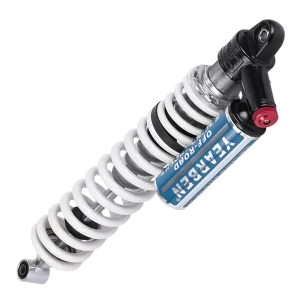
For anyone who maintains or builds ATVs, UTVs, buggies, or 4×4 trucks, the terminology around suspension components can be confusing, and coilovers vs shocks is one of the most common points of uncertainty. The core difference is not about one component being “better” than the other; it is about integration and intended use: a standalone shock absorber is a damping unit that controls suspension movement, while a coilover combines the damper with a coil spring into a single assembly that also carries the vehicle’s weight. In practice, 90% of off‑road vehicles use some form of coilover on the front suspension because packaging and ride height adjustability matter as much as raw damping. The question a buyer or fleet operator should be asking is not “which is better” but “which design matches the vehicle architecture and the type of terrain it will see most often.”
What Is a Shock Absorber?
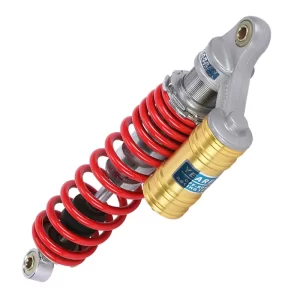
A shock absorber—often called just a “shock”—is a hydraulic or gas-charged damper that resists suspension movement by forcing oil through precisely sized valving orifices. Its job is to convert kinetic energy from spring oscillation into heat, keeping the tire in contact with the ground after a bump. A shock alone does not support the vehicle’s weight; it works in parallel with a separate spring, leaf pack, or torsion bar. On many rear suspension setups on UTVs, lawn mowers, and older 4x4s, this separation makes sense because the spring or leaf pack can be mounted on the axle or chassis independently.
Most standard shock absorbers we manufacture at Yearben follow a monotube or twin-tube construction with a floating piston to separate oil and nitrogen gas. Bore sizes range from 24mm on lawn mower steering dampers up to 35mm or 38mm on heavy-duty seat dampers, and damping force is fixed unless the customer requests an adjustable valve. The advantage of this design for fleet managers and OEM buyers is its simplicity: fewer components mean fewer potential failure points and a lower per-unit cost when ordering in volume.
What Is a Coilover Shock?
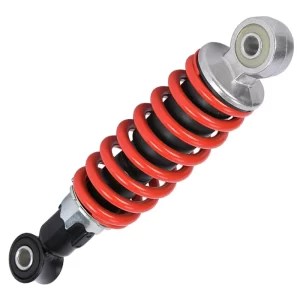
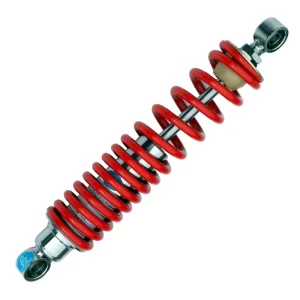
A coilover shock moves the coil spring onto the damper body itself. The spring is seated on adjustable threaded perches—or fixed perches on some OEM units—so that spring preload and ride height can be changed without re-engineering the suspension geometry. On an emulsion coilover (often called a “smoothie” shock), oil and gas mix inside the tube, and the gas is compressible enough to allow the piston to move. A piggyback or remote reservoir coilover separates the nitrogen into a bladder or piston behind a dividing wall, which gives more consistent damping on long runs and reduces oil aeration.
We typically build coilovers for off‑road applications with dual-rate spring setups: a softer tender spring handles small chatter while the main spring engages for larger compressions. This is one of the most practical differences between a coilover and a plain shock with separate springs—the spring rate transition can be tuned as part of the damper package rather than relying on the vehicle’s linkage ratio to sort out later. That makes coilover design more work-intensive on the front end, but once the valving and spring rates are right, the assembly can be installed as a single unit, which reduces assembly complexity on the vehicle production line.
How a Coilover Changes Load Path and Tuning Compared to Separate Components
When a shock and spring are separate, the shock mounts deal only with damping forces; the chassis or control arm picks up the spring load. With a coilover, both loads converge through the damper eyelets and mounting hardware. That means the mounting points themselves must be reinforced and the rod guide and piston rod need to withstand bending moments that a standalone shock does not see. I have seen coilover assemblies where the lower eyelet began to crack after a season of desert racing because the mounting design treated it like a regular shock rather than a load-bearing unit. For this reason, any OEM switching from separate springs to coilovers needs to share the vehicle’s corner weight and motion ratio during the design phase so the shock body and end fittings are dimensioned correctly.
Another substantial difference shows up in damping force calibration. A shock alone works against the spring rate in a linear way, but on a coilover the spring preload changes the initial compression response independently of the damper. If the preload is set high to achieve a target ride height on a heavy vehicle, the initial movement can feel harsh because the spring is already under significant load before the damper even begins to move. This is why adjustable preload collars are not just about ride height—they affect how the first inch of travel feels, and poor preload choice can make a correctly valved coilover feel like it has no small-bump compliance.
When to Choose Coilovers Over Standard Shocks
The decision usually comes down to vehicle architecture, adjustability needs, and total cost of ownership. The table below outlines the most common scenarios where each option is the better choice.
| Application | Preferred Setup | Key Reason |
|---|---|---|
| Front suspension of independent off-road vehicles (ATV, UTV, sand rail) | Coilover | Packaging: spring and damper share mounting points; ride height and preload adjustable in the field |
| Rear solid axle with leaf springs (lawn mowers, agricultural equipment, some 4x4s) | Standard shock + leaf pack | Leaf springs already carry weight and locate axle; shock only needs to damp motion, so separate unit is cost-effective and easy to replace |
| High-speed desert racing or long-distance overlanding with sustained high-frequency movement | Piggyback or remote reservoir coilover | Extra oil volume and separated gas chamber prevent fade; spring load integration reduces total unsprung weight versus separate shock and spring |
| Fleet vehicles where maintenance simplicity and low per-unit cost are priorities | Standard gas shock with fixed damping | Fewer moving parts; no preload adjustment to wander over time; cheaper to stock spares |
| Custom builds that require both ride height tuning and progressive spring control | Dual-rate coilover | Two spring rates in one unit allow soft initial compliance without sacrificing bottoming resistance |
If a vehicle already has a well-engineered mounting system for separate springs and shocks—such as a coil-sprung separate-damper rear multi-link setup on a 4×4—switching to a coilover may not offer a measurable improvement unless you are chasing incremental unsprung weight reduction or packaging clearance for larger tires. For most OEM buyers and fleet managers we work with, the conversation starts with the vehicle’s existing geometry and intended terrain. Changing that assumption can multiply cost without a corresponding performance gain.
What OEM Buyers Should Verify When Specifying Coilovers or Shocks
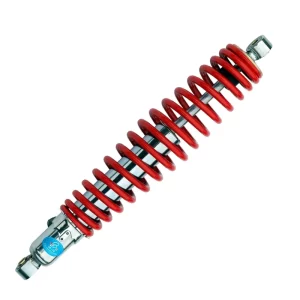
Having supplied over 200 shock models to ATV, UTV, lawn mower, and seat manufacturers, I can say that the quality difference between a well-built coilover and a poorly executed one is usually hidden in four areas: chrome plating thickness on the piston rod, seal compound and energizer spring design, nitrogen fill consistency, and weld integrity at the end eyelets. On a separate shock, a nitrogen charge that drops 10% might cause a slight increase in damping fade after 20 minutes of hard use; on a coilover, that same pressure loss also lets the spring preload relax slightly, which changes ride height at that corner. So gas-loss testing and serial number tracking matter more for coilover units, especially if the customer orders adjustable damping where the clicker mechanism adds another potential leakage path.
For companies sourcing coilovers from Chinese factories, the pre-signing checklist should always include: batch nitrogen-fill records (not just a random sample), salt-spray test hours on the surface coating (we use 100+ hours as a minimum for off‑road applications), and whether the threaded spring perch is welded or machined from billet. Welded perches are fine for lower-cost builds, but on units seeing high spring loads—think 800cc Baja buggies or heavy overlanding rigs—the heat-affected zone near the weld can become a crack initiation point. Our engineering team has migrated most of our own high-load coilover perches to machined adjusters specifically to remove that variable.
If you are evaluating suppliers for a multi-model OEM program that includes both coilovers and standard shocks, ask whether the factory can show you a single serial-number trace from raw tube to final dyno test. A supplier that cannot connect a specific shock to its specific valving chart and gas-fill pressure is essentially selling you a black box, and you will be the one debugging the warranty returns. I would rather see a factory with a smaller catalog and full traceability than a large catalog with batch-level quality records only.
If your next suspension program involves a mix of coilovers and separate shocks, and you need a supplier who can provide both from a single production line with full serialized traceability, we welcome you to send your target specifications, vehicle weight, and quantity to info@yearbenshocks.com or call +86-523-86566899. We will return a damping-force recommendation and a pre-production sample timeline within five working days.
Common Questions About Coilover and Shock Selection
What is the practical difference between a coilover and a regular shock when both are on the same vehicle?
A coilover carries the vehicle’s corner weight through the damper; a regular shock only provides damping. That means the coilover’s mounting structure and internal components see higher combined loads. If you replace a separate-spring setup with a coilover on the same mounts without reinforcement, the mounts will eventually deform or crack.
Does a remote reservoir coilover perform better than a piggyback reservoir design?
The cooling advantage is real but small in most trail-riding scenarios. A remote reservoir hose adds some internal oil volume and moves the gas chamber further from the hot shock body, which can keep oil temperatures 5–10°C lower on sustained high-speed runs. A piggyback design is easier to package and avoids the risk of hose abrasion or fitting leaks. In practice, I recommend remote reservoirs for vehicles where desert racing or high-speed Baja-style use makes up most of the operating hours, and piggybacks for everything else.
Why do my front coilovers lose height after a few months of hard use?
Two common causes: nitrogen migration past the floating piston o-ring (which lets the spring preload relax), and spring sag from metal fatigue if the spring rate was borderline for the vehicle weight. When a customer reports this, we always ask for a standing ride-height measurement on level ground with full fuel and driver weight, because without that baseline you cannot separate spring sag from gas loss. A properly specified coilover should hold ride height within 3mm throughout its service interval; anything more is a sign of either a gas-charge leak or an under-spec spring.
Can I run a standard shock with a separate coil spring and get the same performance as a coilover?
You can get very close in damping performance, but you lose the packaging and preload-adjustment convenience of a coilover. On vehicles where the linkage already provides a progressive mechanical advantage and ride height is set by the spring seat on the chassis, the separate setup is simpler and easier to service. On vehicles where space is tight and you need to adjust ride height without cutting and re-welding mounts, the coilover is the better path.
Is it worth paying extra for adjustable damping on a coilover compared to choosing the right fixed valving from the start?
For a production vehicle where the weight, motion ratio, and intended terrain are known and stable, a correctly chosen fixed-valving coilover will perform as well as an adjustable one day to day. The adjustable clicker becomes useful when the same vehicle needs to transition from soft trail riding to high-speed desert running, or when you are prototyping a new platform and need to experiment with damping curves. If your fleet operates in a narrow weight and terrain window, we often guide customers toward fixed valving to reduce adjustment-related warranty calls. If you are unsure whether a fixed or adjustable setup is right for your program, share your vehicle’s loaded corner weight and target terrain mix with info@yearbenshocks.com. We can provide a damping force recommendation that matches your application without forcing you into complexity you do not need.
If you’re interested, check out these related articles:
Adjustable-Hydraulic-Shock-Absorbers
Best-Off-Road-Coilover
4X4-Heavy-Duty-Suspension