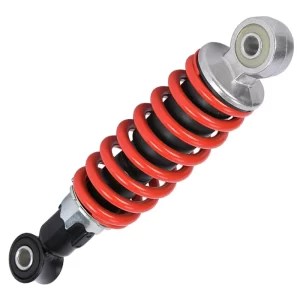
Most suspension failures in military and mining fleets do not start with a broken shaft. They start with heat, contamination, and a mismatched test cycle. Damping shock absorbers for military and mining vehicles operate at sustained high loads, in abrasive environments, and often far from service facilities. A catalog rating for a recreational off-road damper means very little when the vehicle runs loaded across corrugated ground for hours. The right selection process begins with the mission profile and duty cycle, then moves through damper specification, design configuration, manufacturing control, and supply planning. I recommend treating the damper as a primary chassis control component and specifying it with the same rigor as the driveline or braking system.
Operating Conditions That Define Military and Mining Damping Requirements
Military vehicles and mining haul trucks share two conditions that destroy ordinary dampers quickly. Damping shock absorbers for military and mining vehicles carry high sprung and unsprung mass over rough ground at low to medium speed, generating continuous high shaft velocities rather than short impacts. They also operate in contamination. Mine dust, ore slurry, and silt settle on the rod and work past the seal as the suspension cycles. One score or corrosion pit on the rod becomes a leak path, and from that point gas pressure and oil volume bleed away.
Heat is the less visible problem. Continuous shaft movement converts mechanical energy into oil heat, and a loaded mining vehicle on a bench road can keep the damper body hot for hours. When oil temperature rises, viscosity falls, damping force drops, and the vehicle starts to pitch or bottom out. Remote reservoirs and monotube construction matter here because they separate gas from oil and shed heat better than a twin-tube design. The question is not whether the damper can take one hard impact. It is whether the damping curve stays stable after three hours of continuous work.
Specification Parameters for Damping Shock Absorbers in Severe Duty
A useful military or mining damper specification has more than eye-to-eye length and stroke. The force-velocity curve matters more than peak force. I review four sets of numbers before recommending a damper: damping ratio under loaded and unloaded conditions, rod diameter relative to side load, oil viscosity index, and seal material for the operating temperature range.
Damping ratio is the first priority because it determines how quickly the sprung mass settles after an input. Too low, and the vehicle wallows on rough ground. Too high, and the suspension transmits shock into the chassis and the driver. The correct ratio for a loaded mine spec vehicle usually sits below a recreational race tune. The vehicle mass is higher, so a moderate ratio produces acceptable body control without punishing the occupants over a 10-hour shift.
Rod diameter and bore size follow from side load and heat. A small rod can flex under lateral load and wipe out the seal, so military and mining dampers benefit from larger rods than a light ATV shock. Bore size determines oil volume and heat capacity. More oil holds more heat before fade appears, but it also adds weight and packaging length.

Seal material is where a low-cost damper usually fails first. Nitrile works in ordinary applications but stiffens in extreme cold and degrades near sustained high heat. A severe-duty damper should use a seal compound matched to the expected temperature range, and the supplier should be able to name the compound and the test method, not just the durometer. The rod surface finish matters as much as the seal. A rough or thinly chrome-plated rod will abrade the seal lip and shorten service life even if the seal material is correct.
Monotube, Remote Reservoir, and Adjustable Damping Choices
Damping shock absorber construction splits into three practical configurations here: twin-tube, monotube, and monotube with remote reservoir. Twin-tube is common in light vehicles but fades earlier because gas and oil can mix during hard use. Monotube construction uses a separating piston to keep gas and oil apart, which preserves consistent damping force when the damper runs hot. A remote reservoir adds oil volume and cooling surface, which is why it appears on long-travel desert trucks and now on heavy military and mining suspension systems.
Adjustable damping adds flexibility when a fleet runs both empty and loaded. A fixed valve can be correct for one mass state and wrong for the other. Adjustable clickers let a maintenance team set a stiffer response for loaded haulage and a softer response for return runs. The setting must stay repeatable across temperature and time. Some cheap adjusters change feel without changing the actual compression curve enough to matter, so I prefer a supplier that publishes the damping force change per click at the shaft speeds the vehicle actually sees.
| Design | Gas and oil separation | Heat handling | Main tradeoff |
|---|---|---|---|
| Twin-tube | Oil and gas in shared body | Lower | Packaging and cost, but earlier fade |
| Monotube | Dividing piston | Better | More sensitive to rod finish and side load |
| Remote reservoir monotube | Dividing piston plus reservoir | Best | Larger packaging and higher cost |

If your program includes blast-hardening, mine water, or continuous slope work, confirm the damper body material and rod coating before finalizing the bill of materials. Send your environmental requirements to info@yearbenshocks.com or call +86-523-86566899, and we can check the compatible seal, coating, and reservoir configuration for the mission.
Manufacturing Tests and Batch Consistency
A military or mining fleet buyer should not accept a damper sample without asking how the supplier validates repeatability. One good prototype does not predict 500 units arriving with the same damping curve. The manufacturing process has to control piston machining, shim stack assembly, oil fill volume, and gas charge pressure within narrow ranges. When one of those drifts, the vehicle handles differently from unit to unit.
At Yearben, we machine and assemble our own dampers, which lets us hold bore finish and rod alignment within tolerance instead of sorting finished parts. We test each production batch on a damper dynamometer and record the force-velocity curve before shipment. The test includes pressure hold, seal leakage, and temperature stability. I have seen supplier issues where a clean prototype passed every test, but production units varied because the gas charge pressure was set by hand and not verified on a calibrated station. That kind of drift is invisible during installation and shows up later as uneven ride height or premature fade.

Batch traceability matters for long fleet life. A damper supplied to a mine in year one should be replaceable with a unit from year three without revalidating the vehicle. The supplier should retain the shim stack configuration, piston profile, oil specification, and gas charge pressure for each order and be able to resupply against a reference part number. This is more important than a long warranty sentence, because a warranty cannot shorten a haul truck’s downtime when replacements do not match the original tune.
Sourcing Damping Shock Absorbers for Military and Mining Fleets
Procurement for military and mining damping shock absorbers usually runs into three friction points before a single unit ships: custom calibration, long lead-time uncertainty, and specification consistency across repeat orders. A catalog part rarely matches the exact load case, so the supplier must be able to revalve or build to a force-velocity target. Specialty seals, coatings, and reservoirs add lead time if the factory has to outsource them. Time then reveals the third problem: a repeat order arriving with different valving because the original specification was not retained.
Yearben controls these problems with an in-house engineering and manufacturing line. We produce more than 200 damper models and keep an annual production capacity of 1.5 million units, which gives us room to run custom military and mining orders without holding a dedicated line. We also retain order specifications so a repeat order comes back with the same valving, oil, and gas charge as the article validated on the vehicle. The same process applies to our OEM programs for off-road and seat damper customers.

The most useful inquiry is specific. Send your vehicle corner weights, spring rates, shock travel, mounting style, environmental exposure, and target damping force to info@yearbenshocks.com. Include your annual volume and any homologation or test documentation the damper must satisfy. Call +86-523-86566899 and ask for Chen Yibo to define the damping force target from your mission profile. We will then confirm the correct rod, bore, seal, reservoir, and valving combination and return a production timeline with the sample plan.
Common Questions About Military and Mining Vehicle Dampers
How do military vehicle damper requirements differ from standard off-road shocks?
Military vehicles are heavier, often armored, and validated for sustained cross-country use rather than short recreational cycles. The damper needs a more conservative tune that controls body motion without fatiguing the crew, and the rod, seal, and coating must resist mud, sand, and fuel contamination. A standard off-road shock can produce the same peak force but fail after repeated full-load cycles. The practical difference is test validation. Military programs usually want proof that the damper holds its damping force after prescribed durability cycles and environmental exposure.
Does mining vehicle damping need adjustable valving?
It depends on whether the vehicle runs empty and loaded. A fixed tune for a loaded haul truck may be too stiff when the truck returns empty, and a fixed empty tune may fade or bottom out when loaded. Adjustable damping is useful when a fleet cycles between those mass states. If the vehicle always runs near the same gross weight, a correctly tuned fixed damper is simpler and easier to keep consistent. For most heavy mining trucks, I recommend at least two repeatable settings, not a wide range of click positions that no one records.
What is the main cause of damping fade in mining vehicles?
A common assumption is that fade comes from worn seals. Most fade begins with oil overheating before seals fail. Sustained shaft movement heats the oil, viscosity falls, and the damping force falls with it. Once the oil thins, the damper moves faster through its stroke and the vehicle pitches more. The best fix is a monotube or remote reservoir design that separates gas from oil and adds oil volume and cooling surface. Seal condition still matters, but heat management is the first line of defense.
What information do we need to quote a military or mining damper?
Rather than asking for a general quote, send the vehicle axle and corner weights, spring rate, shock travel at full bump and droop, mounting bracket dimensions, and the worst-case environmental exposure. Also state the target damping force or the current damper part number if the request is a replacement. With that information, a supplier can confirm rod diameter, bore size, seal material, and reservoir configuration. Without it, any quote is still a guess. Share your mission profile with us at info@yearbenshocks.com or +86-523-86566899, and we will confirm the correct specification before sampling.
If you’re interested, check out these related articles:
Triple-Bypass-Remote-Reservoir-Shock
Off-Road-Coilovers
Damping-Adjustable-Shock-Absorber
Heavy duty seat damper 35mm, Shock Absorber Manufacturer
Piggyback-2-0-Coilover-Shock