
Coilover shocks do not fit every vehicle, and treating them as a universal upgrade creates more failures than performance gains. A coilover packages a spring and damper into one assembly, so the vehicle must already have the right mounting points, suspension travel, spring rate, and load path. On ATVs, UTVs, buggies, and off-road trucks, they work when those parameters are matched to the chassis and use case. On a stock commuter vehicle or a light equipment platform never designed for them, even a well-built coilover becomes a mounting stress problem. Fitment is the decision point, not shock quality.
The Fitment Limits Behind Coilover Shocks
Every coilover shock has three fitment conditions before spring tuning matters: eyelet size, compressed and extended length, and spring seat clearance. A shock that bolts in but hits the upper control arm at full droop is not fitted. A spring that touches the chassis at ride height wears the finish and changes the wheel rate.
A coil spring is wound around the damper body, so the complete assembly is wider than a bare shock. On vehicles with narrow shock towers, tight chassis rails, or factory exhaust routing, that added diameter is the first reason a coilover will not work without fabrication. Remote reservoir shocks add hose routing and bracket load, and a stock fender does not always clear them.
Before a coilover gets valved, we check the mounting dimensions against the vehicle’s suspension cycle.

Vehicles That Work with Coilover Shocks
Coilover shocks fit naturally on coil-sprung platforms where the spring already sits around or next to the damper: ATVs, side-by-sides, UTVs, buggies, sand rails, go-karts, and many 4×4 trucks. Model-specific coilover kits also work on street cars because the upper mount and lower bracket are designed for that chassis. The issue is never whether a coilover exists in a catalog. It is whether that specific valve length, spring rate, and end fitting match the vehicle.
| Vehicle Type | Coilover Fitment Check |
|---|---|
| ATVs and side-by-sides | Eyelet type, body length, and spring rate matched to chassis weight and travel |
| UTVs | Higher corner weights require stiffer springs, larger shafts, and often reservoir packaging |
| Buggies and sand rails | Custom tube chassis need measured compressed and extended lengths before ordering |
| 4×4 trucks and rock crawlers | Spring rate matched to loaded axle weight and long travel requirements |
| Go-karts and light platforms | Short stroke and low spring rate; standard off-road coilovers are far too stiff |
A coilover that fits a 500 kg UTV is dangerous under an 800 kg 4×4 if the spring rate is not changed. The mounting may line up, but the wheel rate and damping force will not.

The Spring Rate and Travel Factors That Decide Fitment
Spring rate is not a preference. It is the force needed to compress the spring a set distance, and the correct number comes from corner weight, motion ratio, intended ride height, and unsprung weight. When a coilover carries a heavier vehicle than it was specified for, the spring sags and the damper runs too deep in its stroke. When the vehicle is lighter than specified, the spring holds the suspension near full extension and the ride becomes harsh.
Why Vehicle Weight Changes the Required Spring Rate
Vehicle weight sets the load each corner must carry at ride height. A heavier axle or cage pushes the spring deeper into its travel, so the same spring rate produces a lower ride height than it would on a lighter platform. That changes the damper position in the stroke and leaves less compression travel before the shock bottoms. Matching the spring rate restores the intended ride height and keeps the damper working in the middle of its stroke.
What Happens When Compressed or Extended Travel Is Wrong
A coilover that is too long at full compression can bottom before the suspension reaches the bump stop, bending the shock eye or cracking the mount. A coilover that is too short at full droop limits downward travel and causes the suspension to bind or top out under off-road articulation. In long travel builds, we measure both ends of the cycle before confirming a body length.

If your build runs a custom tube chassis or carries a heavier cage, battery pack, or accessory load than stock, it is worth confirming the spring rate and collapsed length with the shock manufacturer before locking in your bill of materials. Reach me at info@yearbenshocks.com.
Matching Coilover Shocks to ATV, UTV, and 4×4 Platforms
For ATV and UTV platforms, the coilover shock has to package around the exhaust, driveshaft, and control arm. A piggyback reservoir takes less hose routing than a remote reservoir but adds width at the top of the shock body. In tight UTV chassis, remote reservoir shocks often package better because only the hose fitting must clear the frame.
At Yearben, we build coilover shock absorbers for ATV, UTV, go-kart, and off-road vehicle applications, with body lengths and spring rates matched to each platform. Lawn mower shock absorbers are a different category. Most use small hydraulic dampers and light coil springs; an off-road coilover is far too long and stiff for that deck suspension.
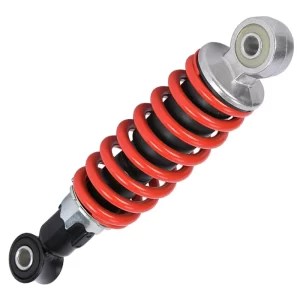
Confirming Coilover Fitment Before You Order
A coilover that bolts in but runs the wrong spring rate turns a performance upgrade into a ride quality problem and a warranty headache. Before ordering, send the vehicle model, approximate loaded weight, shock eyelet size, and the compressed and extended measurements you need for your application. We check those numbers against our coilover shock absorbers for ATV, UTV, buggy, and off-road vehicles and confirm the correct body length, stroke, spring rate, and reservoir packaging. Send your part number and quantity to info@yearbenshocks.com or call +86-523-86566899.
Common Questions About Coilover Shock Fitment
Can I put a coilover shock on a vehicle with a strut front suspension?
Only if a model-specific kit exists for that exact vehicle. A strut carries lateral loads and mounts directly to the knuckle, so a coilover shock with the wrong upper mount or lower fork changes the suspension geometry. When a kit is engineered for the chassis, it comes with the correct brackets, spring rate, and stroke. When it is generic, the result is usually binding, poor steering feel, or a failed upper mount.
What happens if I use a spring rate meant for a heavier vehicle?
A common assumption is that a heavier-rate spring simply makes the ride stiffer. The bigger problem is that the damper runs too deep in its stroke. With a spring specified for more weight than your vehicle has, the suspension sits near full extension, so small bumps transfer into the chassis instead of cycling the damper. The coilover also loses droop travel and the vehicle becomes skittish over uneven terrain. Changing preload does not correct an incorrect spring rate.
Do I need new control arms to run long travel coilovers?
It depends on how much travel you are adding and whether the factory arms can reach the new shock length. A modest coilover upgrade often reuses the stock arms if the compressed and extended lengths stay close to original. Long travel coilovers usually need longer arms, revised mounts, and sometimes longer axles and brake lines. When the arm cannot cycle through the new shock’s full travel, the coilover becomes the suspension limiter, and the eyelet or arm takes the load.
Does a coilover shock change ride height on an ATV or UTV?
In the coilover packages we build for side-by-sides, ride height changes with spring preload, but preload is not a substitute for the correct spring rate. Adding preload raises the chassis and reduces droop travel. Removing preload lowers the chassis and increases bottoming risk. The right move is to select the spring rate for the loaded weight first, then use preload only for small ride height adjustments. If your platform runs a nonstandard eyelet or a long travel kit, share your extended and compressed lengths and we can confirm which coilover body fits before you order.
If you’re interested, check out these related articles:
Aluminum-Utv-Shock-Absorber
Off-Road-Coilover-Shocks
Gas Charged Dual Rate Coilover Shock Absorber