
Lawn mower shock absorber for deck suspension use wears out early when the unit is picked from a catalog without checking deck mass and mounting geometry. In more than twenty years of damper development, I have seen commercial decks destroy dampers because the damping force was too low and the rod cycled into the end of the stroke. Buyers who set deck weight per damper, eye to eye length, and travel first end up with a deck that holds its cut height on rough ground and dampers that last. We make deck suspension dampers from 18 mm to 38 mm cylinder diameters, and the right configuration is usually clear once the load path is measured.
What Does a Lawn Mower Shock Absorber for Deck Suspension Do?
A deck suspension damper controls the vertical motion of the mower deck as the frame rolls over uneven ground. It does not hold the deck up. That job belongs to the tension spring or linkage. The damper converts vertical acceleration into controlled force through valving, so the deck follows the ground without bouncing back past its cut height. In zero turn mowers, this keeps the blades from scalping when one side drops into a rut. A steering damper looks similar in length, but it controls low speed rotational force at the steering shaft. Put that unit on a deck suspension and the deck reacts too slowly at the pivot while still bouncing under repeated bumps.
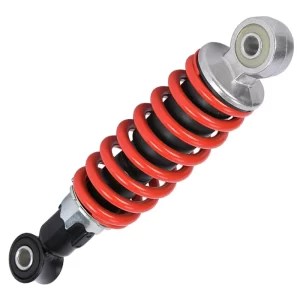
In deck suspension builds we have worked on, matching damper force to the deck arm rather than the tractor frame makes the largest difference in cut quality.
Which Lawn Mower Shock Absorber Specs Matter for Deck Suspension?
Three numbers matter before anything else. Damping force at a given piston velocity, usually in newtons. Eye to eye length between mounting centers. Usable stroke. Deck weight per damper sets the force band. A damper with too little force bottoms on the compression stroke. A damper with too much force makes the deck harsh and slow to react. Mounting geometry sets eye to eye length, and the stroke must be larger than the actual pivot travel by a safe margin.
| Damper Type | Cylinder Diameter | Deck Application | Key Mounting Note |
|---|---|---|---|
| Oil free lawn mower shock absorber | 24 mm | Light to mid deck arms on zero turn mowers | Verify rod alignment to avoid side load |
| Ride on mower shock absorber | 38 mm | Heavy commercial deck assemblies | Higher force capacity for wide cutting decks |
| Lawn mower damper shock absorber | Custom | OEM deck pivot control | Tuned to deck mass and travel |
| Lawn mower steering damper | 18 mm | Steering shaft damping only | Not a direct deck suspension replacement |
How Do You Size Damping Force for a Deck Arm?
Measure the sprung deck mass supported by each damper. In OEM work, the practical starting point is the load per damper in kilograms, then choose a damper whose compression force at around 0.3 m/s slows the deck fall without locking it. A catalog photograph will not tell you that. The damping curve will.
Why Does Eye to Eye Length Override Catalog Fitment?
If the eye to eye length is too short, the deck linkage pulls the damper to its mechanical limit on every bump. If it is too long, the damper cannot control the last portion of deck travel because the rod runs out of stroke. Both conditions wear seals quickly, even on a correctly valved damper.
Oil Free or Gas Charged for Deck Damping?
Oil free dampers remove the hydraulic leak path and work well in dusty grass conditions. Gas charged dampers add a low speed return force, which can settle a heavier deck faster. The choice follows deck mass and operating hours more than personal preference.
Why Do Lawn Mower Shock Absorbers Wear Out Early on Deck Suspension?
Most premature failures we see are not seal defects. They are side load failures caused by misaligned mounting bolts or worn pivot bushings. A damper rod that cycles with a bending load wears the guide bushing on one side, then the rod seal leaks and damping force fades. The second common killer is overstroke. If the replacement eye to eye length is slightly shorter than the original, the piston can hit the end of the cylinder on every bump. That spikes internal pressure, releases metal particles from the impact, and the damper fades quickly. The third problem is heat from high cycle counts. A damper that is too small for the deck mass overheats the fluid or softens the valving stack, which reduces rebound control later in the shift.

If your deck arms are heavy or you keep seeing the same side leak after two replacements, confirm the load per damper and the mounting angle before ordering another set. Send those two measurements to info@yearbenshocks.com and we can check whether the cylinder diameter and valving match the deck.
How Are Deck Suspension Dampers Tested and Qualified?
Before a deck damper enters production, we run the same two tests that matter most. The first is a full stroke cycle test at working frequency. It catches guide bushing wear, end stop failure, and fluid loss under heat. The second is a damping force trace at fixed piston velocities. The trace shows whether compression holds steady and whether rebound force stays above the deck’s need. For gas charged units we also check pressure loss after cycling and inspect the chrome rod for score marks. A damper that passes visual inspection but skips the force trace is not qualified for commercial cutting.
What Should a Damping Curve Show for Deck Suspension?
Look for stable force at the working velocity and no sudden break point in compression. If the force drops below the expected band after cycle testing, the deck will start to bounce and cut height will vary. The curve is more useful than a single maximum force number because deck suspension spends most of its life in the middle of the stroke.
What Reports Do OEM Buyers Need?
For custom deck suspension programs, we send the damping curve, the cycle test summary, and the dimensional drawing. That set is enough to confirm the part before the bill of materials is locked.
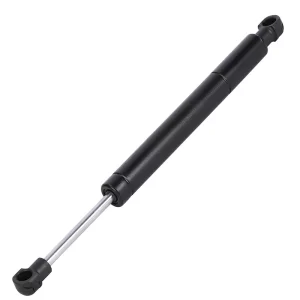
What Should You Send for a Lawn Mower Deck Suspension Quotation?
Wrong damping force on a mower deck shows up as uneven cut, scalping, or early damper leaks. The fix is usually a correct spec, not a heavier spring or a complete linkage change. Send the deck mass per damper, the eye to eye length, and the current damper part number to info@yearbenshocks.com or call +86-523-86566899. We will check the force curve and mounting dimensions against the Yearben 18 mm to 38 mm deck damper range and reply with a matched configuration before you commit to a production order.

What Do Buyers Often Ask About Lawn Mower Deck Suspension Dampers?
Can a steering damper replace a deck suspension shock absorber?
No. A steering damper looks similar, but it is valved for low speed rotational control at the steering shaft. On a mower deck that unit slows the pivot response on every bump and does not control high speed deck motion. The result is cut height variation across rough ground, along with early rod bushing wear from forces the steering damper was never sized to absorb.
How long should a lawn mower shock absorber last in commercial mowing?
It depends on deck mass, ground conditions, and mounting alignment. A correctly sized damper in commercial mowing usually lasts multiple cutting seasons because the piston stays in its working stroke. An undersized or misaligned unit can lose damping force within weeks when the rod hits the end of the cylinder or runs under constant side load. We have seen both modes in OEM service, and the difference is measurable within one season.
Does a stiffer damper make the deck ride worse?
A common mistake is thinking stiffness means harshness. The problem is not stiffness alone, it is a damping curve that rises too fast at low shaft speed. A damper with higher peak force and digressive valving can settle a heavy deck without making the cut rough. Harshness comes from the shape of the curve, not from the maximum force number.
What is the difference between oil free and gas charged deck dampers?
Oil free versions use a sealed friction and spring system instead of hydraulic fluid, which removes the rod seal leak path in dusty grass. Gas charged dampers add a low speed return force that settles a heavier deck faster. For decks that run long hours in dust, oil free is often the safer default. If your deck mass sits near the top of the capacity range, send the arm weight and eye to eye length to info@yearbenshocks.com and we will confirm which variant holds up best.
If you’re interested, check out these related articles:
Best-Shocks-And-Springs-For-Trucks
Lawn mower steering damper 18mm
4X4-Heavy-Duty-Suspension
