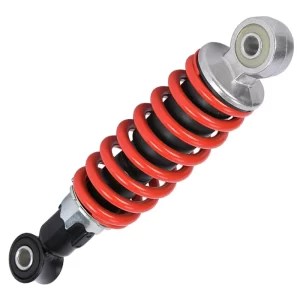
Selecting the right front shock absorber travel starts at the suspension hard points, not at a catalog number. A travel figure only tells you how far the shaft can move from fully compressed to fully extended. What makes that figure usable is the motion ratio, the clearance at full bump and droop, and the spring and valving chosen for the vehicle weight. I have seen too many front ends built around a shock that cycled past the axle or tie-rod limit because the travel number looked good on paper. The correct travel is the stroke that follows your measured wheel travel without binding, topping out, or leaving ride height in the wrong part of the curve.

What Does Front Shock Absorber Travel Actually Define?
Front shock absorber travel, also called stroke, defines the difference between the fully compressed length and the fully extended length of the damper. A shock with a 100 mm stroke can compress 100 mm from its extended position before the piston bottoms against the end of the body. That number is not the same as wheel travel. On a front A-arm suspension, the shock usually mounts inboard of the tire, so a given wheel movement produces a smaller shock movement. The ratio between wheel travel and shock travel is fixed by the mounting geometry, and it changes measurably when ride height or control arm length changes. This is why two vehicles can both claim 200 mm of front wheel travel but require completely different stroke lengths. The correct front shock absorber travel is the stroke that lets the suspension reach full bump and full droop without the damper becoming the limit stop.
How Do You Measure the Right Front Travel?
I measure front travel in this order. First, set the vehicle at ride height with the intended payload on board and record the eye-to-eye or stem-to-eye length. Second, jack the front until the suspension reaches full droop and record the extended length. Third, cycle the front through full bump on both sides and record the compressed length. The shaft travel needed is the difference between those two shock lengths, plus a small margin so the damper does not become the hard stop. On a twin-cylinder UTV front end with an aftermarket bracket relocation, I found an 18 mm shift at the lower mount changed the effective stroke requirement enough to cause coil bind before the ball joint reached its stop. That kind of error does not show up in a catalog chart.
Measure the Mounting Points at Ride Height
Start with the vehicle loaded, not empty. A front end that is measured without a driver, passenger, winch, or front accessory weight will sit too high and give you an extended length that is too short for the real operating position. I record the corner weights first, then measure both sides because most front suspensions are not perfectly symmetrical after years of use or modification.
Cycle the Suspension Through Full Bump and Droop
Do not trust the shock to set the limit. Remove or loosen the shock and move the wheel through its true full range. Watch the tie-rod angle, the CV joint, the brake line, and the bump stop. If any part reaches its limit before the mounting points do, that limit becomes the real stroke boundary. The right front shock absorber travel stops just short of whichever constraint arrives first.
What Happens If Travel Is Too Long?
A stroke that is too long is usually worse than one that is slightly short. The extra length has to go somewhere, and that somewhere is often a component that was not designed to travel that far.
| Symptom | What It Usually Means | Corrective Action |
|---|---|---|
| Clunk at full extension | Damper shaft tops out before suspension reaches droop | Reduce stroke or add a limit strap |
| Coil binds at full bump | Spring reaches solid height before damper compresses fully | Use shorter stroke or different spring stack |
| Axle or tie-rod binding | Wheel travel exceeds component range | Restore bump stop and re-measure |
| Brake line tension | Extra droop stretches the line | Lengthen the line, not the shock |
I have seen a 4×4 build where the front shocks added 25 mm of stroke beyond the axle limit. The result was a heavy steering feel and a torn CV boot after two trips. The fix was not a stronger part but a stroke that matched the measured wheel travel. If your front suspension uses nonstandard mounts, a lift kit, or changed control arms, it is worth confirming the compressed and extended lengths against the actual wheel travel before finalizing the build. Send your mounting dimensions and target wheel travel to info@yearbenshocks.com and we will confirm the correct stroke and spring rate.

Which Travel Matches ATV, UTV, and Buggy Use?
ATV and UTV applications pull the stroke in different directions. A trail ATV that spends most of its time at low speed can use a shorter front shock absorber travel and rely on spring preload for ground clearance. A desert UTV with long A-arms needs more stroke at the damper and a remote reservoir to handle the heat from sustained shaft speeds. Buggies and sand rails sit between the two: long droop keeps the tire on sand, but too much extension makes the front end lazy and lets the tie rods run out of range. The travel number matches the use only when the mounting geometry, the spring rate, and the damping curve all point the same direction. We treat travel as the output of the measured suspension, not as a spec to copy from a feature sheet.

What Should You Confirm With a Shock Absorber Supplier?
The hardest part is not selecting a number from a chart. It is making sure the damper, the bump stop, the steering limit, and the axle travel all agree at both ends of the stroke. That coordination is where a supplier with production experience earns its place. We take the measured eye-to-eye lengths, corner weights, and intended use, then specify the right front shock absorber travel and valving around those inputs. Send your mounting dimensions, current shock measurements, and two photos of the suspension at full droop and full bump to info@yearbenshocks.com or call +86-523-86566899. We will confirm the stroke and spring rate before any production commitment.
Common Questions About Front Shock Absorber Travel
Does More Front Travel Always Mean a Softer Ride?
No. More travel without more wheel travel usually only changes where the suspension runs out of stroke. Ride quality comes from the spring rate and the damping curve, not from total stroke. A front shock that is too long for the linkage often rides harshly at one end of the range because the spring stack hits its limit or the damping curve operates outside its intended zone.
What Is the Difference Between Shock Travel and Wheel Travel?
Shock travel is the stroke of the damper shaft. Wheel travel is the vertical movement at the tire contact patch. The two are linked by the motion ratio set by the control arm and shock mounting points. On a typical A-arm front end, the shock always moves a shorter distance than the tire. That ratio must be measured before the stroke is specified.
Should I Use the Same Travel Front and Rear?
It depends on the vehicle architecture. On most ATVs, rear wheel travel is longer than front, so rear damper stroke also tends to be longer. On a rock crawler with a linked front suspension, front and rear travel can be much closer. The front stroke should follow the front linkage, not the rear shock selection.
What Specs Do I Need to Send for a Correct Stroke Confirmation?
I usually ask for four numbers first: compressed length, extended length, eye-to-eye at ride height, and available wheel travel. Those four figures reveal whether the proposed stroke can cycle without binding. Share those numbers with your vehicle model and one photo at ride height to info@yearbenshocks.com and we will confirm whether your requested front shock absorber travel will cycle cleanly before you commit to production.
If you’re interested, check out these related articles:
4X4-Shock-Absorber-Supplier
Damping-Adjustable-Shock-Absorber
Adjustable Seat Damper 41.5mm
Off-Road-Coilover-Shocks