Remote reservoir shocks cool better than piggyback designs in sustained high-load running because the separated reservoir adds oil volume and moves heated fluid away from the shock body. That does not make piggyback reservoir shocks the wrong choice for every build. Packaging clearance, service access, and typical run duration decide which design earns its place. I have spent years watching both types come back from desert testing and short-course work, and the real difference shows up in damping consistency after the third or fourth hard lap.
Remote and Piggyback Reservoir Shocks Handle Heat Differently
Reservoir shocks generate heat at the piston and valve stack. The oil shears through the compression and rebound circuits, and that work becomes heat. In a standard shock body, the heat stays close to the shaft seal and gas charge. A remote reservoir changes that path by moving a share of the displaced oil through a hose into an external canister. A piggyback reservoir mounts the canister directly to the shock body, so it shortens the heat path but keeps the added oil volume next to the hottest part of the assembly.
The heat transfer difference is not complicated. Remote reservoirs gain more exposed surface area for their oil volume and can be placed in cooling airflow away from the shock. Piggyback reservoirs are compact and self contained, but the shock body, spring, and engine or brake heat all overlap in the same zone. That convergence matters more in continuous use than in a short run. 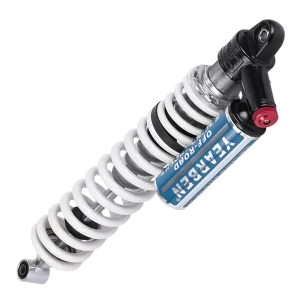
At Yearben, we set the reservoir layout after reviewing the vehicle’s duty cycle, not before. A desert truck with repeated high-speed whoops needs the remote canister placed in clean air for that reason. A trail UTV that sees mixed speeds may not gain enough from the hose and bracket complexity to justify it.
Oil Volume and Packaging Set the Cooling Limits
More oil delays the temperature climb because the same heat input is spread across a larger fluid mass. Remote and piggyback reservoir shocks both add oil volume compared with a smooth body emulsion shock. The remote layout usually does this more effectively in packaged UTV and buggy installations, because the canister diameter and length are not limited by the spring perch or upper mount.
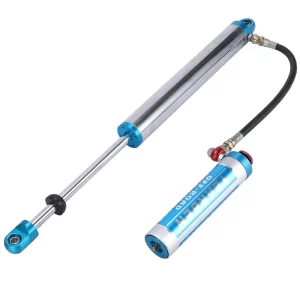
| Factor | Remote Reservoir Shocks | Piggyback Reservoir Shocks |
| Oil Volume | Usually higher in packaged installs | Limited by spring perch and mount area |
| Surface Area | Can be placed in clean airflow | Restricted to the shock body zone |
| Packaging | Requires hose and bracket routing | Self contained on the shock body |
| Service Access | More fittings to inspect | Fewer leak paths |
| Best Fit | Sustained high-load and desert running | Short-course, trail, and tight packaging |
A piggyback canister has to live next to the coil spring and the vehicle’s upper arm. That limits its diameter before it starts hitting brackets, brake lines, or bodywork. Packaging constraints then feed back into the thermal design. A compact piggyback still cools better than a non-reservoir damper, but its maximum oil volume is lower than what a well-placed remote canister can carry in the same vehicle.
For procurement teams, the packaging tradeoff is the first specification to lock. The shock mount, tire clearance, and spring rate all constrain whether a piggyback canister fits without a new bracket design. Once the physical envelope is fixed, the cooling comparison becomes a calculation rather than a preference.
Piggyback Cooling Works Well in Short-Course Use
Not every reservoir shock runs hot. Short-course ATV racing, trail riding, and mixed-speed UTV work rarely hold peak damping loads long enough for the heat gap between remote and piggyback designs to matter. In these conditions, piggyback reservoir shocks are easier to mount, easier to service, and less likely to catch a hose on a rock or branch.
I have seen piggyback shocks come off a 20-minute motocross-style ATV session at a stable damping temperature, with no fade that the rider could feel. The advantage of the remote canister shows up when the load stays high for ten or fifteen minutes at a stretch, not when the vehicle works in bursts. If your program includes trail machines or general-purpose UTVs, piggyback cooling is usually enough.
The decision point belongs here. If your build runs deep sand, high-speed desert, or sustained rock crawling at low airflow, confirm canister surface area and hose routing before locking the bill of materials. Send your platform details to info@yearbenshocks.com and we will check the numbers against your duty cycle.
Sustained High-Load Runs Favor Remote Reservoir Shocks
Remote reservoir shocks earn their place when the vehicle keeps working at high shaft speeds and high damping forces. The external canister adds oil volume, increases surface area, and can be routed into airflow that the shock body never sees. Those three factors compound. A shock that starts its run measurably cooler will stay within the damper’s stable viscosity window longer, which keeps rebound and compression behavior more consistent lap after lap.
Heat does two things to a hydraulic damper. It lowers oil viscosity, and it expands the fluid and gas charge. As viscosity drops, the valve stack that felt controlled at minute five behaves softer at minute twenty-five. As the gas charge rises, cavitation risk changes. A remote canister does not stop that process, but it slows it enough that a race team can tune for a narrower temperature band.
In our long-travel and desert-oriented reservoir shock programs, I prefer the remote layout for any vehicle that will run wide open for more than a few minutes. The bracket and hose add cost and service points, but the damping consistency buys back more than a faster lap time. It keeps the setup predictable for the driver, and that is the point of a performance damper. 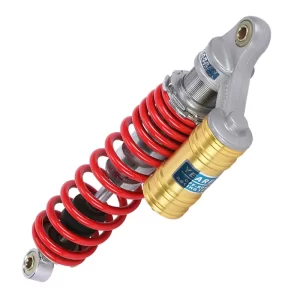
Matching Reservoir Shock Cooling to Your Program
Every build has a cooling limit that comes from three data points: vehicle weight, shaft speed profile, and available airflow. A remote reservoir can have the best theoretical heat rejection and still be the wrong choice if the hose routing creates a leak path or the bracket interferes with suspension travel. A piggyback can fit cleanly and still fade if the duty cycle is too hot.
That is why we start with the duty cycle before quoting. Tell us the vehicle platform, typical terrain, and run duration, and we will give you a reservoir shock recommendation that fits the actual package. For a remote reservoir shock program, we confirm canister placement, hose length, fitting orientation, and seal test points before release. For piggyback reservoir shocks, we verify spring perch clearance and upper mount clearance first.
Send your part numbers, travel, and expected terrain to info@yearbenshocks.com, or call +86-523-86566899. If you are still deciding between remote and piggyback cooling, send the platform details and we will return a written recommendation with the reasoning.
Common Questions About Remote and Piggyback Cooling
Does a remote reservoir always run cooler than a piggyback?
Not in every package. A remote reservoir cools best when the canister sits in clean airflow and the hose length does not add excessive restriction. If the remote canister is buried next to the exhaust or the hose runs across a hot engine, the thermal advantage shrinks. The cooling gain comes from the total system layout, not from the remote canister by itself. We have seen poor remote placement lose to a well-packaged piggyback in the same vehicle.
Is piggyback cooling enough for desert racing?
It depends on run duration and vehicle weight. For lightweight ATVs running short heats, piggyback reservoir shocks often hold a stable damping temperature. For heavier UTVs or trucks running at sustained speed across sand, we specify remote reservoir shocks because the heat load stays high with less natural airflow. If the race format includes long flat-out sections, the remote layout is the safer starting point.
What causes a remote reservoir shock to leak at the hose?
Most hose leaks are not caused by the hose itself. The common failure points are fitting misalignment during assembly, a hose length that pulls tight at full droop, or a bracket that flexes under load and works the fitting loose. In our remote reservoir programs, we set the hose routing at full compression and full droop before locking the bracket position. That keeps the fitting static through the entire stroke.
Can I run a piggyback shock now and convert to remote later?
Direct conversion is possible, but the valve stack and piston are tuned for the oil volume and cooling path of the original design. A remote reservoir changes both, so the damping curve may need a revalve rather than a simple canister swap. If you are evaluating that change, send your current shock part number and operating terrain to info@yearbenshocks.com, and we will confirm whether a remote reservoir conversion fits your damping curve.
If you’re interested, check out these related articles:
Hydraulic-Seat-Damper-Cylinder-Diameter-24MM
Adjustable-Shock-Absorber