Sourcing long travel coilovers that survive Baja-style terrain is not a matter of picking the cheapest ISO-certified factory on a list. I have audited dozens of shock absorber production lines over the past twenty years, and the gap between a supplier that can assemble a coilover and one that can build a long travel shock to specification is wide. Factory audit reports often miss the specific checks that matter for stroke lengths beyond 10 inches because the auditor treats a coilover like a standard gas shock. That is the wrong approach. Here is what I check during an on-site audit before recommending a partnership for long travel coilovers.
Research the Supplier Before You Travel
Fly in blind and you will waste two days on a factory that only builds 6-inch-travel ATV shocks. Before booking a ticket, request a completed capability questionnaire. I ask for a list of long travel coilover projects they have shipped in the past three years, including stroke length, spring configuration, and end-user vehicle platform. A factory that cannot name a single project with over 10 inches of stroke is not a long travel supplier.
At this stage, you also confirm whether they have existing tooling for the extended body lengths your design requires. Tooling up a new shock body, piston rod, and reservoir bracket set can add weeks to the lead time and push MOQ beyond your initial budget. Ask directly: “What is the maximum stroke length you have produced with tooling already on your shelf?” If the answer is under 9 inches and you need 12, you are paying for new tool development whether they admit it or not.
Walk the Production Line and Inspect Assembly
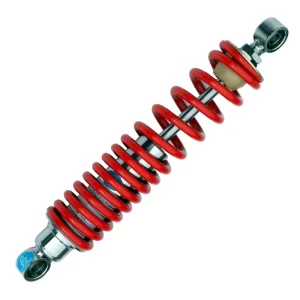
I start my line walk at welding. On a long travel shock, the spring perch, reservoir bracket, and mounting eyelet all carry higher cyclic loads than a standard street shock because the suspension cycles more violently and over a longer arc. I check three things: weld penetration on the spring perch (a surface bead that looks clean but lacks root fusion will crack after a few desert runs), alignment of the reservoir bracket to the shock body, and the condition of the welding jig. A worn fixture produces small angular misalignments that cause seal wear later.
Next, I look at cylinder bore finish. For a shock that will see high-speed shaft movement across 12 to 16 inches of travel, the inner tube surface needs a consistent crosshatch pattern and a roughness average below 0.2 µm. The factory should have a profilometer on the line and be able to show you the last batch measurement. If they run a fingernail across the bore and call it good, walk away.
Spring preload setting is another checkpoint. Some shops preload by counting turns of the collar; others use a spring rate tester and set to a measured load at installed height. For dual-rate springs common on long travel builds, the preload on the tender spring relative to the main spring directly affects how the shock transitions through its stroke. I want to see a documented preload procedure for each order, not a mechanic setting by feel.
Verify Quality Control and Testing Equipment
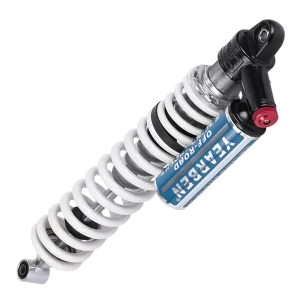
A shock dyno in the corner that has not been calibrated in six months is worse than no dyno at all because it generates numbers people believe. I verify the calibration log first. Then I ask to see a dyno plot from a recent production batch and compare it to the force-velocity specification sheet. Acceptable deviation on a long travel shock is typically under 8% at the target shaft speed. More than that and you will feel the inconsistency across four corners.
Seal integrity testing is non-negotiable. Long travel shocks spend significant time at full extension and compression, pushing the seal against the rod under high pressure. The factory should run a cycle test on a sample from each batch: 10,000 cycles at full stroke while monitoring for oil weepage. I check the test bench for correct mounting angle because testing at a straight vertical stroke while the vehicle runs at an articulation angle misses the sideload that causes real-world leaks.
The other piece of testing equipment that separates a serious supplier from a trading company is a dedicated nitrogen charging station with a pressure decay test. A coilover charged to 150 psi that leaks down to 120 psi over 72 hours is not caught by a visual bubble check. The factory should log initial pressure, hold time, and final pressure for every shock. Request to see a sample log during the audit.
| Coilover Type | Key Feature | Audit Check | Common Issue |
|---|---|---|---|
| Emulsion | Oil and gas mixed in one body | Check dyno plot for cavitation at high shaft speed | Damping fade on long runs |
| Piggyback Reservoir | External reservoir bolted to body | Inspect hose crimp and bracket weld | Hose rub against body causing failure |
| Remote Reservoir | Reservoir mounted off-shock | Verify hose length and pressure test hose assembly | Hose bursting at crimp under full droop |
| Bypass | Multiple compression and rebound adjustment zones | Confirm tube manufacturing accuracy (zone positions) | Zone position drift batch to batch |
If your application pushes past 12 inches of travel, the validation procedures become more critical. It is worth confirming the factory’s fatigue test protocol matches your expected cycle count before you proceed. For programs involving custom valving, we typically request a dyno overlay of the production sample versus the target curve before signing off. Reach out at info@yearbenshocks.com with your intended stroke and vehicle weight, and we can share what specific test data to request.
Evaluate Customization and Engineering Support
Long travel coilovers are rarely off-the-shelf items. You will need a supplier who can read your suspension geometry and adjust shock dimensions accordingly. I look for in-house engineering capability: at least one engineer who can open a 3D model, check eye-to-eye extended and compressed lengths, and confirm the spring perch will not bind at max articulation. A salesperson who says “send the sample and we’ll copy it” is not engineering support.
Ask to see a revision history of a previous custom project. A factory that can show you how they changed piston valving, spring rate, and reservoir hose routing over three revisions in response to field testing feedback is one that will iterate with you. This is especially important for long travel applications where the suspension geometry changes significantly with lift height and control arm length.
On the manufacturing side, confirm that spring suppliers are not a black box. The factory should have spring rate test data from their spring manufacturer and be able to match a set of four springs within a 2% rate tolerance. I have seen pairs of springs labeled “250 lb/in” that measured 240 and 265; that mismatch on a long travel coilover sends one front corner into a different frequency than the other.
After the Audit: Samples and Next Steps
No audit report replaces a sample order. Before committing to a production run, order three pre-production samples built to your full specification, including spring rates, valving, and hose length. Install them on a test vehicle or test fixture and run at least five hard cycles across the full stroke. Check for oil misting around the seal, shock body temperature rise, and any change in damping feel over the test period. Compare the dyno sheet that arrived with the samples to the original spec you provided.
When the samples pass, lock down the production spec sheet with tolerance bands on every dimension: extended length, compressed length, spring rate, nitrogen pressure, and damping force at three shaft speeds. A vague “same as sample” language in the contract is how you receive a future batch with cost-cut springs and a different oil fill.
Finally, agree on in-process inspection points. I prefer to see one inspection gate after welding, one after nitrogen charging, and a final dyno pull on 100% of shocks in the first three batches. For large volume, a valid sampling plan like AQL 1.0 can be discussed, but never on the first run.
What Importers Ask About Long Travel Coilover Audits
How long does a typical factory audit take?
A thorough audit of a shock absorber production line takes one full day on site. Arrive at 8 AM, walk the line, review QC logs, witness testing procedures, and sit down with engineering to review a past project. If you try to compress it into a half day, you will skip the dynamometer verification or the seal test observation, both of which are where problems hide. Schedule a second half-day only if you need to review spring sourcing or discuss a custom design in depth.
Do I need to audit the factory in person, or can I do it remotely?
Remote audits via video call work for a preliminary filter, but they cannot replace an on-site visit. A factory that knows the camera is on will show you the one clean dyno station and skip the worn welding fixture in the corner. I have done remote audits followed by on-site visits and found discrepancies in tooling condition and testing throughput every time. If the order value is significant, fly in.
What is a realistic MOQ for custom long travel coilovers from a Chinese supplier?
It depends on the level of customization. For a design using existing body tooling with custom valving and spring rates, MOQs can be as low as 20 pairs. For a fully new extended body that requires new cylinder tooling, expect an MOQ around 100 pairs. Ask the factory to break down the tooling cost separately from the per-unit cost so you can negotiate reorders without repaying tooling amortization.
If you have a vehicle platform that demands specific stroke lengths and you are uncertain where to start with the audit checklist, share your requirements with us at info@yearbenshocks.com or call +86-523-86566899. We can walk through the five checks above with your exact application in mind and confirm which documentation to request before your visit.
If you’re interested, check out these related articles:
Heavy duty seat damper 35mm, Shock Absorber Manufacturer
Off-Road-Coilover-Shocks
Custom-Shocks-And-Struts
Off-Road-Coil-Over-Shocks-Manufacturer