Off-road vehicles that regularly swallow whoops at speed or climb ledges depend on one critical design choice: long travel suspension. The term refers to a suspension geometry engineered to allow significantly greater wheel articulation than factory setups, typically exceeding 12 inches of vertical movement at each corner. The payoff is improved terrain compliance, reduced shock loading into the chassis, and the ability to keep the tires in contact with the ground when stock arms would have already lifted a wheel. That contact is the difference between forward drive and a stuck vehicle. Not every off-road build needs long travel, but for anyone running desert washouts, sand dunes, or rock gardens at pace, the engineering trade-offs point in one direction.
What Is Long Travel Suspension?
Long travel suspension is a suspension design that extends the range of wheel motion beyond the limitations set by a factory platform. Where a stock half-ton truck might offer 7 to 9 inches of front wheel travel, a proper long travel kit pushes that number past 12 inches and, in dedicated desert racing builds, beyond 20 inches. The extra stroke comes from a combination of longer control arms, revised mounting points on the frame or subframe, extended axles, and dampers with correspondingly longer stroke lengths.
The defining characteristic is not simply a taller ride height. A leveled truck with spacer lifts still operates within the same arc of control arm motion. Long travel suspension changes the arc itself. The upper and lower control arms are lengthened and repositioned to create a wider motion envelope, which also widens the track width. That track width gain improves lateral stability at the same time the longer stroke improves straight-line compliance.
For the suspension to actually use that envelope, the shock absorber stroke must match. This is where off-the-shelf replacement shocks fall short. A shock designed for 8 inches of stroke will top out or bottom out long before the control arm reaches its limit, converting the potential travel into a mechanical stop that breaks parts. Matching the shock stroke to the geometry is the first integration step that separates a working system from a parts-collection exercise.
Why Does Wheel Travel Matter Off-Road?
More wheel travel means each tire can follow the ground independently through deeper irregularities without lifting. When one front tire drops into a rut while the opposite side crests a rock, a short-travel suspension unloads the dropping tire early. That tire loses contact, and the vehicle loses steering and braking force on that corner. In a sand wash at speed, that moment of lost contact causes the front end to wander. On a rock face, it stops forward progress.
Long travel suspension keeps the tire pushed into the terrain for a longer portion of the suspension cycle. This does not just add comfort. It maintains the vehicle’s ability to put power down and steer predictably on surfaces that are constantly changing shape. The reduction in chassis motion also lowers the frequency at which the driver has to correct steering inputs. The vehicle does more of the terrain reading on its own, which reduces driver fatigue over multi-hour desert legs.
Heat management is the secondary benefit that buyers often overlook. A longer stroke spreads the damping work across a larger volume of fluid. Instead of compressing a short-stroke shock violently and repeatedly, the damper piston moves further but with reduced peak velocity for the same wheel speed. The lower peak fluid velocity produces less instantaneous heat, and the larger oil volume in a long-stroke shock helps dissipate that heat more effectively. On sustained high-speed runs where shock fade kills short-travel setups, this difference is measurable.
What Components Make Up a Long Travel Suspension System?
A complete long travel suspension kit includes more than just shocks. The control arms are the most visible change. Upper and lower arms are fabricated from chromoly or DOM steel tubing, with the inboard mounting points moved further outward on the chassis. That relocation, combined with longer arm lengths, defines the new wheel path. The arms connect to the spindle via high-misalignment uniball or ball-joint assemblies that tolerate the wider angular sweep without binding.
Axles follow the arms. Extended-length halfshafts or driveshafts with higher-angle CV joints are required to transmit power through the full range of motion. Standard CV joints quickly reach their angular limit and begin to bind, which destroys the joint and sends vibration through the driveline. Plunging inner joints or slip-yoke designs accommodate the length change that occurs as the suspension cycles through its arc.
Spring selection is often misunderstood. A longer travel system does not automatically need a stiffer spring. The motion ratio changes with the arm geometry, and a spring that was appropriate for the stock motion ratio may now produce an entirely different wheel rate. Matching the spring rate to the new motion ratio and the vehicle’s corner weight is what determines whether the front end floats or bottoms predictably. I always run the wheel-rate calculation against the actual corner weight before specifying a coilover spring, because getting it wrong makes even a well-valved shock feel harsh or mushy.
How Do Shock Absorbers Control Long Travel Movement?
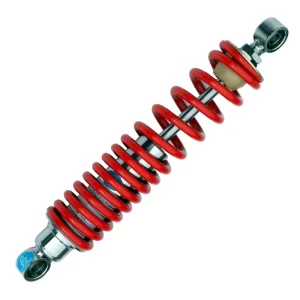
Dampers are the component that most directly determines how well a long travel system actually works off-road. The shock absorber is responsible for converting the kinetic energy of the unsprung mass into heat, and for metering that conversion across compression and rebound. In a long travel application, the damper must manage a larger volume of oil movement, a longer piston stroke, and higher sustained loads than in a stock suspension.
Emulsion vs Piggyback vs Remote Reservoir Shocks
The choice of damper architecture determines how the shock handles heat and cavitation over extended use. An emulsion shock mixes the oil and nitrogen charge inside the main body. That design is simple and cost-effective, but under sustained high-frequency cycling the oil aerates and damping consistency drops. For moderate-speed trail use, emulsion shocks can be sufficient.
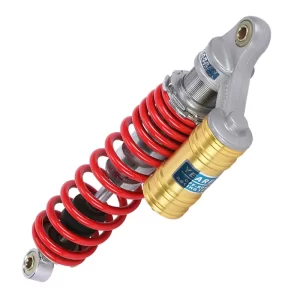
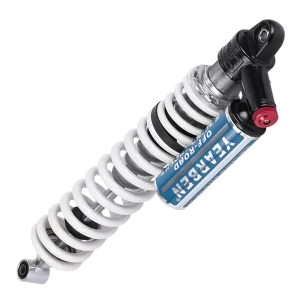
A piggyback reservoir bolts directly to the shock body and separates the oil and nitrogen with a floating piston. The separated gas charge provides more consistent damping and better heat dissipation because the oil stays bubble-free. The compact packaging makes piggybacks a good fit for tight engine bays or mid-travel applications where a remote reservoir would be difficult to route.
Remote reservoir shocks take the separation further by moving the reservoir away from the shock body via a high-pressure hose. This increases the total oil volume and places the reservoir in a location with better airflow, which helps in sustained high-speed desert use. For vehicles running hard in ambient temperatures above 38°C (100°F), the extra cooling capacity of a remote reservoir is not a luxury. The table below summarizes the differences.
| Feature | Emulsion | Piggyback Reservoir | Remote Reservoir |
|---|---|---|---|
| Oil/Nitrogen Separation | Mixed in body | Floating piston, attached | Floating piston, remote |
| Aeration Resistance | Low | High | Highest |
| Heat Dissipation | Moderate | Good | Best |
| Packaging Complexity | Simple | Compact | Requires hose routing |
| Typical Use Case | Casual trail | Performance trail/light desert | Desert racing, heavy sustained use |
Valving and Damping Tuning for Long Travel
A longer stroke shock sees a different piston velocity profile than its short-stroke equivalent. Time spent near the middle of the stroke is proportionally longer. Valving that works on an 8-inch shock can feel underdamped at low shaft speeds on a 14-inch shock. The solution is a digressive or progressive valving curve tailored to the expected shaft speeds of the specific vehicle and terrain. At Yearben, when we develop a long travel shock for a customer, we map the expected velocity envelope based on vehicle weight, intended speed, and the spring rate the builder selected, then valve the piston accordingly. No off-the-shelf tune covers all uses.
If your program involves sustained high-speed running in sand or silt, it is worth confirming the nitrogen charge pressure and oil-volume specification with the factory before locking in the order. A shock that is slightly undercharged or undersized for the heat load will fade predictably after 20 minutes of hard running. For technical questions on damper specs, reach out at info@yearbenshocks.com.
How Should You Match Shocks to Vehicle Weight and Terrain?
The shock and spring combination must be matched to two numbers that matter more than any catalog description: the sprung corner weight and the intended terrain speed. A box-stock long travel kit arrives with a generic spring rate and a middle-of-the-road valving profile. That generic setup will function, but it will leave performance on the table because it was built for a weight range, not your specific vehicle.
Weigh each corner of the vehicle with full fluids, occupants, and spare equipment aboard. That gives you the actual sprung mass the shock will control. From that weight, calculate the required spring rate using the motion ratio of the specific long travel kit. Do not rely on the kit supplier’s spring recommendation without checking the math: a heavy winch, a tube bumper, or a full-size spare hanging off the back can add over 100 pounds to a corner, pushing the spring rate up by 50 lb/in or more.
Valving follows the weight and the terrain. A vehicle that spends most of its time crawling at low speed needs generous low-speed compression valving to resist body roll and brake dive, but not much high-speed damping. A desert runner sees sustained high-speed shaft movement and needs a firmer high-speed compression stack to prevent the piston from blowing through the stroke. These are not interchangeable settings. I have seen vehicles built for rock crawling suffer from stiff aftermarket valving that never opened the high-speed circuit, making the ride punishing over washboard while the axle refused to drop into holes.
Sourcing Custom Shocks for Your Build
When standard-length catalog shocks cannot deliver the stroke or valving the vehicle needs, a custom damper order makes sense. That order should start with the stroke length, extended and collapsed lengths, mounting type, spring rate, and the terrain description. A factory that only asks for “a long travel shock for a Toyota” is not asking for enough information. At Yearben, we request the stroke, corner weight, and intended use before recommending a body size, reservoir type, and valving curve. That ensures the shock works as an integrated part of the system rather than a random component. For OEM projects or one-off builds, sending the bump-stop to full-droop measurements and a few photos of the mounting points is enough to begin a design conversation.
What Are the Most Common Questions About Long Travel Suspension?
Does long travel suspension make a vehicle less reliable on the street?
Reliability depends on the build quality, not the stroke length. A properly fabricated long travel kit with reinforced mounting points, high-angle CV joints, and correctly sized hardware can be driven daily. The wider track and softer spring rates do change the steering feel. Bump steer becomes more pronounced if the tie-rod geometry is not corrected, and body roll increases without an upgraded sway bar. These are solvable problems, but they require attention during the build. When we supply custom coilovers for a long travel conversion, we always ask whether the vehicle will see street miles, because the valving and spring rate often need a different bias for pavement than for pure off-road.
Can I run long travel suspension with my factory shocks?
No. The extended stroke will either top out or bottom out the factory shock before the control arm reaches its full travel, which snaps internal components. Even if the stroke length happened to match, the factory valving is tuned for a completely different motion ratio and corner weight. Installing a long travel kit without replacing the shocks turns a significant investment into a damaged vehicle. The shock and the arm geometry are a paired system; replacing one without the other defeats the purpose.
How much should I budget for a proper long travel suspension setup?
A front-only long travel kit with high-quality control arms, axles, and coilover shocks typically runs between $3,500 and $7,000, depending on the vehicle platform and the damper specifications. A full four-corner setup with remote reservoir shocks and custom valving can exceed $12,000. The largest cost driver is the shock absorber: a well-built race-grade coilover with remote reservoir and custom tuning costs more than the arms themselves. Cutting the shock budget is a mistake buyers often regret, because it is the shock that determines how the suspension rides, not the arm length.
What is the difference between mid-travel and long travel?
Mid-travel usually describes a system that adds 2 to 4 inches of wheel travel compared to stock, typically using a slightly longer arm and an aftermarket shock, while retaining the factory mounting points and axle configuration. Long travel involves substantially longer arms, relocated mounting points, and extended axles, adding 6 inches or more of travel. On many trucks, mid-travel brings the front travel to 10 to 11 inches; long travel pushes it past 13 inches. The jump from mid to long travel is a structural change to the vehicle, not a bolt-on upgrade.
What do I need to provide when ordering custom long travel shocks?
Four measurements get the conversation started: the extended and collapsed lengths between the mounting eyes, the total available stroke of the suspension, the vehicle’s corner weight, and the primary terrain type. A photo of the upper and lower shock mounts helps confirm the hardware size and orientation. If you are building a desert truck or rock crawler and need a damping solution matched to your exact travel numbers, share your requirements with our engineering team at info@yearbenshocks.com or call +86-523-86566899. Those four data points let us confirm whether an existing model fits or whether a custom stroke is necessary.
If you’re interested, check out these related articles:
Monotube-Shock-For-Off-Road
Adjustable Seat Damper 41.5mm
Hydraulic-Shock-Absorber-24MM
Piggyback-2-0-Coilover-Shock
Best-Off-Road-Coilover