OEM buyers looking to launch a custom steering damper often assume the hard part is finding a factory. The reality is different. The hardest part is supplying a drawing that the factory can build from without weeks of questions, missing tolerances, and trial-and-error sampling. I’ve seen programs stall for two months because a single dimension on the mounting eyelet wasn’t toleranced. This guide walks through the full process, from the initial drawing to the first production batch, so you know exactly what the engineering team needs and what to expect at each stage.
What a Factory-Ready Steering Damper Drawing Should Include
A complete drawing does more than show the overall length. It defines the interfaces, the materials, and the expected behavior of the damper. Without these, the factory is guessing. When we receive a drawing that is missing three of the items below, quoting slows by at least a week.
Minimum drawing details:
| Parameter | Why it Matters |
|---|---|
| Extended and compressed lengths | Sets the stroke and packaging envelope; the factory uses this to confirm rod and body length |
| Mounting eyelet inner diameter and width | The most common source of fitment returns; must include tolerance (plus or minus 0.1 mm is typical) |
| Piston rod diameter and surface finish | Affects seal life and breakaway friction; hard chrome with 10–20 µm thickness is standard for off-road applications |
| Damping force specification in Newtons at a given velocity | Lets the factory valve the piston correctly; if missing, the first samples will almost certainly feel wrong |
| Working angle and attachment hardware | Determines bushing type and whether a spherical bearing is necessary to prevent binding |
If the vehicle is a prototype or one-off, include the steering geometry data. Without it, the factory cannot calculate the required stroke. I’ve had a customer send a drawing that looked complete but omitted the rod diameter. The factory assumed a 14 mm rod, but the real load demanded 16 mm. The first samples bent on the first field test.
How an OEM Evaluates Your Design for Manufacturability
Once the drawing arrives, the engineering team at the factory runs a formal design review. The goal is not to reject the design but to flag any dimension that is physically impossible to machine, test, or assemble with the available tooling. Over the years, these are the three review points that cause the most delays.
Piston-to-Body Clearance and Honing Tolerance
The piston must maintain a sliding seal inside the cylinder body. If the clearance is too tight, the damper will seize when hot. If it’s too loose, damping force drops and oil bypasses the piston. A typical working clearance is 0.04 to 0.08 mm on diameter, depending on the piston seal material. The factory will check whether the specified cylinder bore and piston O.D. allow a honing process that can hold that tolerance across a batch. If the drawing calls for a rolled tube with a raw inner surface instead of a honed tube, we will push back on seal longevity.
Rod Straightness and Hard Chrome Adhesion
A steering damper rod cycles under side loads. A rod that isn’t straight within 0.15 mm TIR over the full length will cause premature seal wear and internal scoring. The hard chrome layer must bond without microcracks. In our production, we check every rod on a profilometer after chrome plating. If the drawing does not specify a surface roughness of Ra 0.2 µm or better on the rod, we flag it and ask if the customer is aware of the potential leak risk.
Mounting Eyelet Stress and Weld Integrity
The eyelets take the full steering force. A weld failure here is a safety issue. The factory will check whether the eyelet is welded, threaded, or machined from solid and whether the wall thickness around the bushing is sufficient. If the drawing shows a 5 mm wall thickness and the damper is for a heavy UTV, we will recommend increasing to 7 mm minimum. This is one of those details where a few minutes of engineering review before tooling saves thousands in warranty claims.
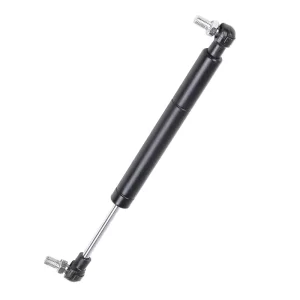
How Custom Steering Dampers Are Manufactured Step by Step
After the drawing is approved and the tooling is confirmed, production follows a sequence that hasn’t changed much in principle but has gotten far more precise in measurement. Understanding these steps helps when you need to estimate lead times or troubleshoot a quality issue.
Step 1: Cylinder tube preparation. The tube stock is cut to length, and the inner bore is honed to the specified finish. For off-road dampers, we use a cross-hatch pattern that retains oil and reduces piston stiction.
Step 2: Piston rod machining and chrome plating. The rod is turned from alloy steel bar stock, ground to diameter, and sent for hard chrome plating. After plating, it’s polished to the required Ra. Every rod is measured for diameter and straightness before assembly.
Step 3: Piston and valving stack assembly. The piston is match-machined to the cylinder bore, and the valving shims are stacked to achieve the damping force curve on the drawing. We run a first-article test on a dynamometer at three velocities to confirm the curve before building the rest of the batch.
Step 4: Welding and seal installation. The end cap and mounting eyelets are welded to the body and rod. We use a dual-seal system with a rod scraper and a low-friction primary seal. The eyelet welds are checked with a dye-penetrant inspection on the first five pieces of every batch.
Step 5: Oil filling and final assembly. The damper is filled with a high-index damping oil, purged of air, and closed. The completed unit is cycled on a test stand to check for consistent damping force, smooth travel, and any noise or hydraulic knock.
The whole process from drawing approval to first-article samples typically takes four to six weeks, assuming no unexpected tooling changes. If the order requires a new mold for rubber bushings or a specific color anodizing, add two weeks.
Testing and Quality Control for Custom Steering Dampers
A steering damper that leaves the factory without testing is a warranty claim waiting to happen. The testing protocol that makes the most difference to OEM buyers isn’t the high-tech dynamometer curve; it’s the simplest one: a consistent, repeatable force-velocity check across every unit in the batch.
What a Good QC Report Should Show
Every batch of custom dampers should come with a report that includes at least these three data points:
- Damping force at 0.1 m/s, 0.3 m/s, and 0.5 m/s for compression and rebound.
- Gas charge pressure (if applicable) at room temperature.
- Rod straightness and chrome thickness measurements for a sample size defined in the contract.
We test 100 percent of custom steering dampers on a dedicated test stand before packaging. The stand runs a full stroke at three speeds and plots the force curve. If any unit falls outside the agreed tolerance band, it is pulled and reworked. I’ve seen competitors ship dampers that were only batch-tested at 10 percent, and those orders always come back with at least a handful of units that feel noticeably softer. The additional testing cost is small compared to a recall.
Common Questions When Ordering Custom Steering Dampers
What’s the typical lead time for a new custom steering damper design?
Lead time runs four to eight weeks for first-article samples, depending on whether the design requires new tooling for end fittings or rubber bushings. A damper that uses existing tooling and only changes the valving and stroke can ship samples in three weeks. Production quantities after approval usually add another four weeks for the first run. The biggest variable is always the drawing approval phase; if the factory finds issues, the clock resets.
How do I protect my custom design from being sold to another buyer?
Specify exclusivity in the supply agreement. We routinely sign mutual nondisclosure agreements before even reviewing a drawing, and the final contract can include a clause that prohibits the factory from selling your specific damper geometry to another party for a defined period. Tooling that you pay for also acts as a practical barrier; the factory cannot easily reuse it for another buyer without your permission.
What’s the minimum order quantity for a fully customized steering damper?
A typical MOQ starts at 100 to 200 units for a completely new design, because the tooling cost needs to be amortized. If you are prototyping or need a small pre-production run, we can often accommodate 20 to 50 units at a higher unit cost. The exact number depends on how many custom components are required. A damper that uses a standard body size but a custom rod and valving can be done at 50 pieces.
Can a factory match an existing damper if I send a sample?
Yes. We reverse-engineer samples frequently. The process involves measuring all critical dimensions, testing the damping force curve on a dynamometer, and disassembling one unit to check the piston design and seal type. That data is used to create a production drawing, which we send to you for approval before cutting any metal. The turnaround for this is about three weeks for a sample match and another four for the first batch.
How do I know the production batch will match the approved sample?
Ask for a first-article inspection report that covers the agreed control dimensions and damping force, and then specify in the contract that subsequent production batches must not deviate beyond the established tolerance band. We also recommend that the buyer perform a random incoming inspection on the first shipment. A good factory will welcome that because it aligns expectations. If your project involves a high-volume run with zero tolerance for field failures, share your part number and annual forecast with us at info@yearbenshocks.com; we can structure a production validation plan before the first batch ships.
If you’re interested, check out these related articles:
Adjustable-Shock-Absorber-For-Car
Utv-Shocks-For-Off-Road
Triple-Bypass-Remote-Reservoir-Shock