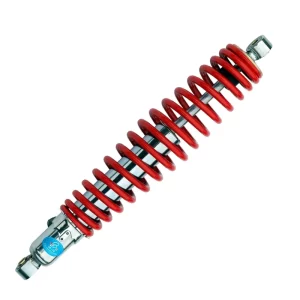
Coilover max travel is a number that gets quoted often, but what it actually delivers for a specific build is rarely straightforward. I have spent over twenty years designing and refining coilover specifications for ATV, UTV, and special-purpose off-road vehicles, and I’ve learned that maximum travel is never an isolated spec. It is the result of shock body length, suspension geometry, and the way the vehicle loads every millimeter of stroke. This article explains the real engineering constraints behind travel ratings and what to check before committing to a number on a catalog page.
The Definition of Max Travel and Why It Matters
A coilover’s maximum travel is the total axial movement the shock absorber can make from full extension to full compression. This measurement, often called stroke, determines how much vertical wheel articulation the suspension can deliver before the shock binds or bottoms out. It matters because too little travel limits vehicle capability on rough terrain, while too much without proper geometry can cause tire rubbing, driveline binding, or loss of control. Builders need to see max travel as a system parameter, not a standalone performance number.
Key Dimensions: Stroke, Extended Length, and Compressed Length
To size a coilover correctly, three dimensions matter: stroke, extended length, and compressed length. Stroke equals extended length minus compressed length, but that simple equation hides practical complexities. The shock must be mounted with enough clearance at full compression for the bump stop and enough droop at full extension before the spring unseats. For ATV applications, coilovers with strokes of 80 mm to 120 mm are common, while UTV shocks may reach 150 mm or more. The overall shock length from eye to eye must also fit the mounting points without interfering with chassis, control arms, or brake lines.
| Vehicle Type | Typical Stroke (mm) | Typical Body Diameter (mm) |
|---|---|---|
| ATV | 80–120 | 36–46 |
| UTV | 120–180 | 46–60 |
| Off-Road Truck | 150–250 | 60–73 |
| Desert Buggy | 200–300 | 60–73 |
How Suspension Geometry Limits Actual Wheel Travel
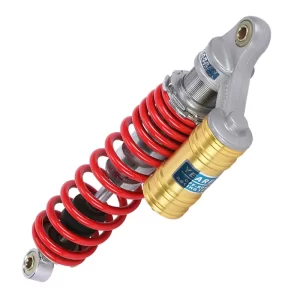
A shock with 10 inches of stroke does not guarantee 10 inches of wheel travel. The suspension linkage creates a motion ratio that amplifies or reduces shock movement relative to wheel movement. In many double-wishbone ATV front suspensions, the motion ratio is roughly 0.6 to 0.8, so 100 mm of shock stroke can produce 125 to 165 mm of wheel travel. The exact number depends on where the shock is mounted along the control arm and the angle of the link. If the geometry is not designed correctly, you can end up with a shock that maxes out before the wheel does, limiting travel artificially. In custom builds, we often start by defining the desired wheel travel and working backward to the required shock stroke and mounting positions.
OEM Customization: Extending Travel Beyond Standard Catalogs
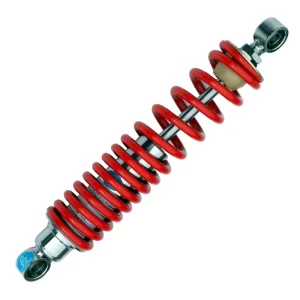
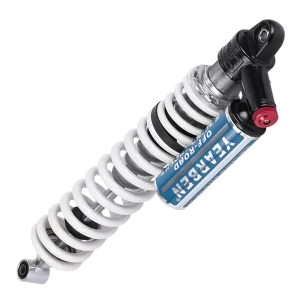
Off-the-shelf coilovers are designed to cover a broad range of vehicles, which means the stroke is fixed to common lengths. When a builder needs more travel than standard, a custom OEM shock is the answer. At Yearben, we can extend the shock body and shaft to increase stroke, provided the spring pocket, reservoir packaging, and seal design are recalculated. We have built coilovers with up to 300 mm of stroke for sand rail applications by using a larger body tube and a remote reservoir that moves the gas charge away from the main piston. This approach removes the stroke limitation caused by internal floating piston travel. The key is to work with the factory early, sharing the vehicle’s suspension geometry and intended use so the shock dimensions are engineered to match, not picked from a catalog.
If your program involves building a long-travel suspension that needs a non-standard stroke, it is worth confirming the motion ratio and damper dimensions with an engineer before finalizing your bill of materials. We have seen cases where a 5 mm change in extended length made the difference between a clean install and a shock that bottomed on the first hard hit. Reach us at info@yearbenshocks.com for a design review.
Practical Limits: Heat, Valving, and Durability at Full Travel
Pushing a coilover to its maximum travel repeatedly generates heat that can thin the oil, alter damping, and accelerate seal wear. The faster the shaft moves through the oil, the higher the risk of cavitation behind the piston, especially if the reservoir pressure or internal valving is not tuned for the stroke length. Durability at full travel also depends on shaft diameter: a longer stroke with a thin shaft may bend under high lateral loads. When we design a custom coilover for extreme travel applications, we match the shaft size, piston band material, and oil volume to the expected stroke frequency and loads. This prevents fade and premature failure.
When you are specifying a coilover for your build, the max travel figure on paper is just the start. Getting the right combination of stroke, geometry, and durability takes a tailored approach. At Yearben Shock Absorber Technology, we support OEMs and custom builders with coilovers engineered to meet exact travel and performance requirements. Send your vehicle specs, current suspension measurements, and target wheel travel to info@yearbenshocks.com, or call +86-523-86566899, and we will work through the constraints before you commit to a final design.
Common Questions About Coilover Travel Specifications
What is the difference between shock travel and wheel travel?
Shock travel is the distance the shock shaft moves inside the body, while wheel travel is the vertical movement of the wheel at the hub. The motion ratio of the suspension linkage converts shock travel to wheel travel. In many vehicles, wheel travel is larger because the shock is mounted inboard on the control arm.
Can I increase my coilover’s travel by adding a longer spring?
No. Spring length changes ride height and preload, but the internal stroke of the shock is fixed by the length of the body and shaft. To increase travel, you need a shock with a longer body and longer shaft, or a different mounting point on the chassis.
How much travel do I need for rock crawling versus desert racing?
Rock crawling demands large articulation with lots of droop to keep tires on the ground, so max travel matters. Desert racing requires high-speed bump absorption and effective heat management. Both benefit from generous stroke, but valving and spring rates are tuned differently. A coilover with longer travel helps both disciplines, provided the suspension geometry can use it.
What happens if I exceed the rated max travel of my coilover?
Exceeding rated travel can cause the shock to bottom internally, damaging the piston, bending the shaft, or blowing seals. At full extension, the spring may unseat and cause a sudden loss of control. Always stay within the manufacturer’s specified stroke.
Can Yearben build a custom coilover with a specific max travel?
Yes. We design and manufacture coilovers to order, with stroke length and body dimensions matched to your vehicle’s geometry and performance targets. Share your requirements and we will confirm the achievable travel and durability documentation before production.
If you’re interested, check out these related articles:
Gas Charged Dual Rate Coilover Shock Absorber
Fixed-Preload-Atv-Shock-Absorbers