
A high-HP side-by-side does not corner harder because it makes more power. Power changes how quickly the machine arrives at an obstacle, how much heat the damper has to shed, and how abruptly the chassis loads and unloads over a short distance. The right UTV shock absorber for a high-HP side-by-side is therefore chosen from speed, corner mass, wheel travel and cooling capacity, not from the output figure on the badge. Pick a damper that holds its damping force across a full run, then match spring rate and valving to the geometry the car actually runs.
Why a high-HP side-by-side punishes the damper differently
Kinetic energy rises with the square of speed. A car that clears a whoop section at a higher entry speed does not simply arrive sooner; it compresses the damper faster and repeats the cycle more often in the same distance. Damping force rises with shaft velocity, so the quicker car generates far more force in an identical bump, and each of those cycles turns motion into heat inside the oil. That is the first reason a high-output build destroys dampers that survived behind a stock engine.
The second reason is load transfer. More torque reaching the ground pitches the chassis harder on corner exit, and a locked or aggressively ramped differential shifts load from the inside tire to the outside tire quickly. The damper registers that as a low-speed event, not an impact, which is why a shock tuned only for big hits can still feel restless under throttle.
The third reason is mass added without a matching damper change. Taller tires, heavier wheels, spare carriers, cages and passengers raise sprung or unsprung mass, and unsprung mass hurts most because the damper must control the wheel before the tire can follow the ground.
“It bottoms out, so it needs a stiffer spring” is the most common wrong diagnosis on these machines. Stiffening the spring raises the load the chassis carries, reduces compliance over small chop, and often leaves the real fault untouched: too little high-speed compression control, too little reserve shaft travel, or a bump stop doing work the spring should never do.
Setting spring rate and preload for a faster build
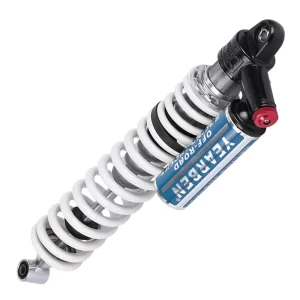
Spring rate and preload do different jobs, and confusing them is where many high-HP builds start to feel wrong.
The spring carries static load and sets ride frequency. Preload only changes where the spring sits in its travel. On a given spring, more preload raises ride height and shifts the crossover point, but it does not change the rate. If the car needs more rate, it needs a different spring, a dual-rate stack, or a different motion ratio.
Wheel rate at the tire equals spring rate multiplied by the square of the motion ratio. Move the lower mount outward on a long travel conversion and the motion ratio changes, so the same spring now delivers a different wheel rate. That is why a kit that relocates mounting points needs a recalculation rather than a copy of the previous spring.
| Parameter | What it sets | How to verify it |
|---|---|---|
| Spring rate | Wheel rate and ride frequency | Measure installed length at static ride height with the car loaded as it runs |
| Preload | Ride height and crossover timing | Record thread turns, then recheck ride height at the same fuel and passenger load |
| Crossover ring position | Where the secondary rate begins | Watch the transition during slow compression with a zip tie on the shaft |
| Eye-to-eye at full droop | Available droop travel and spring retention | Measure with the car on stands and the springs seated |
| Shaft remaining before the bump stop | Reserve travel | Fit a zip tie to the shaft and read where it stops after a run |
| Gas charge pressure | Gas spring contribution and oil separation | Check with the charge tool at a consistent temperature reference |
Set ride height with the machine in the condition it actually runs, meaning driver, passenger, tools and fuel aboard. A car set up empty will sit lower and run into the bump stop sooner once loaded.
What low-speed and high-speed adjusters actually change
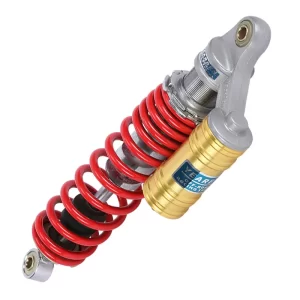
An adjuster moves the damping curve. It does not move the spring, the travel, or the mass.
Low-speed adjustment acts on the bleed path, the oil route that opens under slow shaft movement. That band covers brake dive, body roll in a corner, and the pitch that follows a throttle input. Adding low-speed control settles the chassis without making the car harsh over small stones.
High-speed adjustment acts on the shim stack or a separate high-speed circuit, and it governs what happens when the wheel meets a square edge or a whoop at speed. This is the band that protects the chassis from impact and the band that most often needs attention on a fast machine, because a damper with generous low-speed control and weak high-speed control will feel planted in a car park and violent on a rough section.
Adjustment range is finite, and it works inside the piston and shim package it was built with. If the spring rate is wrong or the shaft runs out of travel, no click will correct it. Record base settings before changing anything, count from the fully seated position rather than from memory, and note oil temperature, because a damper adjusted cold behaves differently once the oil is hot.
Adjustment clicks only move the curve inside the hardware’s range, and the shape of that curve depends on how the piston and shim stack were built. <Damping-Adjustable-Shock-Absorber> covers how an adjustable damper is configured.
Choosing between piggyback, remote reservoir and bypass for heat
Damping turns motion into heat in the oil. Oil that runs too hot thins, and thinner oil flows more easily through the same orifice, so damping force drops. That is fade, and on a high-HP car it is usually a heat problem before it is a valving problem.
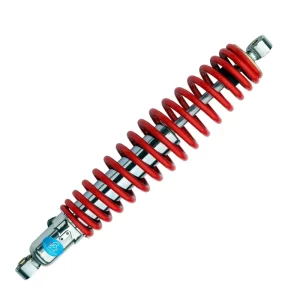
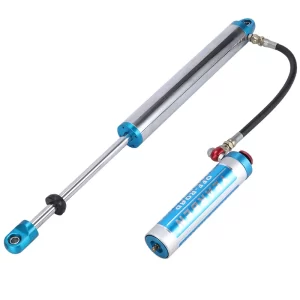
Three layouts address it differently. An emulsion damper lets gas and oil share one chamber, which is simple and compact but allows aeration under hard cycling. A piggyback reservoir keeps a separating piston close to the body and adds oil and gas volume without long plumbing. A remote reservoir moves that volume away from the body on a hose, which improves cooling and mounting freedom but adds a hose and fitting as service points. A bypass damper adds external tubes with position-sensitive valving, giving separate control zones over the stroke at the cost of more tuning variables and more places to leak.
Match the layout to duty. Short trail runs rarely justify bypass complexity. Sustained high-speed running, long travel and heavy tires do, because the damper needs oil volume and surface area to shed heat rather than a single clever shim stack.
Oil volume and gas separation decide how long damping survives a hard run, not the sticker on the body. <Piggyback-2-0-Coilover-Shock> covers the piggyback reservoir layout and where that extra volume sits.
Wheel travel and geometry changes that force a new damper spec
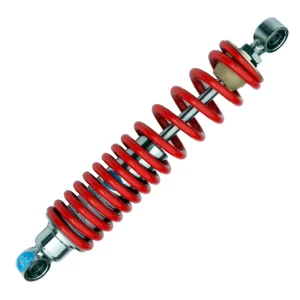
Fitting a longer shock does not automatically produce usable travel. The limits usually sit somewhere else.
Drive shafts and CV joints set the practical droop limit, because angle and plunge bind before the shock runs out of stroke. Brake lines, wiring, tie rods and steering rack ends set the compression limit on many builds. Spring retention sets the droop limit on a coilover, since a spring that comes unseated at full extension is a safety problem, not a tuning preference.
Travel also changes the relationship between wheel movement and shaft movement. If a kit adds wheel travel without adding proportional shock stroke, the damper reaches full compression before the suspension does and the bump stop takes the load. That feels like bottoming out, but the cause is geometry.
Confirm four measurements before ordering: eye-to-eye at full droop, eye-to-eye at full bump, wheel travel at each corner, and the shaft length actually used in normal running. If the last figure is close to the total stroke, the car is riding on its bump stops and needs either more rate, more travel, or a different mounting position.
Travel figures only mean something when they are tied to the geometry that produces them, and a longer body does not fix a linkage limit. <Off-Road-Coilover-Shocks> covers off-road coilover shock configuration.
What a shock spec sheet can and cannot prove
A spec sheet is a declaration by the supplier, not a test report on your car. Reading it accurately is faster than arguing about it later.
| Claim | What it establishes | What it does not establish |
|---|---|---|
| Body diameter and shaft size | Physical envelope and hardware class | Damping quality or heat capacity at your speed |
| Compression and rebound adjustable | Presence of adjustment hardware | Range of adjustment or whether both bands are independently useful |
| Nitrogen charge pressure | Set pressure at the stated condition | Whether that pressure holds after repeated heat cycles |
| Fits a model year range | A mounting compatibility claim | Spring rate suitability for your build mass |
| Cycle tested on a dyno | A test was performed on a sample | That your unit matches the tested sample or your terrain |
| Race proven | A claim of use in competition | Any measured outcome or the conditions behind it |
Ask for damping force data plotted against shaft velocity if the supplier has it, and ask which velocities were tested. Ask whether the quoted gas pressure is a fill value or a measured value after cycling. Ask how batches are traced, so a later replacement can be matched to the original build.
None of this replaces a test on your car. It narrows the range of dampers worth testing, which is the point of a specification conversation.
What to send when you request a damper quote
A supplier cannot specify a damper from a horsepower figure. The useful request describes the machine, the load and the terrain in measurements.
| Field | What to send | Why it changes the answer |
|---|---|---|
| Machine and model year | Exact model, plus any chassis or suspension kit fitted | Mounting and motion ratio depend on the kit, not the base model |
| Corner load | Measured corner weights with fuel and rider, or ride height at each corner | Sets the spring rate the car actually needs |
| Travel | Eye-to-eye at full droop and full bump, plus wheel travel | Sets stroke and prevents a bump stop carrying the load |
| Tires | Size and running pressure | Changes unsprung mass and the load the damper controls |
| Current setup | Spring rate, free length, installed length, gas pressure | Gives a baseline that can be corrected rather than guessed |
| Duty | Terrain, speed range, run length, service interval | Sets heat capacity and the reservoir or bypass choice |
A weak request and a usable one differ in a predictable way.
Reject this line: “Need good shocks for a built machine, around 200 hp.”
Replace it with: model and year, the suspension kit fitted, measured corner weights with fuel and rider, eye-to-eye at full droop and full bump, wheel travel, tire size and pressure, the spring rate and free length currently fitted, the terrain, the speed range, and the run length between services.
Send the build data and we will return a damper spec
Tell us the machine and model year, the suspension kit fitted, measured corner weights or ride heights, eye-to-eye lengths at full droop and full bump, wheel travel front and rear, tire size and running pressure, the spring rate and free length currently fitted, gas pressure if known, your terrain and speed range, and the run length between services. With those figures we can propose a body size, reservoir layout, spring rate and valving starting point instead of a catalogue guess.
Yearben Shock Absorber Technology builds dampers for off-road and utility platforms and can work from a drawing or a measurement sheet. Email info@yearbenshocks.com or call +86-523-86566899.
FAQ
Does a high-HP build need stiffer springs than a stock machine?
Only if the measured corner load is higher. Power does not add corner mass, so a car with the same weight and the same motion ratio needs the same rate regardless of output. Springs should change when you add cage weight, passengers, fuel capacity, heavier tires or a kit that alters the motion ratio. Measure ride height and corner weight loaded as the car runs before changing rate, because raising preload to fix a sagging corner hides a rate problem rather than solving it.
How much wheel travel can the shock support?
Travel is set by the whole linkage, not by the damper alone. The practical droop limit is usually CV joint angle and axle plunge, and the compression limit is often the bump stop, tire-to-fender clearance or a brake line. The damper has to be long enough to use that travel without running out of shaft first. Measure eye-to-eye at full droop and full bump, then compare with the shaft length used in normal running. If little shaft remains, the car is already on its stops.
Why does damping fade after a few hard minutes?
Heat. Damping converts motion into heat in the oil, and hot oil flows more easily through the same orifice, so force drops. Fade is usually a capacity problem before it is a valving problem. Check oil volume, reservoir type, mounting position and airflow, then look at valving. A damper with a small oil volume and no reservoir will fade on a fast, rough section even with good shim stacks, while a reservoir unit with the same valving holds longer.
Can a stock damper be revalved instead of replaced?
Sometimes, and it depends on what the stock unit offers. Revalving works when the body, shaft and oil volume are adequate and the problem is the force curve. It does not fix a damper that runs out of stroke, overheats because of small oil volume, or lacks the adjusters the car needs. Ask what the stock unit’s travel and oil volume are, compare them with the duty cycle, and rebuild only if the hardware has headroom.
If you’re interested, check out these related articles:
Truck-Seat-Damper-38MM-Shock-Absorber-Manufacturer
Oil-free lawn mower shock absorber 24mm
Utv-Shocks-For-Off-Road
Custom-Shocks-And-Struts
Adjustable-Gas-Shock-Absorbers