
UTV shocks are sold under three labels that look like competing options: piggyback, remote reservoir, and coilover. They answer different questions. Piggyback and remote reservoir describe where the gas and oil reservoir sits. Coilover describes whether the spring rides on the damper body. A single shock can be a piggyback coilover or a remote-reservoir coilover, so a buyer who treats the three labels as three separate products can end up with a part that matches the description and not the machine. The decision splits into two: how much oil volume and cooling the vehicle needs, and whether the spring should be carried on the shock.
What the Three UTV Shock Labels Actually Describe
A damper converts suspension movement into heat. Oil is forced through the piston valving, and the resistance that oil creates is the damping force the chassis feels. A gas charge behind the oil keeps pressure on the oil column so it does not foam at low pressure, and it compensates for the volume the shaft displaces as it enters the body. Every label in this article describes something added to that basic job, not a different job.
The table below separates what each label names from what it leaves open.
| Label | What it names | What it does not tell you |
|---|---|---|
| Piggyback | A reservoir clamped parallel to the damper body | Oil volume, valving, spring rate, or how much air reaches the can |
| Remote reservoir | A reservoir connected by a hose and mounted away from the body | Whether that mounting position stays cool in your chassis |
| Coilover | A spring carried on the damper, usually on a threaded perch | Reservoir type, spring rate, or the usable ride-height range |
| Emulsion | A damper with gas mixed into the oil and no separate reservoir | How quickly it fades under sustained work |
Read the table as a boundary rather than a ranking. A piggyback label says nothing about bore size, shaft diameter, valving, gas separation, or spring rate. Two shocks carrying the same label can behave differently on the same UTV when those internal specifications differ, and a supplier label is not a specification. The overlap is the part buyers miss: a coilover fitted with a reservoir answers both questions at once, which is why that combination is common on sport side-by-sides.
How Reservoir Placement Changes Cooling and Mounting
Heat is generated where oil passes the piston, and it leaves through the body, the oil, and the reservoir. Adding a reservoir adds oil volume and surface area, so for the same heat input the temperature rise is smaller, provided the reservoir sits in moving air. That condition is the one most installations fail.
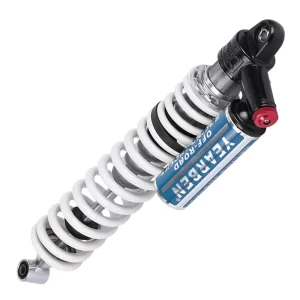
A piggyback reservoir is clamped parallel to the body and fed through a short port. The path is short, there is no hose to rub or kink, and the assembly stays compact inside one envelope. The cost is that the reservoir now competes for the same space as the spring, the tire, and the arm. On a UTV with long travel and a wide spring, that envelope can be tight at full bump, and a reservoir pressed against a spring becomes a wear point rather than a cooling feature.
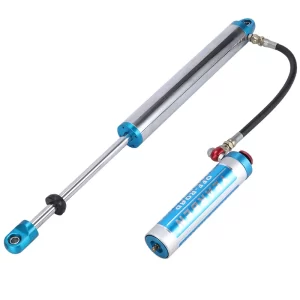
A remote reservoir moves that volume onto a hose and a bracket. It can be larger, because it no longer has to fit beside the spring, and it can be placed where air reaches it. The trade is a hose that has to be fixed at both ends, routed clear of the tire at full steer and full droop, and shielded from brush. A hose that kinks or chafes is a likely failure point before the damper itself.
| Your situation | Piggyback | Remote reservoir |
|---|---|---|
| Sustained fast running on dunes or desert | Works when the can sits in clean air and the oil volume suits the shaft speed | Better when the can can be placed in airflow away from the spring |
| Tight chassis with the spring close to the body | Risky if the can fouls the spring at full bump | Fits when the hose can reach a protected bracket |
| Brush, rocks, or tire debris near the arm | Fewer parts to snag | Only with a shielded, fixed hose path |
| Frequent valving or gas service | Access may require removing the unit | Easier when the remote is mounted within reach |
| Lowest cost and part count | Simpler assembly, no hose or fittings | Adds hose, fittings, and a bracket |
The exclusion matters as much as the fit. Do not choose a piggyback because it looks cleaner if the only place it fits is behind the spring. Do not choose a remote because it looks more serious if the hose has no fixed path and no shield. Both layouts show the same symptom once the reservoir stops doing its job: fade rather than a broken part.
A remote reservoir only pays back when the can is mounted where air reaches it and the hose has a fixed, protected route. <Remote-Reservoir-Shocks-Manufacturer> covers remote reservoir shock options and how the reservoir and hose are built.
What a Coilover Changes and What It Does Not
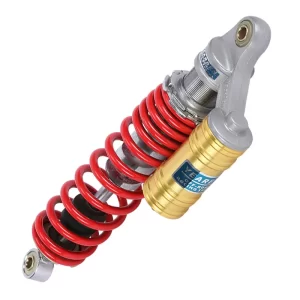
A coilover carries the spring on the damper body, usually on a threaded perch. That changes the load path: vehicle weight and spring force now pass through the damper body and its mounts, where a separate spring would have sent them into the chassis or the arm. The damper therefore sees bending and side loads it would not see in a separate-spring layout, and the mounts have to be designed for them.
What the layout buys is adjustment. A threaded perch sets ride height and preload without changing parts, and a spring swap changes rate without changing the damper. On a UTV that carries two or four occupants plus cargo, that range is useful, because the load on each corner changes with the way the machine is used.
What it does not change is the damper’s internal behavior. A coilover with poor valving is still poorly valved, and a coilover with an undersized shaft still flexes. The layout also adds a clearance problem: the spring sits around the body, so a piggyback can on that same body has less room than it would on a separate-spring installation. Check spring-to-reservoir clearance at full bump before ordering, not after.
The spring carries the vehicle, but the damper body and mounts now carry the spring, so mount strength and clearance decide whether the layout works. <Off-Road-Coil-Over-Shocks-Manufacturer> covers coilover shock options for off-road builds.
Matching the Setup to Trail, Dunes and Race Pace
Trail and rock work runs at low shaft speeds with frequent small inputs and occasional large ones. Heat is rarely the limit; impact protection and articulation are. A piggyback coilover with a spring rate set for the loaded weight usually covers this use, and the reservoir should sit where a rock cannot reach it.
Dune and desert running is the opposite case. Shaft speeds stay high for minutes at a time, oil volume matters, and the reservoir has to shed heat continuously. A remote reservoir placed in airflow earns its place here, and a piggyback works when it has enough volume and clean air. In both cases the spring rate has to hold the vehicle off the bump stops at speed, or the damper spends its travel on the stops and overheats regardless of reservoir type.
Race use adds adjustment and service access. Being able to change valving or gas pressure between sessions matters more than the label on the shock, and a remote reservoir that can be reached without removing the unit shortens that work.
Utility and work machines put the priority on load and stability. Added occupants, a bed load, or a plow change corner weight, and the spring and preload have to be set for the real load rather than the dry weight. A damper tuned for an empty machine can sit low and bottom out once the load arrives.
Terrain sets the oil volume and cooling requirement before any label is chosen. <Utv-Shocks-For-Off-Road> covers UTV shock options for off-road use.
What to Measure and Ask Before Ordering
Most fitment failures come from measurements taken after the order rather than before it. This list is short enough to finish in an afternoon with the vehicle on stands.
- Measure extended and collapsed length eye to eye, with the vehicle at ride height and again at full droop.
- Record shaft exposure at full bump. If the shaft is close to fully compressed, the bump stop is doing the work and the travel figure on the sheet is optimistic.
- Weigh the corners with the load the vehicle actually carries, including occupants and cargo.
- Check clearance through the whole range: reservoir to spring, reservoir to tire at full steer, hose to arm at full droop.
- Ask for the valving specification and a damping curve, not only a part number. A curve shows what the shock does at the shaft speeds the vehicle reaches; a part number shows what it is called.
- Ask what is inspected between production lots to confirm the specification holds, and ask for the service parts: seal kit, shaft, and gas charge specification.
A quote that answers only length and price leaves the two hardest questions open: what the damper does at the shaft speeds the vehicle actually reaches, and whether the next unit will do the same thing. Those two questions are worth putting to any supplier, including a factory building to your drawing.
Where Bypass Shocks Fit and When They Earn Their Place
Bypass shocks add external tubes that open and close extra flow paths as the shaft moves through its travel. That produces position-sensitive damping: softer in the middle of the stroke, firmer near the end, without relying on the bump stop alone. The cost is more parts, more tuning time, and more places to leak. For a trail machine the benefit rarely justifies the complexity. For a race car chasing the last few percent over repeated big hits, it often does. The three labels in this article still apply underneath, because a bypass shock still has a reservoir location and still may or may not carry a spring.
Send Your Build Details Before You Order
The fastest way to narrow the choice is to send the details that decide it. Tell us the machine and model, the loaded corner weights, the intended use (trail, dunes, race, or work), the travel you are targeting, the spring rate you have now, the mounting envelope around each reservoir, and the order volume you are planning. If you already have a damping curve from a previous set, include it, because it says more than a description. Taizhou yearben shock absorber Technology Co., Ltd. builds UTV and off-road dampers across more than 200 models with an annual capacity of 1.5 million units, and our engineers can review a build sheet against a valving specification before a sample is cut. Email info@yearbenshocks.com or call +86-523-86566899.
FAQ
Is a piggyback shock the same as a remote reservoir shock?
No. Both add a reservoir to a damper, but they place it differently. A piggyback clamps the reservoir to the damper body and feeds it through a short port. A remote reservoir sits on a hose and a bracket, so it can be positioned away from the spring. The two differ in mounting space, airflow, and the number of parts that can fail, not in the basic job of adding oil and gas volume.
Which cools better, piggyback or remote reservoir?
It depends on where each one ends up, not on the label. A remote reservoir can carry more oil and sit in moving air, which helps during sustained fast running. A piggyback with enough volume and clean air around the can works well too. A remote reservoir tucked behind a skid plate with no airflow can run hotter than a well-placed piggyback, so route and shield the reservoir before comparing types.
Do I need coilovers for trail riding?
Not by definition, but most sport side-by-sides already use them. What matters on a trail build is the spring rate for the loaded weight and valving that controls small inputs without harshness. A coilover makes ride height and spring rate easier to change, which helps when the machine carries different loads. A separate-spring layout can work, but it limits how much you can adjust without changing parts.
Can I add a reservoir to my existing UTV shocks?
Usually not. Adding a reservoir means a different body with a gas chamber, a port, and mounting hardware, so it is a new damper rather than an accessory. Welding a can onto a sealed body is not a practical route. If the current shocks fade on long runs, the realistic options are a damper built with a reservoir, or accepting the shorter duty cycle of the existing set.
How do I know my shocks are fading?
Fade shows up as damping that weakens during a run and returns after the vehicle cools. The ride gets harsher over repeated bumps, the body bottoms more easily near the end of a fast section, and the damper body or reservoir runs noticeably hotter than on a short run. Fade points to heat and oil condition rather than a single failed part, so the first check is whether the reservoir has airflow and whether the oil volume suits the way the machine is used.
If you’re interested, check out these related articles:
Adjustable-Shock-Absorber-For-Car
Best-Off-Road-Shocks
Adjustable-Shock-Absorber
Hydraulic-Seat-Damper-Cylinder-Diameter-24MM
Custom-Shocks-And-Struts