
A gas shock absorber controls wheel motion; it does not carry load. The gas charge keeps the damper oil under pressure so the piston can keep producing the damping force a heavy build needs when the axle is moving fast. That distinction decides most of the specification work on a modified or overland vehicle. Treat gas pressure as a load rating and you end up with a stiff, harsh unit that still bottoms out on a loaded trail. Treat it as one variable inside a damping, travel and mounting package and the damper behaves on the last day of a trip the way it did on the first. The sequence below follows the order in which those numbers have to be fixed.
What the gas charge does and does not do
Nitrogen sits on one side of a separating piston, bladder or floating divider, with oil on the other. When the shaft moves quickly, oil on the trailing side of the piston drops in pressure. Without a pressurised baseline, dissolved gas comes out of solution and the oil foams. Foam is compressible, so the damper stops generating the force its shim stack was built for, the wheel keeps travelling and the body follows it. A gas charge raises the oil’s baseline pressure and keeps the fluid column intact through repeated strokes.
Holding the vehicle up is a different job. Load passes through the spring, not through the gas. Raising nitrogen pressure increases the force needed to pull the shaft out, because gas force is pressure multiplied by rod cross-section, and it presses the seal against the shaft a little harder. Neither effect adds payload capacity. A build that has gained a steel bumper, a winch and a roof tent needs more spring rate and more damping, not a higher pressure figure on the box.
Two different products also share the phrase. A low-pressure twin-tube keeps gas in the outer chamber to prevent aeration; a high-pressure monotube separates gas from oil behind a piston. Both are gas shock absorbers, they behave differently near the limit of travel, and a specification written for one does not transfer to the other. Settle which type the quote describes before comparing anything else.
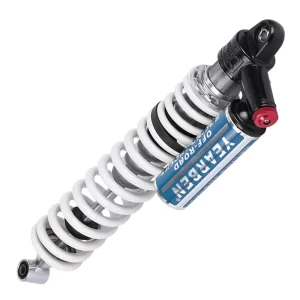
How build weight changes the damping target
Sprung mass added above the axle changes two things at once: the spring rate needed to hold ride height at the loaded weight, and the damping force needed to control that mass. Damping ratio depends on spring rate and mass together, so weight added without a change to either leaves the body moving more slowly but oscillating longer after a bump. Added damping on the original springs makes the damper work harder and heats the oil sooner, without correcting ride height or roll.
An overland build also carries a variable load. The same vehicle may run a full trip load of fuel, water and gear, then run close to empty for a week of daily driving. Those are two different damping targets, and that variation is the honest reason to consider adjustment. It is not a reason to buy the widest click range on the market.
Most specification errors show up at low shaft speed. Low-speed compression controls dive under braking and roll into a turn; low-speed rebound controls how quickly the body settles and whether the suspension packs down across a run of corrugations. Too much low-speed rebound is a common failure on loaded builds. The damper holds the body down, the next bump arrives before the spring has pushed the wheel back out, and usable travel shrinks corner by corner.
| Change on the build | What it does to the damper’s job | What to settle first |
|---|---|---|
| Steel bumper, winch, sliders | Adds sprung mass at the front and outboard | Front spring rate, then low-speed compression |
| Roof tent, drawers, fridge, water tank | Adds sprung mass high and rearward | Rear spring rate and rebound damping |
| Larger tyres and heavier wheels | Adds unsprung mass at the axle | High-speed compression and bump stop control |
| Fuel and water carried for a trip | Loaded mass changes between trips and between legs | Adjustment range, progressive or dual-rate springs |
| Long corrugated tracks | Sustained shaft speed and rising oil temperature | Oil volume and reservoir type |
| Suspension lift | Moves the travel limits and changes motion ratio | Shock stroke plus extended and compressed length |
A dual-rate spring changes what the damper sees around its crossover. Below the crossover the combined rate is soft and the damper is controlling a lighter effective mass; above it the rate steps up and the same wheel movement produces more shaft speed. A damper valved without knowing where that crossover sits tends to feel wrong on one side of it.
Spring rate and gas charge interact most strongly at the crossover point. <Gas Charged Dual Rate Coilover Shock Absorber> covers a dual-rate coilover built around a gas-charged damper.
Travel and droop numbers to measure before ordering
Lift height describes the spring and the ride height it produces. It says nothing about how much shaft travel remains before the piston reaches the cap or before the bump stop takes over, which is the number the damper has to be ordered against. Measure it on the vehicle, at the shock, corner by corner.
- At ride height on level ground, record the exposed shaft length at each corner.
- Raise the chassis until the wheel is off the ground with the spring fitted and the shock connected, then measure again. The difference is the droop available at that corner.
- Remove the spring and cycle the suspension by hand to the bump stop. Confirm the shock still has shaft remaining and that no hose, coil, half shaft or control arm becomes the limit first.
- Record extended length eye to eye, compressed length and mounting style, then repeat for the other three corners.
A shock that runs out of extension becomes the limit strap. The piston contacts the cap, the shim stack absorbs the load, and repeated top-outs damage the seal head or bend the shaft. A shock that is too long bottoms internally before the bump stop is reached, so the bump stop never does its job and the damper takes an impact it was not built for.
On independent suspension the shock rarely moves the same distance as the wheel, so a published wheel travel figure does not equal the stroke to order. The motion ratio sits between them, and it changes when the suspension is lifted.
On a coilover, the damper body also carries spring load, which puts the lower mount and the spring perch inside the structural path. On a modified build the mount weld, bolt grade and perch thread matter as much as the valving. A separate spring and damper splits those loads but does not remove the travel requirement.
Coilover packaging decides where the spring load goes and how much shaft is left at droop. <Off-Road-Coilovers> covers off-road coilover assemblies for modified vehicles.
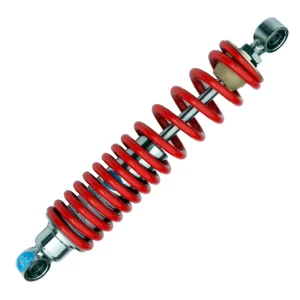
Valving and adjusters, and where adjustment stops helping
An adjuster changes something specific, and the label on the knob does not always say what. Most single adjusters alter low-speed bleed by opening a bypass around the piston; they do not re-shim the high-speed stack. If the complaint is a harsh square-edge hit at speed, turning a low-speed clicker will not solve it. High-speed behaviour comes from the shim stack, from a position-sensitive bypass, or from a bypass tube with its own zones.
Check where the useful setting lands inside the range. If the best ride sits at the first or last click, the unit is valved for a different load and the adjustment is compensating for a mismatch rather than fine tuning it. A healthy range puts the accepted setting somewhere in the middle with usable travel in both directions.
Adjustable dampers also add parts that can fail: detent balls, seal glands and the small passages that make the click positions repeatable. A fixed-valved unit matched to one known build is more consistent across a fleet; an adjustable unit earns its cost when the load genuinely changes.
Adjustment only helps where the damper was built with a range to adjust within. <Adjustable-Gas-Shock-Absorbers> covers gas dampers with adjustable damping.
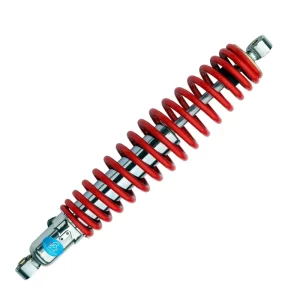
Reservoirs, hoses, and heat on long days
Damper oil heats as it works. Viscosity falls as temperature rises, so the force produced at a given shaft speed falls with it, and that is the mechanism behind fade on a long corrugated section. A reservoir adds oil volume and external surface area, so the same work raises the oil temperature less and the damper holds its force longer.
Remote and piggyback reservoirs do the same thermal job in different packages. A piggyback can sits on the damper body, which keeps the plumbing short but places the can close to the axle where airflow is poor and where it competes for space at full bump. A remote can be routed into cleaner air, but it adds hose, fittings and a snag path. Route the hose with a service loop so it is never under tension at full droop, keep it clear of the tyre and the spring, and orient the fittings so the hose leaves in a straight line rather than bending at the crimp.
Separation matters as much as volume. In an emulsion damper, gas and oil share a chamber and mix under hard use; performance drifts as the mixture changes. A separated design keeps them apart behind a piston, bladder or reservoir, so the damping curve stays closer to the one that was tested.
A reservoir does not add travel and does not carry load. It buys thermal headroom and consistency, and it costs packaging space.
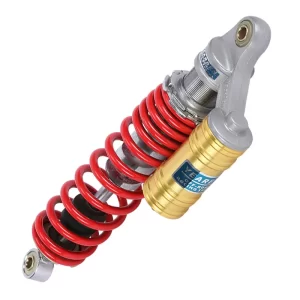
What to put in a shock specification sheet
The specification sheet is the difference between a quote and a guess. Six fields carry most of the decision.
| Field | What to send | Why it matters |
|---|---|---|
| Axle loads | Front and rear, at kerb and fully loaded | Damping target follows loaded mass, not kerb mass |
| Lengths and mounts | Extended and compressed eye to eye, bolt or stem diameter | The most common ordering error on a lifted build |
| Spring | Rate, type and rate at fitted length | The damper is valved to the spring, not to the model name |
| Use profile | Surface mix and the share of highway, corrugation, rock and sand | Sets the low-speed and high-speed balance |
| Adjustment | None, single or dual, and which circuit | Prevents paying for a clicker that cannot fix the problem |
| Environment | Dust, salt, water crossings, ambient temperature range | Drives seal, shaft coating and body finish |
The same six fields turn a vague request into a workable one.
Reject this line: gas shocks to suit a two inch lift, heavy duty valving, 4×4.
Replace it with: front and rear axle loads at kerb and loaded; extended and compressed length eye to eye with mounting type; current spring rate and type at fitted length; the surface mix and the speeds the build actually runs; whether adjustment is needed at low speed, high speed or both; and the dust, salt and water the seals will see.
Yearben manufactures dampers across ATV, UTV, buggy and off-road platforms and more than 200 models, which is a useful reminder that a body diameter and a model number are not specifications until the load and length figures are attached to them.
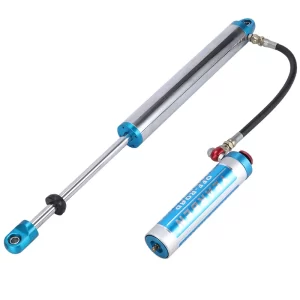
How to check a gas shock before you commit
Four checks separate a unit that will last from one that will not, and none of them needs a dyno on site.
Shaft finish. Look along the chrome at a shallow angle under a bright light. A ground and polished shaft shows an even finish with no spiral marks, no polishing swirl and no pits. A scored shaft destroys the seal within a short service life.
Gas retention. A pressurised monotube pushes its own shaft back out when you compress it and release, and it should still do so after standing. A unit that has lost its charge may feel smooth by hand but will cavitate as soon as it works hard.
Joints and fittings. Check the welds at the reservoir bracket and the spring perch, the thread engagement on the hose fittings, and the condition of the crimp. Most field failures on reservoir shocks start at a fitting rather than inside the damper.
Batch record. Ask for a damper force plot at more than one shaft speed, and ask for the same plot from a second unit in the same batch. A single good sample proves the design; two matching samples prove the process. Serial-level traceability on the delivered parts closes the loop.
Send the load and length figures first
Before comparing brands or prices, put four numbers on one page: loaded front axle load, loaded rear axle load, extended length and compressed length. Those figures decide whether an existing damper can be re-shimmed for your build or whether the body and stroke have to change.
Send them to info@yearbenshocks.com or call +86-523-86566899. The engineering team at Yearben will tell you which of the two it is, and what to measure next if a figure is still missing.
FAQ
Does a gas shock absorber increase load capacity?
No. Load is carried by the spring; the gas charge pressurises the damper oil so the piston keeps producing consistent force at speed. A higher nitrogen pressure raises the force needed to extend the shaft and presses the seal harder against it, but it does not raise payload or ride height. If a loaded build sits low, check the spring rate first, then the damping.
Can I add gas shocks to a standard height overland build?
Yes, provided the extended and compressed lengths suit the suspension and the valving matches the spring. A gas charge helps most where the damper works hard and fast, such as corrugations and washboard, because it keeps the oil from foaming. On a lightly loaded vehicle with standard springs, a well valved twin-tube often does the same job, so compare the valving and the lengths rather than the gas label alone.
How do I tell if my shocks are out of travel after a lift?
Measure at the shock, not at the wheel arch. Record the exposed shaft at ride height, raise the chassis until the wheel leaves the ground, then measure again. Also cycle the suspension to the bump stop with the spring removed. If the shock runs out of extension before the wheel droops fully it is acting as the limit strap; if it bottoms before the bump stop it is taking an impact it was not built for. Either result means the stroke is wrong for that build.
Are adjustable gas shocks worth it for overlanding?
They are worth it when the load genuinely varies, for example a vehicle that runs fully loaded on trips and close to empty the rest of the time. They are harder to justify when the build carries the same weight every day, because a fixed valve matched to that weight is more consistent and has fewer parts to fail. Judge by how often the load changes, and check where the accepted setting sits inside the adjustment range before committing.
Can a gas shock be re-valved later?
It depends on the body design and on whether the manufacturer supports re-shimming. Sealed and crimped bodies usually cannot be opened without destroying them; bodies with a threaded seal head or a serviceable reservoir can be re-valved if the shim stack and piston are still available. Ask before you buy, and ask what specification the re-valve would be based on, since the answer will be the same six fields a new order needs.
If you’re interested, check out these related articles:
Best-Shocks-And-Springs-For-Trucks
Adjustable-Hydraulic-Shock-Absorbers
Custom shock absorbers for seat Φ41.5mm manufacturing