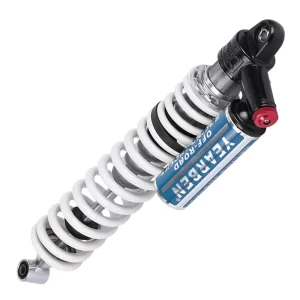
Front shock absorber specs are usually read in the wrong order. A buyer checks extended eye-to-eye length first, then spring rate, and only later realizes that the damping curve was the spec controlling most of the ride behavior. For an ATV or UTV, that order gets fitment and performance backwards. This guide walks through the measurements suppliers use to qualify a front shock absorber, why each number matters at the front axle, and what to send before a drawing is approved.
Which Front Shock Specifications Actually Decide Fitment
The first gate is not travel. It is whether the assembled shock can move through the suspension arc without binding, contacting the axle, or forcing the spring into coil bind. On an ATV or UTV, the front shock is often packaged tightly around the upper control arm, brake line, and drive shaft, so fitment data must be treated as a complete dimensional assembly.
The shock displacement is not the same as wheel travel when the shock mounts partway along the control arm. Motion ratio describes that relationship: wheel travel divided by shock travel. In an independent front suspension, that ratio often changes slightly through the arc, so a small change in compressed length can create a large change in metal-to-metal clearance at full bump.
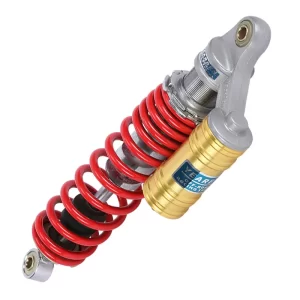
The minimum fitment dataset is simple but rarely complete. A front coilover drawing should state extended length, compressed length, stroke, mounting width, hardware size, spring inner diameter, spring free length, and spring perch position at ride height. Without the compressed dimension and perch position, the supplier cannot confirm spring block height or reserve clearance for the adjusting collar.
Spring Rate and Damping Tuning at the Front Axle
Spring rate is usually specified in kg/mm or lb/in, but it only becomes useful when paired with corner weight and motion ratio. A stiff spring on a light ATV produces a harsh ride and reduces droop travel. A soft spring on a heavy UTV with a winch, bumper, and plow can collapse ride height and force the shock to operate too deep in the compression stroke.
Preload does not change spring stiffness. It changes static ride height within the available threaded range. Many field problems described as “spring fatigue” are actually preload set beyond the linear portion of the shock travel, leaving the front end with no droop reserve. The correct sequence is to set chassis ride height, measure remaining droop, then confirm the spring force at that position is within the supplier’s allowed preload band.
Damping is where the front shock does its real work. On a damping force-velocity curve, low-speed and high-speed valving are not interchangeable. Low-speed damping controls body roll, pitch, and steering response. High-speed damping controls spike loads from rocks, holes, and hard landings. The Shock Absorber Handbook reports typical passenger-vehicle damping ratios in the 0.2–0.4 range, and off-road vehicles are often tuned toward the higher end of that band to control body motion over rough terrain [1].
Most front shock harshness complaints are resolved at the valving edge, not in the spring. <Best-Off-Road-Shocks> covers how off-road shock performance is evaluated in real use.
For a UTV or buggy front-end build, spring selection and damping tuning need to be evaluated together. <Off-Road-Coilover-Shocks> covers the coilover configurations Yearben offers for off-road platforms.
Gas Charge, Heat, and Fade on ATV/UTV Front Shocks
A nitrogen gas charge does more than prevent oil foaming. It keeps the oil column under pressure as shaft speed rises, which reduces cavitation at the piston and preserves damping force during repeated high-velocity cycles. Front shocks on an ATV or UTV see more of these cycles than many rear shocks because the front axle arrives first at obstacles and carries sharp steering loads.
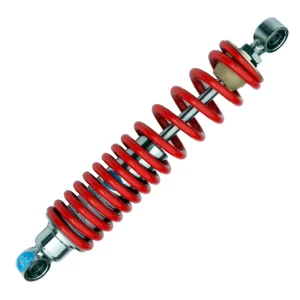
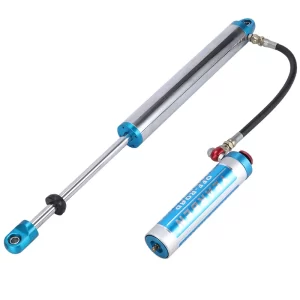
Heat changes the operating behavior of any hydraulic damper. As oil temperature rises, viscosity drops, and the same valving can deliver less resistance at a given shaft speed. The front shock therefore needs enough fluid volume, or a reservoir, to replace hot oil from the compression side without creating a lag in force. Monotube packaging helps separate gas from oil and shortens the heat path; twin-tube packaging is generally simpler but can be more sensitive to sustained repetitive loading without a proper gas charge.
A front coilover with adjustable valving adds another layer of practical specification. Adjusters normally change a bleed path or stack preload, not the full shape of the curve. When a buyer asks for “adjustable compression and rebound,” they should expect a defined click range and a known change in force at each end of the adjustment. Without those written targets, two shocks with the same clicker label can behave differently.
Fitment data should include the full compressed dimension and spring perch clearance, not just static height. <Adjustable-Hydraulic-Shock-Absorbers> covers what changes when adjustable valving is added to a front shock.
Request a Damping Curve Check
Before approving a front shock drawing, ask for the force-velocity curve at low, mid, and high shaft speeds. Send vehicle weight, motion ratio, and intended terrain to info@yearbenshocks.com, and ask for a proposed rebound/compression split with gas charge pressure and spring preload stated as written targets. That one request catches most mismatched front shock specifications before tooling starts.
Catalog Spec vs Custom Front Shock: What Changes
A catalog front shock is built around an existing damping curve, spring package, and mounting family. A custom front shock changes one or more of those boundaries. The most common custom changes are extended compressed length for a lifted control arm, stiffer valving for additional frontal weight, longer stroke for high-clearance lower arms, and a remote reservoir for sustained desert running.
ANSI/SVIA 1–2017 defines ATV categories around rider capacity and engine displacement, so the same physical damper family can require different spring and valving calibrations depending on the classified gross vehicle weight [2]. ANSI/ROHVA 1–2016 requires ROV lateral stability and occupant protection validation, which pushes front shock valving toward stronger low-speed body control rather than pure softness [3]. A replacement front shock that preserves fitment but ignores those vehicle-level requirements may pass a bench test and still perform poorly at the chassis level.
Checkpoints Before You Approve a Front Shock Order
Production validation should cover more than a visual drawing check. A serious front shock supplier should confirm the force-velocity curve on a shock dynamometer, then run the assembled unit through durability cycles that include full bump contact, shaft sideload, and temperature stabilization. Seals should be selected for the local environment, and the gas charge should be verified after assembly with a written leak-deviation test.
ISO 9001:2015 process control around traceability and calibration provides a useful minimum audit screen for a front shock supplier [4]. It does not by itself validate valving, but it reduces the chance that the sample unit and production units are built from different records. The buyer should still request batch traceability for piston, shim stack, spring, seal, and gas charge, because those are the parts most likely to produce field variation.
Send These Front Shock Data Points for a Quote
To avoid a long correction loop, prepare six data points before sending a front shock inquiry: vehicle make and model year, measured front corner weight, current extended and compressed length, mounting type and hardware width, spring rate or desired ride frequency, and terrain type or racing use. If the front shock is for a lift kit or long-travel arm package, include the designed motion ratio or suspension drawing.
Send those details to info@yearbenshocks.com or call +86-523-86566899. Yearben’s engineering team can check whether an existing platform already meets the specification or whether a custom front shock build is the cleaner path.
FAQ
What is the most important front shock spec for ATV fitment?
Compressed length and mount width are the first gating dimensions. A front shock must fit the suspension arc at full bump without binding or contacting nearby components before any other performance spec matters.
How do I measure front shock extended and compressed length?
Measure center-to-center on mounting eyes, or the equivalent reference point on a clevis or pin mount. Extended length is the shock at full extension, and compressed length is the same reference dimension with the shaft fully bottomed out.
Can I increase travel by installing a longer front shock?
Not safely. A longer shock can create coil bind, CV joint contact, or bump stop loss unless the upper and lower control arms, steering geometry, and driveshaft path are matched for the change.
What spring rate do I need for a UTV front coilover?
Spring rate must be calculated from measured corner weight, motion ratio, and intended ride height. Choosing rate from a similar model can work as a starting point, but it will not account for a winch, spare tire, or aftermarket bumper load.
How does gas charging affect front shock fade?
The nitrogen charge keeps the oil column under pressure, which reduces cavitation during fast shaft movement and helps the damping curve stay stable as oil temperature increases.
References
[1] J. C. Dixon, The Shock Absorber Handbook, 2nd ed., John Wiley & Sons, 2007.
[2] ANSI/SVIA 1–2017, American National Standard for Four Wheel All-Terrain Vehicles, Specialty Vehicle Institute of America, 2017.
[3] ANSI/ROHVA 1–2016, American National Standard for Recreational Off-Highway Vehicles, Recreational Off-Highway Vehicle Association, 2016.
[4] ISO 9001:2015, Quality management systems — Requirements, International Organization for Standardization, 2015.
If you’re interested, check out these related articles:
Adjustable Seat Damper 41.5mm
Driver-Seat-Damper-24MM-Cylinder-Diameter
Lawn-Mower-Damper-Shock-Absorber