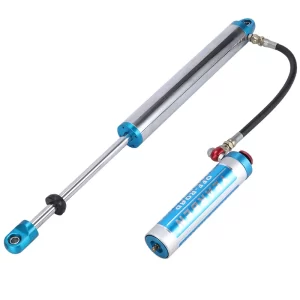
A vehicle shock absorber does its best work when valving, oil volume and mounting are matched to the input the machine actually sees, and off-road and agricultural machines rarely see the same input. A trail buggy loads its dampers with short, high-velocity impacts. A tractor or a zero-turn mower loads them with long, low-frequency undulation that repeats for hours. Sizing both from the same catalog page is how buyers end up with shocks that fade, top out, or beat the operator. What follows separates the two duty cycles by the forces and heat each one produces, then sets out the specification data a factory needs to quote accurately and the checks that decide whether a sample is ready for volume.
What Off-Road and Agricultural Duty Cycles Demand From a Shock
A damper does one job. It turns suspension movement into heat by forcing oil through a restriction, and the rate at which it does that decides both how the vehicle feels and how long the part survives. What changes between a buggy and a field implement is the shape of the movement: amplitude, shaft speed, and how many times per hour the cycle repeats.
Square-edge impacts push shaft speed up quickly. Damping force rises with shaft speed until the shim stack opens and blows off, which is the purpose of a digressive curve. Set the blow-off too high and the peak force travels into the chassis and the mounts. Set it too low and the wheel follows the ground while the body keeps moving.
Field work is the opposite shape. Inputs arrive long and slow, perhaps one every few metres, and nothing cools the damper except air moving past it. The risk here is standing heat and dust rather than a single impact, so oil volume, seal quality and rod protection matter more than peak force.
| Duty cycle | Dominant input | Travel demand | Heat pattern | First thing to fail |
|---|---|---|---|---|
| Desert, trail and dune off-road | Square-edge impacts and repeated whoops at speed | Long, uses most of the stroke | Short bursts of very high work | Oil aeration, then rod seal wear |
| Rock crawling and technical trails | Low shaft speed, high force, large single events | Articulation biased, often one wheel | Low, with long cooling gaps | Bent shaft or cracked mount |
| Field implements and trailers | Long, low-frequency ground undulation | Moderate but continuous | Sustained moderate work | Fade and dust ingress |
| Mower decks and turf equipment | High cycle count, small amplitude from blades and turf | Short | Low to moderate | Rod end and bushing wear |
| Operator seat suspension | Whole-body vibration driven by vehicle mass | Short | Low | Seal weep and stiction |
Read the table as a selection filter rather than a specification. Two dampers with the same body diameter and the same eye-to-eye length can sit at opposite ends of this table, and the label on the box will not tell you which one you have.
Matching Damping Force and Valving to the Load
The force-velocity curve is the document that decides whether a damper suits the machine, and it has two regions that are tuned by different parts. At low shaft speed, force is governed by bleed and port area, which sets body control, turn-in and how the vehicle settles after a bump. At high shaft speed, force is governed by the shim stack, which sets how the damper absorbs an impact without passing it to the chassis.
Rebound and compression are tuned separately, and getting the ratio wrong produces two recognisable faults. Too much rebound holds the suspension down after a series of bumps and the vehicle packs lower with each one. Too little rebound lets the body float and keeps moving after the wheel has stopped.
Adjusters change one of these regions, not the whole curve. A needle bleed adjuster shifts low-speed force and leaves the high-speed stack largely untouched. Spring preload changes ride height and the point in the travel where the damper sits, but it does not change spring rate. Dual adjusters separate compression from rebound, which is useful on a vehicle that carries variable load, and adds two more seals and two more settings that somebody has to get right.
The practical check is to ask for the measured curve in both directions at agreed shaft speeds, produced on the actual build you will receive, not a family curve from the catalog. Compare that curve against the drawing before you ride the sample, because a damper can feel acceptable on a short test and still be twenty percent away from the target everywhere on the curve.
There is a real tradeoff in adjustment range. A fixed damper with the correct curve is often the better product for a fleet or an OEM build, because there is nothing to misconfigure and one less seal to leak. Adjustment earns its place when the same platform carries different loads or runs different terrain within a week.
Coilover or Separate Spring and Damper
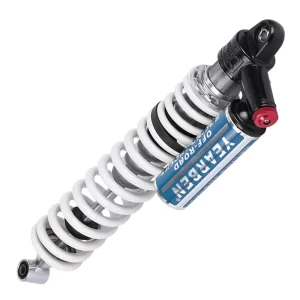
A coilover puts the spring seat on the damper body, so the body carries spring load as well as damping force, and any misalignment at the mounts arrives as bending in the shaft and rod guide. That is a design consequence, not a defect. It is also why a coilover body wall, perch weld and upper mount all need to be designed for the combined load rather than the damping force alone.
The perch style is the decision most buyers underestimate. A threaded perch gives ride height and preload adjustment, but the thread collects grit and needs protection in mud and field work. A welded or circlip perch is cheaper, stiffer, and cannot be adjusted, which is sometimes exactly what a production line wants.
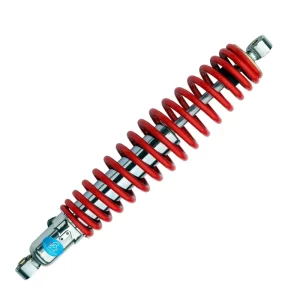
A separate spring and damper splits the jobs. The damper sees damping force only, the spring sits on its own seat, and each can be tuned or replaced without touching the other. The cost is packaging space and more parts to stock.
Coilover packaging and spring load paths are the first thing to settle before travel and valving are fixed. <Off-Road-Coilover-Shocks> covers coilover shock configuration for off-road builds.
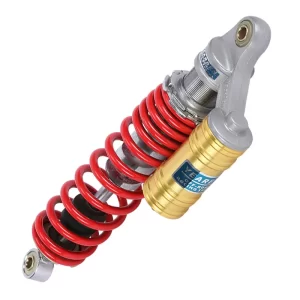
Agricultural equipment usually takes the separate route. A mower deck or a seat suspension typically pairs a spring or air element with its own hydraulic damper, because the two wear at different rates and the damper is the cheaper part to replace.
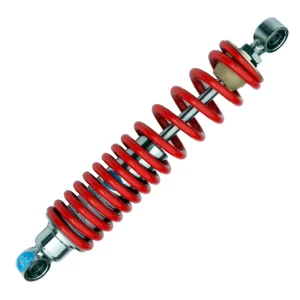
Reservoir and Monotube Choices for Heat and Travel
Fade is a heat problem with a mechanical symptom. Damper work becomes heat in the oil, oil temperature rises, viscosity falls, and damping force drops with it. If pressure on the rebound side falls low enough, dissolved gas comes out of solution, the oil aerates, and the force loss becomes larger and less predictable.
A monotube holds the oil under gas pressure behind a floating piston, which keeps the oil from cavitating and allows the damper to be mounted in orientations that a twin-tube would not tolerate. A twin-tube keeps gas in the outer chamber at lower pressure, costs less, and tolerates a small gas loss more gracefully, which is why it remains common on light agricultural and seat duty.
A reservoir adds oil volume and surface area outside the main body, so the same work raises temperature less. Remote and piggyback versions solve the same problem with different packaging. Remote puts the reservoir where air flows, at the cost of hose routing, bleeding and chafe. Piggyback keeps the fluid path short and clamps the reservoir to the body, at the cost of clearance near the spring.
| Architecture | Heat capacity | Packaging freedom | Service and risk | Fits when |
|---|---|---|---|---|
| Twin-tube, gas in outer chamber | Lower, less oil and less area | Good, compact body | Tolerates small gas loss, inexpensive to replace | Light agricultural, seat and turf duty |
| Monotube with floating piston | Higher, oil held under pressure | Body must clear the spring through full travel | Needs correct gas fill, resists cavitation | Off-road where shaft speed is high |
| Piggyback reservoir | Higher again, extra oil close to the body | Clamp sits near the spring, watch clearance | Short fluid path, fewer hose joints | Builds with room around the body |
| Remote reservoir | Highest, oil and area away from the heat source | Hose allows mounting in airflow | Hose routing, bleeding and chafe are new failure points | Long travel and sustained high-speed work |
The check that settles most arguments is a thermal test on the intended duty cycle, measuring damping force cold and again at the end of the run on the same unit. That gives a fade number instead of an opinion about reservoir size.
Long-travel off-road work raises shaft speed and heat together, which is where tube architecture starts to matter more than valving. <Monotube-Shock-For-Off-Road> covers monotube shock construction for off-road use.
Shock Absorbers for Mowers, Tractor Seats and Field Equipment
Seat suspension dampers
A seat damper works in parallel with a spring or air element to control the vertical motion of the operator and the seat mass. The damping ratio has to suit that mass. Too much damping and the seat transmits the shock instead of absorbing it; too little and the seat bottoms out on the bump stop, which is worse than a firm ride because the stop passes the full input through in one event.
Operator exposure is regulated in many markets. Directive 2002/44/EC sets an exposure action value of 0.5 m/s² A(8) and an exposure limit value of 1.15 m/s² A(8) for whole-body vibration over an eight-hour reference period [1]. Those figures define an employer’s obligation to assess and control exposure. They do not specify a damper, and no single damper setting will satisfy every machine, seat and operator weight.
The catalog range for seat dampers runs from 24 mm to 41.5 mm cylinder diameter. The larger bores carry more oil and produce more force for the same pressure, which suits heavier operators and higher input levels. Adjustable seat dampers let the damping be trimmed to operator weight, an option worth having when one seat model serves a wide weight range.
Mower deck and turf equipment
Deck and turf dampers live at the other end of the scale. Travel is short, cycle count is high, and the input is small amplitude, so stiction matters more than peak force. A rod that sticks at the start of each stroke transmits the small inputs instead of absorbing them, and the operator feels it as chatter rather than as a bump. Rod finish, guide bushing clearance and seal friction decide whether that happens.
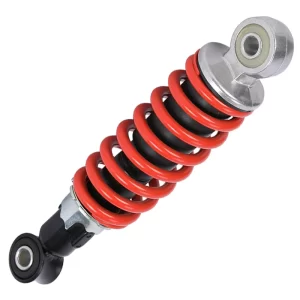
Deck and turf duty rewards small-bore dampers built for high cycle counts, with rod protection that survives dust and clippings. <Ride-on Mower Shock Absorbers 38mm> covers ride-on mower shock absorbers in a 38 mm size.
Steering dampers sit alongside these components on the same machines and solve a different problem, controlling kickback through the steering linkage rather than supporting mass. They are often bought on the same order, and they should be specified on their own torque and stroke requirements rather than as an accessory.
Specifying a Vehicle Shock Absorber for a Custom Order
Most quoting delays come from missing inputs, not from factory capacity. A supplier who receives a length and a photograph will quote a length and a photograph, and the damper that arrives will be a family curve adjusted by guesswork.
Two habits cause the worst outcomes. The first is specifying by body diameter, which says something about oil volume and nothing about the force curve. The second is specifying by comparison, such as a request for a unit that is stiffer than the current one, which gives the factory no target to hit and no way to prove it hit the target.
Write the requirement instead.
| Field | What to send | Failure it prevents |
|---|---|---|
| Mounting geometry | Eye-to-eye length at static ride height, at full bump with the stop engaged, and at full droop, plus bore, bushing width and misalignment allowance | A short or long unit loads the shaft in bending and cracks the rod guide |
| Masses and spring rate | Sprung and unsprung mass at the corner, spring rate and preload | Valving chosen without mass becomes a curve that suits no vehicle |
| Duty description | Input type, speed range, cycles per hour, ambient range and target hours | A damper validated for turf is not validated for desert racing |
| Fluid and gas target | Viscosity grade, gas type and charge pressure | A fluid substitution changes the curve with no drawing revision |
| Adjustment requirement | Whether the rider or operator must change settings, and in which direction | An adjuster added without a purpose becomes a leak path nobody tunes |
| Documentation | Force-velocity curve, dimensional report, finish specification, change notification rule | A silent shim stack revision changes the ride without a part number change |
Put the reject and the replace side by side when you write the inquiry. Reject a request for a unit that is the same as the old one but longer, and replace it with the three measured lengths and the misalignment allowance. Reject a request for a damper that handles rough ground well, and replace it with the input description, the speed range and the hours the machine runs in a season.
Yearben’s own catalog spans more than 200 damper models across ATV, UTV, buggy, mower and seat applications, built at a stated annual capacity of 1.5 million units, and even at that scale the custom process still begins with the buyer’s geometry and masses rather than a stock length.
Approving a Sample Before Volume Production
Approval is a sequence of checks, and each one answers a narrower question than buyers expect it to. Keeping those questions separate is what stops a certificate from being mistaken for a part approval.
Run the checks in this order. Measure the sample against the drawing, including thread, bore, stroke and the three lengths. Sweep damping force in both directions at the agreed shaft speeds and compare the result with the curve in the drawing. Stand the unit and recheck gas pressure to catch a seal that only leaks under charge. Cycle it to the agreed count and sweep the force again on the same unit, because a damper that has lost force after cycling has told you something a dimensional report cannot.
| Document or claim | What it does establish | What it does not establish |
|---|---|---|
| ISO 9001 certificate | The management system was audited against ISO 9001:2015 [2] | That any particular damper matches your force curve |
| Force-velocity report | Behaviour of the tested unit at the tested shaft speeds | Vehicle ride without the suspended mass and spring rate |
| Salt spray result | Finish performance on the tested substrate for the tested hours | The same result on a different plating, or on a scratched rod |
| Cycle test record | Survival of that sample under that profile | Field life under a different duty cycle |
| IATF 16949 certificate | Automotive quality system conformity within the statement scope [3] | Approval of your part, or coverage of sites outside the scope |
Finish with the parts that fail in the field rather than on the bench. Inspect the weld at the perch and the mount for undercut and porosity. Check rod surface finish and straightness after the cycle test. Confirm that the boot or bellows still seals after being compressed to full bump, since a boot that tears in the first week lets grit into the guide and ends the seal life early.
Get a Valving Proposal for Your Duty Cycle
Send the three mounting lengths, the corner masses, the spring rate and a plain description of what the machine does all day. That is enough to build a valving proposal and a sample plan against a target, instead of a catalog unit that happens to fit.
Yearben builds dampers for ATV, UTV, buggy, mower and seat applications, and a custom order starts from your measurements. Email info@yearbenshocks.com or call +86-523-86566899 to open the review.
FAQ
How do I know if my off-road shock is valved too stiff?
The usual sign is a harsh square-edge hit where the chassis deflects and the tires skip instead of the suspension absorbing the event. A quick field check is to place a zip tie on the shaft and see how much travel the damper actually uses over a section you know well. If the shaft never approaches the bump stop while the ride is still harsh, the valving or the spring is carrying too much force. Confirm it with a measured force-velocity curve before changing parts.
Can a lawn mower shock absorber be used on a light trailer or implement?
Sometimes, but the duty has to be checked rather than assumed. A mower damper is built for small amplitude and a light sprung mass, so a heavier load raises oil pressure and temperature, and the small oil volume fades sooner. Confirm the eye-to-eye lengths at both extremes of travel, the load the damper was built for, and whether the available bump travel is enough for the largest input the trailer sees.
What travel should I specify for an agricultural seat damper?
Specify enough travel to absorb the largest input the seat will meet without reaching the bump stop in normal work, and let the stop handle the extreme. Measure the seat’s vertical travel at its pivot, not at the damper, and account for the full operator weight range. The damper must control the motion without becoming the limit on seat travel, because a damper acting as a travel stop passes the whole input into the frame.
Why does a damper lose damping force after a long run?
Heat is the first cause. Oil temperature rises during sustained work, viscosity falls, and the force the damper produces falls with it. If pressure on the rebound side drops far enough, the oil aerates and the loss becomes larger and less consistent. Reservoir volume, oil quality and gas pressure all slow the effect. The check is a force measurement on the same unit when cold and again at the end of the duty cycle.
References
[1] Directive 2002/44/EC of the European Parliament and of the Council of 25 June 2002 on the minimum health and safety requirements regarding the exposure of workers to the risks arising from physical agents (vibration), Official Journal of the European Communities, 2002.
[2] ISO 9001:2015, “Quality management systems — Requirements,” International Organization for Standardization, 2015.
[3] IATF 16949:2016, “Quality management system requirements for automotive production and relevant service parts organizations,” International Automotive Task Force, 2016.
If you’re interested, check out these related articles:
Best-Shocks-And-Springs-For-Trucks
Adjustable-Gas-Shock-Absorbers
Steering-Damper-18MM
Best-Off-Road-Shocks