
A rear shock absorber for ATV and agricultural use has to satisfy two operating profiles that are not the same. On an ATV, the rear damper controls jump landings, trail impacts, and body roll while keeping the tire in contact with loose ground. On a sprayer, mower, spreader, or small utility vehicle, the same component runs for hours under a changing payload, often at low speed, where heat, corrosion, seal wear, and sag become the main risks. The right specification therefore starts with load, travel, mounting geometry, and the expected duty cycle, not with a single part number or a generic heavy duty label. This guide separates ATV-focused requirements from agricultural-duty requirements and shows which checks to request before ordering or approving a replacement.
How Rear Shock Duty Differs Between ATVs and Agricultural Equipment
A rear shock absorber is not a load-carrying spring. The spring supports static mass, while the damper converts kinetic energy from suspension movement into heat by forcing oil through valves and bleed paths. That distinction matters because the two applications load the damper differently.
For an ATV, the important condition is velocity. Jump landings, whoops, and rutted trails create short, high-energy movements that send the shaft moving quickly. Damping force must build enough to control bottom-out and rebound without losing compliance over small trail chatter. For agricultural equipment, the duty cycle is different. A sprayer tank or spreader hopper changes weight, and the machine may run for hours at low speed on uneven ground. The rear shock must manage repeated small inputs, resist seal and bushing wear, and tolerate moisture, fertilizer, and chemical exposure. A shock specified only for ATV style impact can still be too firm or too soft for that long, variable agricultural load.
Rear Shock Specifications Buyers Should Confirm First
Before comparing brands, collect the dimensions and duty data that determine fit and tuning.
| Parameter | What to confirm | Why it matters |
|---|---|---|
| Extended and collapsed length | Mounting-center dimension at full extension and full compression | Controls whether the unit fits the rear mount and reaches the required travel |
| Spring rate and preload range | Spring stiffness or coil rate, plus preload adjustment range | Determines ride height under payload and how sag changes with implements or passenger load |
| Travel and damping force | Stroke and low/high shaft speed damping targets | Separates an ATV impact-tuned damper from an agricultural low-speed control damper |
| Mounting ends and hardware | Eyelet, bar pin, bushing width, bolt size, and orientation | Avoids misalignment and bushing wear that can create noise and shorten service life |
| Working angle and reservoir clearance | Installed angle, surrounding frame, and space for a piggyback or remote reservoir | Prevents bending loads on the rod or reservoir interference |
These fields allow a supplier to check whether the shock is dimensionally valid before discussing internal valving. Nominal part-number interchange is only a screening step. It does not prove that the spring and damping curve match the vehicle’s rear weight distribution or duty cycle.
Choosing an ATV Rear Shock for Travel, Preload, and Heat Management
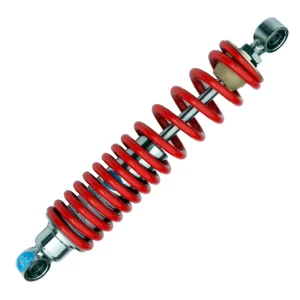
For most ATVs, rear shock selection starts with total wheel travel and the linkage or swingarm motion ratio. A damper that packages correctly can still be valved incorrectly if the motion ratio is not considered. The spring needs enough rate to support the machine plus rider and cargo without excessive sag, and enough preload adjustment to correct the static ride height.
Once the spring side is set, the damper must control both compression and rebound. Too little compression damping on a heavy landing allows the shock to blow through its stroke and bottom out. Too much rebound damping prevents the wheel from returning quickly enough for the next bump, which makes the rear end pack down. Fixed preload shocks reduce complexity when the payload is stable. Adjustable preload becomes more useful when racks, spray tanks, towing, or a passenger change the rear load.
Rear cargo racks and tow loads change the working ride height, so the spring setting should be matched to the loaded machine rather than the empty chassis. <Fixed-Preload-Atv-Shock-Absorbers> covers fixed preload options for ATVs where simplicity and repeatable ride height matter.
Heat is another consideration for recreational and utility ATVs in dunes or long trail sections. Fade comes from oil aeration and viscosity loss, so consistent damping depends on adequate oil volume, gas separation, and shaft-speed-appropriate valving.
Agricultural Rear Shock Selection for Load, Corrosion, and Service Life
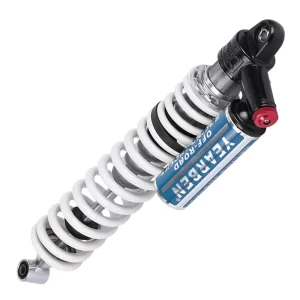
Agricultural equipment often carries a load that changes as the tank empties or the hopper feeds. The rear shock must be specified for the maximum working load and the way that load changes, not only the empty vehicle. A spring that is correct empty can sag too far when a sprayer is full. Preload adjustment or a dual-rate spring can keep ride height more consistent, but the damper still needs to handle low-speed roll and pitch control. Agricultural duty rarely demands the extreme shaft velocities of an ATV jump. It demands stability under weight and enough damping to reduce oscillation in the field.
Sealing, plating, and bushing choice also affect service life. Fertilizer dust and liquid chemicals are more damaging than dry trail dust when they collect around the shaft seal. A chrome-plated rod, a suitable shaft seal arrangement, and corrosion-resistant body treatment help protect the oil and gas charge. Mounting bushings need to survive long hours and frequent wash-down if the machine is cleaned after use. These requirements should be written into the specification, not left to an ambiguous agricultural grade description.
Coilover, Piggyback, and Remote Reservoir Configurations
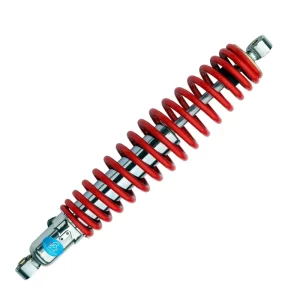
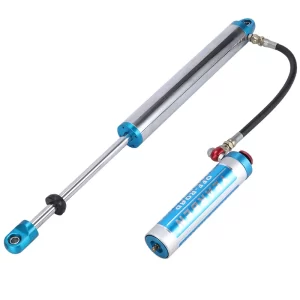
Rear shock packages fall into a few common forms. A smooth-body or coilover rear shock places the spring around the damper or on a separate spring seat. A piggyback reservoir mounts to the body, while a remote reservoir connects by hose. The configuration changes two things: oil cooling and packaging. More oil volume and a separating gas charge can keep damping more consistent during sustained work, but the reservoir must clear the frame, exhaust, and suspension links.
A coilover with a threaded spring seat gives more adjustment for ride height. A piggyback or remote reservoir design helps keep gas separated from the oil during repeated movement. When the application involves mixed ATV and agricultural use, the configuration should follow the most demanding condition. If fade or long-run heat is the limiting factor, a piggyback or remote reservoir may help. If the primary problem is fitting the spring and damper into a tight rear mount, a compact coilover may be the better starting point.
Some agricultural and utility platforms need a coilover-type rear unit because the spring platform and damper travel are packaged together, making spring changes and ride-height adjustment easier to control. <Coilover-Shock-Absorber> covers coilover shock choices where spring preload and damping are matched as one assembly.
Custom OEM Sourcing for Rear Shock Projects
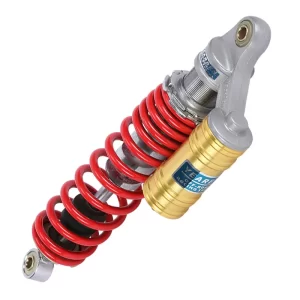
Custom projects should begin with the complete vehicle envelope and the duty cycle. At Yearben, a rear shock project normally starts with the vehicle model, mounting dimensions, load range, and the most demanding operating condition rather than only a part number. The supplier can then propose a body type, spring rate, preload range, damping curve, coating, and bushing specification. Without that information, a factory can only match physical dimensions. It cannot confirm that the shock will control the rear axle at the required speed and load.
Validation should be defined before production. Common checks include dimensional inspection, spring rate and preload verification, damping force measurement at multiple shaft speeds, seal durability under contamination, corrosion testing, and fatigue or endurance testing on a representative sample. The approval basis should state which checks are for fit, which checks support performance, and which checks are acceptance tests. A sample that fits a fixture only proves geometry. It does not prove field life. Ask for the test record and the pass criteria for each requirement.
When agricultural and ATV programs share a rear platform, the coilover body type and reservoir package should be selected from known vehicle envelope and heat data before valving is finalized. <Off-Road-Coilovers> covers off-road coilover configurations that can be adapted to mixed duty when the mounting and load details are clear.
Confirming a Rear Shock Specification
To keep sampling on schedule, send the vehicle model, rear mounting dimensions, extended and collapsed lengths, working payload, spring and preload requirements, and the main operating condition. Yearben reviews these inputs against its ATV and agricultural shock absorber range and returns a recommended configuration, damping proposal, and sample lead time. Contact Chen Yibo at +86-523-86566899 or info@yearbenshocks.com.
Frequently Asked Questions About Rear Shock Absorbers
Is a rear shock absorber for agricultural equipment just a heavy duty ATV shock?
It can share the same structural body, but the tuning and protective requirements often differ. An ATV shock is usually valved for higher shaft speeds and impact control. An agricultural shock is more concerned with load support, low-speed stability, seal protection, and corrosion resistance. A dimensionally interchangeable shock may still need a different spring, preload range, damping curve, or shaft and body finish.
How do preload and spring rate affect a rear shock absorber under changing loads?
The spring rate determines how much the rear suspension compresses for a given load. Preload adjusts the installed position of the spring so that the vehicle sits at the correct ride height. If the payload changes repeatedly, an adjustable or dual-rate setup helps maintain ride height. If the load is stable, fixed preload is simpler and may reduce setup error.
Can a piggyback or remote reservoir help on agricultural equipment?
It helps when the duty creates enough heat or movement to require more oil volume and gas separation. On a slow-moving sprayer with light suspension movement, the benefit may be smaller and the packaging risk greater. The decision should follow the actual duty cycle, available mounting space, and the expected operating temperature, not the appearance of higher performance.
What information should an OEM order include?
A complete request should include the vehicle model, rear mount type, extended and collapsed length, spring ID and rate or load target, travel requirement, dominant payload, operating terrain or use, and any corrosion, testing, or finishing requirements. This lets the factory check fit first and then propose a damping curve, preload range, and validation plan that matches the rear suspension.
If you’re interested, check out these related articles:
Ride-on Mower Shock Absorbers 38mm, Shock Absorber Manufacturer
2-0-Air-Shock
Customized Steering Dampers 24mm
Off-Road-Coilovers