
A reservoir shock and a standard shock can share the same piston, shims, and oil and still behave differently at the end of a long, fast run. The difference is heat capacity. Damping converts wheel motion into heat inside the oil, and a reservoir gives that oil extra volume, a place to sit apart from the gas charge, and more surface to shed heat. That is worth paying for when shaft speed stays high long enough to overwhelm a standard body. It is wasted money when the real problem is spring rate, travel, or a worn seal. The sections below set out the conditions that separate those cases, the checks that show which one you have, and the measurements a supplier needs before either type can be quoted correctly.
What a reservoir adds to a shock body
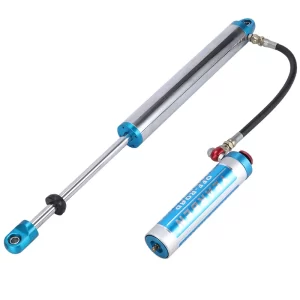
A shock absorbs energy by forcing oil through a restriction, and that energy leaves the oil as heat. Two things limit how long a damper keeps its tune under load: how much oil it holds and how well the gas charge stays out of that oil. By standard, this guide means a damper with no separate reservoir, either a smooth-body monotube or a twin-tube, gas charged or not. Those units work with the oil volume inside the main tube alone. A reservoir adds a second chamber connected by a port or a hose, so the same damper carries more oil and has more wall area in contact with air.
The chamber does a second job. In a simple emulsion damper the gas mixes into the oil as the shaft cycles quickly, and foamy oil cannot build consistent pressure. A reservoir with a dividing piston or a bladder keeps the gas behind a barrier, so the oil stays dense and the damping curve holds at high shaft speed. That is the mechanism behind the feeling that a damper still works at the end of a hard run instead of going soft.
It helps to think of a heat budget. Energy enters the oil faster as shaft speed rises, and it leaves through the body wall and the reservoir surface into the air. A reservoir raises the amount of energy the damper can absorb before the oil thins and the curve drifts. It does not change travel, spring rate, or load capacity, and it does not create grip by itself.
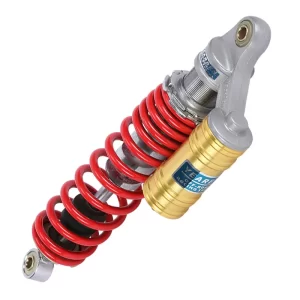
Four comparison points carry most of this argument, and each supports a narrower conclusion than the marketing usually implies.
| Comparison point | What it is based on | What it legitimately supports | Do not infer |
|---|---|---|---|
| Oil volume | Body and reservoir dimensions on the supplier drawing | A larger oil mass heats more slowly for the same energy input | That fade resistance scales with volume alone; surface area and airflow decide how fast heat leaves |
| Gas separation | Teardown or drawing showing a dividing piston or bladder | A separated charge keeps gas out of the oil at high shaft speed | That every part sold as a reservoir damper is gas separated; some still run an emulsion charge |
| Damping curve | Dynamometer sheet at stated shaft velocities and oil temperature | The curve describes that unit at those conditions | That one peak force figure predicts comfort or lap time |
| Reservoir position | Bracket drawing and photographs of the installed layout | Position sets hose routing and how much heat the reservoir sees | That a larger reservoir runs cooler; one mounted beside an exhaust can run hotter |
These are relationships between geometry, gas layout, and heat flow rather than test results from a particular vehicle. The values behind them come from drawings and dynamometer sheets for the unit you are buying, which is why a test sheet without a stated shaft velocity and oil temperature says very little.
Remote and piggyback reservoirs solve different packaging problems
Both layouts add volume. The difference is where that volume sits. A piggyback reservoir is clamped to the damper body, so the oil path between the two chambers is short and the assembly stays compact. The cost is bulk in the worst place: right beside the spring and the control arm, where airflow is poor and clearance is already tight on a small ATV or UTV corner.
A piggyback body keeps the extra oil next to the damper, so the fluid path is short and the assembly stays compact. <Piggyback-2-0-Coilover-Shock> covers the piggyback 2.0 coilover shock layout.
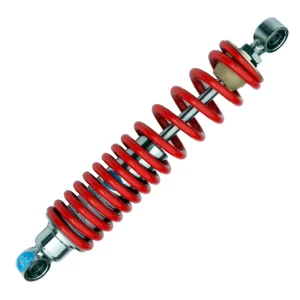
A remote reservoir sits on its own bracket, joined by a hose. It can be larger, mounted where air actually moves, or routed into space the damper body cannot use. The trade is plumbing: hose length, two crimp joints, a minimum bend radius, chafe against the frame, and a longer fluid path that has to be bled properly. A remote hose is a wear item and belongs on the service checklist, not only in the installation drawing.
The two labels describe position, not gas separation or damping quality. Some reservoir dampers still run an emulsion charge inside, and some smooth-body monotubes already separate gas with an internal floating piston. Ask for the internal layout and the damping curve, not the product name.
Our own production at Yearben covers both layouts across more than 200 damper models for ATV, UTV, and off-road platforms, and in a custom build the constraint that decides between them is rarely damping force. It is usually the space around the spring and the path a hose can take without touching a moving part.
How to tell heat fade from a worn or wrong setup
Before spending on hardware, separate three patterns: heat fade, wear, and a setup limit. The clearest signal is recovery. Ride the same section hard, note how the damper behaves at the start and at the end, then let everything cool and repeat. Damping that returns after a rest points to temperature. Damping that is weak from the first bump points to gas loss, worn shims, air in the oil, or valving that never matched the spring.
Symptoms that follow temperature
Onset comes late in a run and worsens on hot days or long climbs where airflow over the damper is low. The working end fades first, the body and reservoir feel hot to the touch, and the same obstacle that felt controlled at the start now feels soft or bouncy. Measure the body and reservoir temperature with an infrared thermometer straight after the run, record the ambient reading, and repeat the cold comparison. A large rise combined with a return to normal damping is the signature of a heat limit rather than a broken part.
Symptoms that follow load or position
A damper that bottoms at low speed on one specific obstacle is usually short of travel, bump stop, or spring rate, not short of oil volume. Ride height that drops over weeks points to spring fatigue, preload, or mount wear. Weakness in one corner only suggests damage, a bent shaft, or a kinked hose on a remote unit. A harsh response on small bumps from the first metre points to excessive low-speed compression or bushing bind. An oil film at the shaft is a seal problem.
A compression adjuster changes where the curve sits, not how much oil the damper holds. Turning it in raises damping force at the same shaft speed, which raises heat input at the same time. On a unit already close to its heat limit, that can make fade arrive sooner.
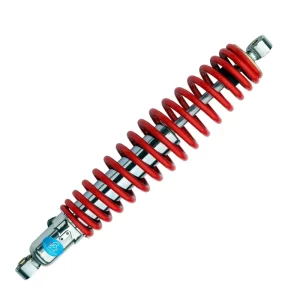
Two habits make the diagnosis usable. Fit a cable tie on the shaft, ride a normal lap, and measure where it stops to see how much travel is actually used. Then measure static sag at ride height with the usual load. Those two numbers answer most questions about whether the damper or the setup is the limit.
When standard shocks are the correct choice
A standard damper is the right answer when the oil never gets close to its heat limit. Short trail rides broken by rest stops, low-speed utility work, mower deck suspension, and seat damping all fall into that group. The damper is doing its job; the reservoir would sit cold. Buying one anyway adds cost, a bracket, and a service step that never pays anything back.
Logistics decide a second group. Where bracket space is fixed, where units are swapped in the field by staff with no gas charging equipment, or where a fleet needs identical spare parts across many machines, the simpler body is easier to keep working. Complexity has a cost that shows up months later, not on the purchase order.
A reservoir also does not guarantee a better curve. Valving, piston design, and oil quality set the curve in the first place; the reservoir only slows how fast that curve drifts. A well-matched standard monotube can hold its tune for a whole ride while a badly valved reservoir unit feels harsh from the first kilometre. Judge the tune before the hardware.
Where the real limit is travel or spring rate, the decision belongs to the coilover platform rather than to the damper type. Longer travel and a matched spring change what the wheel can do; a reservoir only changes how consistently the damper controls it.
Travel, spring rate, and mount geometry are set at the platform level, before the damper question is settled. <Off-Road-Coilovers> covers off road coilover configurations for this stage of the decision.
| Duty profile | Standard shock holds up when | Reservoir earns its cost when | Do not upgrade when |
|---|---|---|---|
| Short trail rides with stops | Rest stops let the oil cool between sections | The same rider holds pace for long stretches without stopping | The damper is not drifting yet; springs and valving come first |
| Fast gravel and desert | The section is short or the day is cold | Heat input stays high for minutes at a time | Tires and geometry already limit the vehicle |
| Utility and farm work | Shaft speed is low and loads are intermittent | Rough ground keeps the shaft moving fast under load | The complaint is sag under load, which is a spring and bump stop decision |
| Racing with practice and heats | One short heat, with a full cool-down before the next | Heats run back to back with no full cool-down | The tune still changes every weekend; settle the valving first |
| Rock crawling | Average shaft speed is low, with brief spikes | Spikes repeat often and compression adjustment matters | The goal is articulation, which travel and link geometry decide |
| Fleet with a basic workshop | Units are swapped in the field with no gas equipment | A trained technician and a gas fill station are on site | Nobody can bleed and recharge the unit |
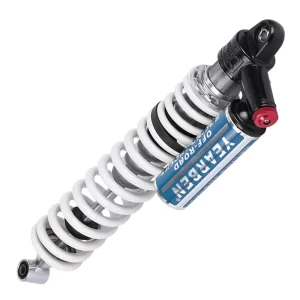
Two rows are easy to misread. Low-speed crawling and loaded utility work feel demanding because the machine works hard, yet heat input into the oil depends on damping force multiplied by shaft velocity over time, not on engine load. Brief spikes still count, but a long slow climb through rocks can leave a standard damper cooler than a short fast gravel section.
What to measure before you order
A damper supplier can only match what you describe. Work through this list on the vehicle itself, with the usual load on board.
- Eye-to-eye length at full droop, with the suspension fully extended and the wheels off the ground, then again at ride height.
- Travel actually used, measured with a cable tie on the shaft after a normal ride.
- Mount hardware: eye to eye or stem top, bushing width, bolt diameter, and the angle of one eye relative to the other.
- Spring rate, free length, installed preload, and whether the perch is threaded or fixed.
- Corner or axle load with the passengers and cargo you normally carry.
- Clearance envelope at full lock and full bump: tire, brake line, half-shaft, exhaust, control arm, and the space left for a reservoir bracket plus hose bend radius.
- Duty description: terrain, average speed, run length, and ambient temperature.
- Adjuster access, if you plan to change settings between sessions.
A quote built from a model name alone is a guess. Send the measurements and the symptom, and the specification can be checked against something real.
A custom damper order starts with the numbers on the vehicle rather than with a part number that looks close. <Custom-Shocks-And-Struts> covers custom shock and strut builds.
Problems a bigger reservoir cannot solve
Bottoming at low speed is a travel, bump stop, or spring rate problem. Adding oil volume does nothing for a suspension that runs out of stroke on a known obstacle.
Ride height that slowly disappears is a spring, preload, or mount issue. A new damper will hold it briefly and then show the same sag if the spring is tired.
Harshness on small bumps comes from low-speed compression valving or from a suspension that binds. A reservoir makes the curve more consistent, which can make a bad tune more consistently uncomfortable rather than less.
Oil at the shaft is a seal failure. The rebuild costs more on a reservoir unit because there are more joints to inspect and a gas charge to reset, so it is not a shortcut around a worn damper.
Heat that arrives from outside the damper is worth treating at the source. An exhaust or turbo sitting close to the body or the reservoir can dominate the heat budget, and shielding or rerouting does more than a larger can in the same hot pocket.
Load capacity does not change either. Axle rating, spring rate, and structure carry the load; the damper controls how that load moves. On a light ATV or UTV corner, the extra mass of a reservoir and bracket adds unsprung weight, which is a genuine cost on chatter and small-bump response.
Installation and service differences that change the cost
Reservoir units need the oil de-aerated before the gas charge goes in, by vacuum or by careful cycling, and the charge is set with the shaft fully extended. Air left in the system appears as inconsistent damping that no adjuster will fix, so the bleed procedure is part of the product, not an optional extra.
Hose routing on a remote layout needs checking twice: once at installation, and again after the first hard run when the suspension has settled and the hose has taken a set. Confirm bend radius, clearance to moving parts, and crimp condition. Tighten brackets to the supplier figure, and mark the adjuster position before any rebuild so the unit returns at the same setting.
Keep a log of hours, terrain, and ambient conditions. The rebuild interval follows duty rather than calendar time, and a reservoir damper that is never serviced loses the advantage it was bought for. A standard damper with a failed seal also needs a rebuild, so compare the two on total cost over the same service hours, including brackets, hose, gas fill, and downtime, against the fade you actually experience.
Get a damper recommendation from your own measurements
Send the vehicle and model, the corner or axle load with the load you usually carry, eye-to-eye length at full droop and at ride height, travel actually used, mount type, spring rate and free length, the clearance around the spring and frame, and the duty you ride. State whether the complaint is fade late in a fast run, bottoming at low speed, or harshness on small bumps, because those three lead to different hardware rather than different sizes of the same part.
Email info@yearbenshocks.com or call +86-523-86566899 with that list. Taizhou yearben shock absorber Technology Co., Ltd. builds standard, piggyback, and remote reservoir dampers from those measurements, so the recommendation starts with the vehicle instead of a catalogue number.
FAQ
Are reservoir shocks worth it for trail riding?
Usually not, unless the riding style or the machine changes the heat picture. Trail work is broken into short sections with idle time between them, so the oil cools before the curve drifts. The upgrade starts to pay when the same rider holds a fast pace for long stretches without stopping, when the machine is heavy for its class, or when the ground is loose and fast rather than technical. The practical test is comparison: if the damper feels different at the end of a long ride than at the start and recovers after a rest, price a reservoir unit. If it feels the same both times, spend elsewhere.
How can I tell whether a shock is fading or worn out?
Recovery separates the two. Fade returns to normal after the damper cools, so the same section feels different at the start and the end of a run and then comes back. Wear does not recover: damping is weak from the first bump, one side may behave differently, and there is often an oil film at the shaft seal. Check body and reservoir temperature with an infrared thermometer straight after the run, note the ambient figure, and repeat the same section cold. A large rise plus a return to normal damping points to heat. No rise with poor damping points to wear or gas loss.
Can a reservoir be added to my existing shocks?
Not as a practical retrofit. A reservoir damper is designed around the extra volume and the gas barrier, with a port, a dividing piston or bladder, and valving matched to the larger oil mass. Welding a can onto a standard body changes the volume without giving you the internals, and it puts a pressure joint on a tube that was not designed for one. The realistic route is a damper built with the reservoir from the start, specified from your own vehicle measurements.
Do reservoir shocks need more maintenance than standard ones?
Yes, in two places. The gas charge and oil condition need checking on the supplier schedule, and a remote layout adds a hose with crimp joints that has to be inspected for chafe, kinks, and weeping. A piggyback layout avoids the hose but still needs a proper bleed and recharge at rebuild. A standard damper also needs a rebuild when its seal fails, so compare the two on total cost over the same service hours rather than on purchase price alone.
If you’re interested, check out these related articles:
2-0-Air-Shock
Triple-Bypass-Remote-Reservoir-Shock
Lawn-Mower-Damper-Shock-Absorber
4X4-Shock-Absorber-Supplier