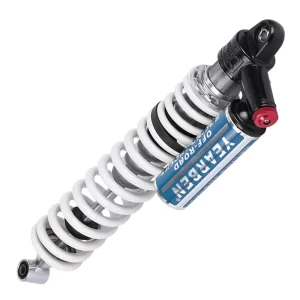
A hydraulic shock absorber loses damping when the oil inside it stops being forced through the piston: it escapes past a seal, slips around a worn piston band, carries entrained gas, or thins out under heat. The resisting force falls, and the vehicle answers with extra oscillation, earlier bottoming, or a ride that changes between the first hour and the third. Because leakage, aeration, heat, and wear produce similar complaints, the useful question is not whether the damper is weak but which path opened first. The checks below are ordered to answer that before a unit is replaced or a batch is blamed.
How a Weak Damper Shows Up in Driving and in Data
A damper is a velocity-controlled device. Oil has to pass a restriction for the unit to generate force, and the size of that restriction separates a soft tune from a firm one. Force therefore rises with shaft speed and is tuned as a curve across the speed range rather than as one number. When the curve drops, the springs have not changed, but the vehicle has lost part of its control over them.
Drivers rarely describe this as a force problem. They report a rear end that steps out over ripples, a machine that bottoms on a section it used to clear, a cab seat that bounces twice after a pothole, or a damper that feels acceptable on a cold start and vague after an hour of work. Each description points to a fall in force at particular shaft speeds rather than to total failure.
Spring sag is the most common misdiagnosis. A spring carries load and sets ride height; a damper controls how quickly the suspension moves. If ride height has dropped and the unit bottoms while the body still settles quickly after a bump, check the spring first. If ride height is unchanged and the body keeps moving after the bump, check the damper first. Both faults can sit on the same vehicle, which is why the height measurement comes before any opinion about the shock.
| Symptom pattern | Likely mechanism | First check |
|---|---|---|
| Soft over small ripples, still firm over large bumps | Internal bypass around the piston at low shaft speed | Low-speed force curve against the build record |
| Bottoming on compression over ground that used to clear | Lost oil volume or lost gas charge | Oil film at the rod seal, ride height, gas pressure |
| Two or three extra oscillations after one bump | General fall in force | Body motion observation plus rod extension test |
| Acceptable cold, weak after sustained work, better next morning | Thermal fade or fluid breakdown | Force measured hot and again after cooling |
| Knock or rattle over sharp edges | Foamed oil, cavitation, or a worn mounting bush | Internal noise check off the vehicle, bush condition |
Where the Oil Escapes and Where It Bypasses
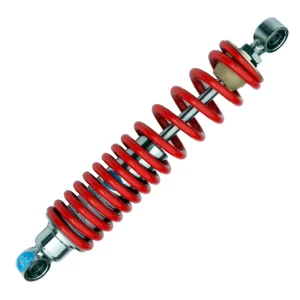
External leakage happens at the rod seal and wiper. A dry dust ring is normal. A wet film that returns after the rod is cleaned, or dust clinging in a dark ring around the seal, shows that oil is reaching the outside. Fluid volume falls, the gas space above it grows, and compression support drops before rebound control does. The same seal that lets oil out under pressure can let air in during rebound, when the rod side of the unit runs below atmospheric pressure.
Internal bypass leaves no trace on the outside and is harder to accept. Oil travels around the piston instead of through it: past a piston band that has lost its preload against the bore, past a scored bore wall, past a rod guide worn enough to let the rod move sideways and open a gap, or through a shim stack whose discs no longer seat flat. The signature is specific. At low shaft speed the pressure is low, the shims stay closed, and nearly all displaced oil must pass the fixed bleed; a leak path then takes a large share of that small flow. At high shaft speed the pressure opens the shims and the main flow passes there, so the same leak is a smaller fraction of the total. The result is a unit that still feels firm over large bumps and imprecise over small ones.
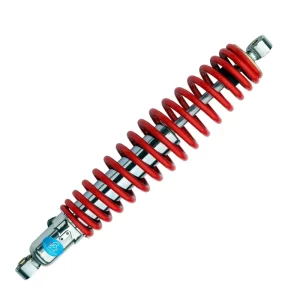
Small-bore dampers feel the same faults sooner. A seat damper or a steering damper holds little oil and works through a short stroke, so a small volume loss or a small bypass gap changes its force curve more than it would on a large off-road unit.
A compact hydraulic unit carries so little oil that the volume loss which barely moves a large off-road damper will shift the curve of a small one. <Hydraulic-Shock-Absorber-24MM> covers a 24 mm hydraulic shock absorber built around that smaller fluid volume.
Why Entrained Air Makes the Force Spongy
Oil is nearly incompressible; gas is not. Once gas is mixed into the working oil, the damper has to compress it before pressure can build, so force lags behind shaft movement and the response becomes inconsistent from one bump to the next. Entrained air usually enters through a seal on the rebound side, from an oil level set too low at assembly, or from a fill process that did not evacuate the unit before closing it.
Cavitation is a different mechanism with a similar feel. When pressure behind the piston falls below the vapour pressure of the oil, vapour cavities form and then collapse against the shim edges and the bore wall. Each collapse removes a little material and leaves particles in the oil, so a unit that cavitates loses force and also generates the debris that wears it further. Entrained air is a filling or sealing problem and responds to proper bleeding. Cavitation is a pressure-balance problem, and it can persist on a correctly filled unit when the gas charge, the rebound setting, or the oil grade does not match the application.
A drain sample separates both from thermal problems quickly. Oil released into a clear container after a run and left to stand for a few minutes shows persistent foam when gas is entrained, a milky look when water is present, and a dark colour with suspended particles when wear or overheating has been at work.
How Heat Changes Damping and Where Fade Becomes Failure
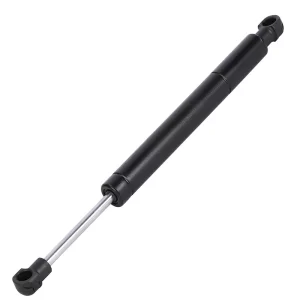
Damping converts motion into heat, and heat raises the oil temperature. Viscosity falls as temperature rises, and for flow through a fixed restriction the resulting force falls with it. This is not a defect; it is the reason a damper is tuned with both a cold and a hot condition in mind. It becomes a complaint when the unit is worked outside the duty it was built for, or when the oil volume is too small to absorb the heat that duty produces.
Viscosity grades are reference points, not descriptions of running behaviour. ISO 3448 defines grade numbers by nominal kinematic viscosity at 40 °C [1], so two oils carrying the same grade can behave differently at 100 °C inside a working damper. Where an application runs hot for long periods, the high-temperature behaviour of the fluid matters more than the number on the drum.
Heat also ages the fluid and the seals. Oxidation thickens the oil and forms deposits on the shims, viscosity index improvers shear down under repeated high-pressure flow, and seal compounds harden and lose elasticity. These changes are permanent. The practical test is a repeat measurement: a unit that recovers its force after cooling has faded, while a unit that stays weak after cooling has lost oil, gas charge, shim preload, or seal compliance.
A cab seat damper works through short strokes at a high cycle count, so it builds heat in a small oil volume long before a suspension damper reaches the same temperature. <Twin-Tube-Hydraulic-Seat-Damper-28MM> covers a 28 mm twin-tube damper built for seat suspension duty.
Wear, Contamination, and a Lost Gas Charge
Particles in the oil come from outside and from the damper itself. Dust enters past a damaged wiper, and cavitation erosion releases metal from the bore and the shim edges. Those particles then abrade the piston band and the rod, which opens the bypass and produces more particles. ISO 4406 codes the particle count of a fluid sample at three size thresholds [2], which tells you the fluid is dirty; it does not tell you which part wore, and a clean sample does not clear a worn internal part if the debris has already been flushed out or has settled in a low point of the body.
Water is more destructive than dust in the same quantity. It corrodes the bore wall and the shim faces, and the corrosion products change both the surface finish and the fluid. A damper that has taken in water often feels erratic rather than simply soft, with force varying between strokes.
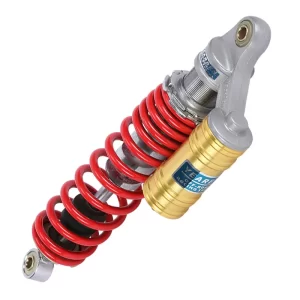
Gas charge loss is the quiet cause on sealed and monotube units. A nitrogen charge holds the oil under pressure so that cavitation begins only at a higher shaft speed. Pressure escapes slowly through seal permeation over years of service, or quickly past a damaged floating piston seal or a leaking valve core. The visible sign is a rod that no longer extends by itself when the unit is removed and compressed by hand; the driving sign is a loss of control that appears earlier on rough ground than on smooth roads.
A monotube unit depends on the gas charge behind its floating piston to keep the oil under pressure, and once that charge escapes, cavitation starts earlier in every stroke. <Monotube-Shock-For-Off-Road> covers a monotube design intended for off-road use.
Shim fatigue belongs in the same list. A shim that has flexed millions of times can crack or take a permanent set, so it opens at a lower pressure than the build record specifies. Because the shim stack governs high shaft speed behaviour, the loss shows up first over sharp edges and at speed, while low-speed control stays close to normal. Fluid choices made in service matter as well: DIN 51524-2 sets anti-wear and ageing requirements for HLP oils [3], while the viscosity grade is fixed separately under ISO 3448 [1]. Topping up a unit with an unknown fluid changes both properties at once, and the original curve no longer describes that damper.
A Diagnostic Order That Separates the Causes
Record the complaint and its conditions. Note the temperature, load, surface, running hours, and whether the unit is new or has completed a season. A loss that appears only when hot points toward the fluid and the heat path; a loss present in the first hours points toward build or installation.
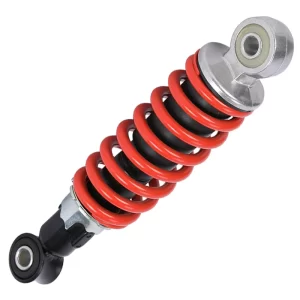
Inspect on the vehicle before removing anything. Measure ride height at each corner against the specification, check spring free length, look for an oil film at the rod seal, and check the mounting bushes and the rod for side load or a bend. A bent rod from a misaligned bracket scores the guide and destroys the seal, and no rebuild survives that.
Test the gas charge where a valve or a serviceable reservoir is fitted. Compare the pressure with the build specification, and check whether the rod extends after the unit is compressed by hand. This is a coarse check: it separates a unit with no charge from one with a partial charge, not a small pressure drift.
Measure the force curve on a bench at defined shaft speeds in both directions, then compare it with the curve recorded for that build. A curve that is low at low shaft speed only points to internal bypass. A curve that is low at high shaft speed points to the shim stack, the gas charge, or foamed oil.
Repeat the measurement at working temperature. A curve that recovers after cooling has faded; a curve that stays low has lost oil, charge, or preload. This is the single test that separates a thermal complaint from a mechanical one.
Open the unit only after the first five steps narrow the cause. Then measure the bore for scoring and out of round, the piston band for preload and flat spots, the rod for chrome loss at the seal line, and the shims for cracks and set. Opening a unit first costs a seal kit and destroys the evidence that would have told you which path failed.
| Check | What it confirms | What it does not confirm |
|---|---|---|
| Oil film at the rod seal | A leakage path exists at the seal | How much oil was lost, or that the loss explains the complaint |
| Force low at low shaft speed only | Internal bypass around the piston | Which internal part opened the bypass |
| Force recovers after cooling | Thermal fade | That the fluid is undamaged, since heat also ages oil |
| Foam in the drained sample | Gas is entrained in the oil | Where the air entered |
| Metal particles in the fluid | Wear is generating debris | That the piston band and bore are the source |
| Rod extends on its own after compression | Some gas charge remains | That the charge matches the build specification |
What to Send When a Unit Loses Damping
A replacement chosen without a measurement usually reproduces the same complaint, because the cause was never located. Send the bore and body size, the oil grade and fill volume, the gas type and charge pressure, the seal and rod finish specification, the shaft speed points used for the force curve, and the conditions where the loss appears, including temperature, running hours, and load. Our engineering team at Taizhou yearben shock absorber Technology Co., Ltd. can compare those figures with the production curve and tell you whether the loss sits in the fluid, the gas charge, or the piston. Email info@yearbenshocks.com or call +86-523-86566899.
FAQ
Can a damper that lost force be rebuilt, or should it be replaced?
It depends on construction and on the condition of the housing. A unit with a removable seal head, a serviceable piston, and a gas valve can be rebuilt when the bore shows no scoring and the rod chrome is intact at the seal line. Crimped or welded sealed units are replaced. A rebuild on a scored bore restores force for a short period and then fails again, so the inspection result decides, not the price of the seal kit.
How do I tell a worn damper from a worn spring?
Measure ride height at each corner against the specification, then watch how the body moves after a bump. A sagged spring sits low, reduces travel, and bottoms the unit, but the body still settles quickly. A worn damper holds correct ride height while the body keeps moving after the bump. If the vehicle sits low and continues to move, both parts are suspect and the spring check comes first because it changes the damper’s working range.
Will a thicker oil restore damping force?
It changes force at every shaft speed rather than only where force was lost, so it treats the symptom and hides the cause. A grade number is defined by viscosity at 40 °C [1], and an unknown thicker fluid also raises internal pressure, shifts the balance between compression and rebound, and leaves you without a reference curve. Correct the leak path, the gas charge, or the shim stack, and use the fluid specified on the build record.
Why do new units lose damping within the first weeks?
Look at build and installation before wear. Under-filling, air left in the body before closing, a seal damaged during rod insertion, an incorrect gas charge, and contamination at the fill stage all produce early force loss. Installation faults do the same: wrong installed length, a misaligned bracket that side-loads the rod, or a bush tightened so the eye cannot articulate. A unit that weakens within hours is a build or fitting problem, not normal service life.
References
[1] ISO 3448:1992, Industrial liquid lubricants: ISO viscosity classification, International Organization for Standardization, Geneva, 1992.
[2] ISO 4406:2021, Hydraulic fluid power. Fluids. Method for coding the level of contamination by solid particles, International Organization for Standardization, Geneva, 2021.
[3] DIN 51524-2:2017, Pressure fluids. Hydraulic oils. Part 2: HLP hydraulic oils, minimum requirements, Deutsches Institut für Normung, Berlin, 2017.
If you’re interested, check out these related articles:
Damping-Adjustable-Shock-Absorber
4X4-Shock-Absorber-Supplier