
Remote reservoir shocks matter in trophy truck builds because they move the gas charge out of the main shock body. That change increases oil capacity, improves heat rejection, and gives the suspension more consistent damping as the truck runs hard over whoops, silt, and graded desert roads. The right reservoir shock is not simply a standard shock with an extra hose. It is a system decision that ties body diameter, hose routing, piston valving, spring rate, and service access together. This guide covers the specifications builders should confirm before ordering or installing reservoir shocks for a trophy truck or go-fast desert build.
Why Remote Reservoirs Change Trophy Truck Suspension
A remote reservoir separates oil and nitrogen into two chambers. In a smooth-body emulsion shock, gas and oil can mix. In a remote reservoir shock, a dividing piston or bladder keeps the gas charge away from the working fluid. For a trophy truck, the benefit is not only a longer heat path. The larger oil volume slows temperature rise, reduces aeration, and keeps damping force more stable during long full-throttle sections. That stability matters when the truck cycles the suspension many times per minute and the driver is relying on predictable body control.
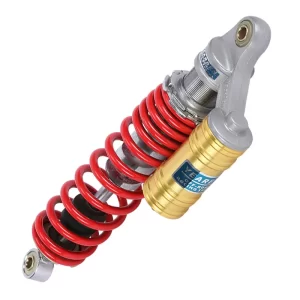
A remote reservoir also adds packaging freedom because the main body can stay shorter while the reservoir is mounted away from the shock. <Remote-Reservoir-Shocks-Manufacturer> covers production-level remote reservoir shock specification for off-road vehicles.
Core Specifications to Lock Down
For a trophy truck, several dimensions need to be resolved before the first sample is built. The table below separates the common specification areas from what they actually change on the vehicle.
| Specification | What it affects | What to confirm |
|---|---|---|
| Body diameter and shaft size | Heat capacity, bending stiffness, seal load | Corner weight and expected shaft speed, not only travel |
| Travel and extended/collapsed length | Bump travel, bottom-out control, chassis clearance | Eye-to-eye open and collapsed lengths plus bump-stop distance |
| Reservoir size and oil volume | Fade resistance, pressure change | Fill volume, bleed procedure, and pressure change across full stroke |
| Hose length and fitting orientation | Installation stress, seal life | Routing at full droop, full bump, and full steering angle |
| Valving configuration | Compression and rebound force shape | Vehicle weight, unsprung mass, track width, and target speed range |
| Spring rate and preload | Ride height, pitch control, bottom-out behavior | Motion ratio and spring selection separate from damper tuning |
Reservoir Mounting, Hose Length, and Seal Integrity
Most remote reservoir failures start at installation boundaries. The hose is a wear item with a finite flex life. If it is short, the hose can pull at the banjo or swivel fitting at full droop. If it is long, it can rub against chassis tubing, exhaust parts, or body panels. Routing should be checked at full bump, full droop, and full steering angle. Use lined clamps on smooth sections and avoid mounting the reservoir to a point that moves independently from the shock. The reservoir should also sit so the hose end does not collect air at a high point, unless the manufacturer specifies a self-bleeding orientation.
Tuning Remote Reservoir Shocks for Desert Race Conditions
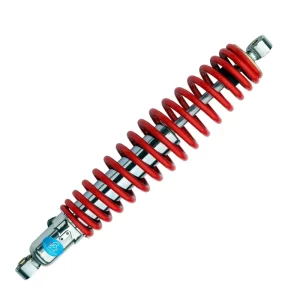
Trophy truck and desert racing suspension uses more compression damping than a trail side-by-side, but the tune must still protect the tire contact patch. Start with enough rebound control to keep the wheel from packing over repeated bumps, then shape compression around chassis pitch and bottom-out force. The remote reservoir influences this because reservoir pressure and oil volume change how the low-speed and high-speed circuits recover after each event. Builders often begin with a single compression and rebound setting, log shock temperature and driver feedback, then change valve stacks in small steps. High-speed blow-off should be set by shaft speed, not by vehicle speed alone.
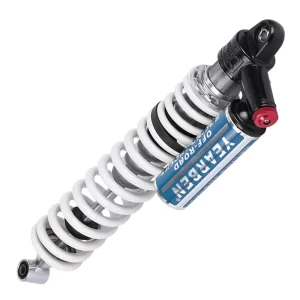
Base valving still leaves zone control on the table when the truck needs separate bump and top-out behavior. <Triple-Bypass-Shock-For-Off-Road> covers bypass shock zones and tune choices for go-fast desert use.
Heat Management and Common Failure Modes
Remote reservoirs improve heat rejection, but they cannot remove all fade risk. Fade comes from oil viscosity loss, nitrogen pressure rise, and seal friction when the shock temperature climbs. The reservoir body should be treated as part of the cooling system. Fin bodies, clamp-on heat sinks, or placement in clean airflow can help, but the first checkpoint is reducing misfit damping. A shock that is valved too stiff will generate heat faster than any reservoir can reject. Common failure signs include reduced low-speed control, an oily film around the hose fittings, inconsistent pressure after service, and a change in ride height when the gas charge leaks down. Before changing valving, confirm the gas charge and inspect the reservoir piston or bladder for leakage.
OEM Sourcing and Acceptance Testing
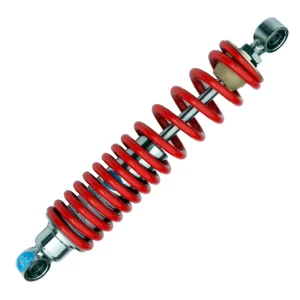
For a trophy truck program, do not treat the shock as an off-the-shelf part. Request a documented sample approval that includes the piston and shim build sheet, reservoir piston or bladder type, hose assembly specification, nitrogen fill procedure, and rod surface finish. Ask for a cycle test or damper dyno curve before bulk production, then compare incoming units against the approved reference sample. A serious supplier should hold consistent force between batches and trace raw-material changes. Yearben Shock Absorber Technology, for example, applies this documentation approach when developing remote reservoir shocks for off-road and specialty vehicle builders.
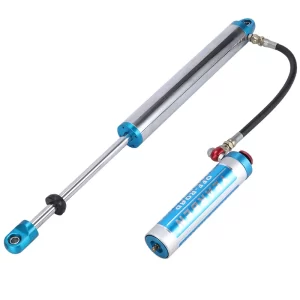
A clear sample and production control loop works best when the supplier already has established off-road shock manufacturing and testing capability. <Off-Road-Coil-Over-Shocks-Manufacturer> covers factory qualification and manufacturing capacity for off-road coilover and shock programs.
Remote Reservoir Shock Specification Review
Send the specifications identified in this guide instead of only a product number. Include vehicle weight, motion ratio, eye-to-eye open and collapsed length, desired shaft travel, reservoir mounting position, hose routing photos, current spring rate, and the terrain or race format the truck must handle. The engineering team can review the package for fit, pressure, valving, and production documentation, then return a sample plan and quote. Contact Yearben Shock Absorber Technology at info@yearbenshocks.com or +86-523-86566899.
FAQ
Does a remote reservoir increase shock travel?
No. The travel is set by the main body, shaft, top-out spacer, and bump stop. The remote reservoir changes oil capacity, gas separation, and heat rejection. It does not add stroke unless the package length and mounting points change at the same time.
How much nitrogen pressure should a trophy truck remote reservoir shock use?
There is no universal number. The correct charge depends on the reservoir volume ratio, shaft diameter, expected oil displacement, and the manufacturer’s piston or bladder design. Use the supplier’s fill curve and check the pressure with the shock cool and fully extended after service. Do not use shop air.
Can an emulsion shock be converted to a remote reservoir?
Usually no simple bolt-on conversion is reliable. The body must have the correct internal divider, fluid passages, and hose port made to direct displaced oil into the reservoir. If the damper was not designed with that port and separator, adding a reservoir may trap air or bypass low-speed flow.
What should I send for a custom remote reservoir shock order?
Send eye-to-eye open and collapsed lengths, spring ID and rate, motion ratio, reservoir hose routing and length, vehicle weight, shaft size preference, and the race surface or terrain. Add photos of the mount area at full droop and full bump. The supplier can then check fitment, heat capacity, and valving before quoting.
If you’re interested, check out these related articles: