Off-road racing teams sourcing bypass shocks face a practical question: can a bypass shocks factory deliver shocks that hold up to desert racing conditions and race-level valving demands? After two decades engineering suspension components for OEM and performance applications, I’ve seen the gap between a shock that fits and one that performs. Building a bypass shock to race spec is not a matter of assembling parts; it requires dyno-proven damping curves, repeatable gas pressure management, and a manufacturing process that treats every tube, piston, and seal as a precision element. The answer is yes, a qualified factory can deliver race-spec bypass shocks, but only when engineering drives the production line, not cost reduction.
What Separates Race-Spec Bypass Shocks from Standard Units?
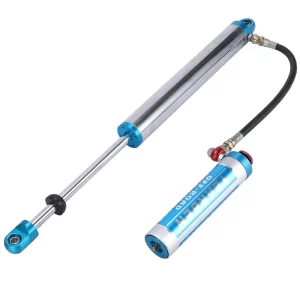
A standard bypass shock provides external compression and rebound clickers with a nitrogen-charged reservoir, but race-spec units push beyond. They must deliver consistent damping force across a wider speed range, manage heat buildup from repeated high-cycle inputs, and retain seal integrity under sustained lateral loads. The difference often lies in the piston design: race pistons use precisely machined orifices and shim stacks calibrated to the vehicle’s motion ratio, not a generic curve.
| Feature | Standard Bypass Shock | Race-Spec Bypass Shock |
|---|---|---|
| Valving | Fixed or limited clicker range | Custom shim stacks, broad adjustment range |
| Seal Material | Standard nitrile | High-temperature fluoroelastomer (Viton) or PTFE |
| Bore Finish | Standard honing | Micro-polished surface, <0.2 Ra |
| Gas Pressure Control | Basic Schrader valve | Precision fill with bleed screw and Schrader |
| Reservoir Design | Simple piggyback | Remote reservoir with high-pressure hose assembly, tested to 600 psi |
| Dyno Testing | Sample batch | Individual shock curve documentation |
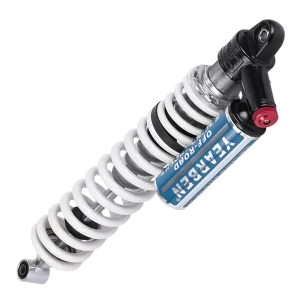
When we develop a bypass shock for desert racing applications, the dyno becomes the final arbitrator. Matching a twin-tube or triple-bypass configuration to a vehicle’s weight and motion ratio takes iterative testing, something a factory without an in-house shock dyno cannot promise. I’ve seen programs where teams assumed a catalog shock would work, only to find mid-stroke harshness because the piston didn’t open the bypass early enough for the big hits. That is the gap.
Can a Factory Produce Build-to-Order Race Bypass Shocks?
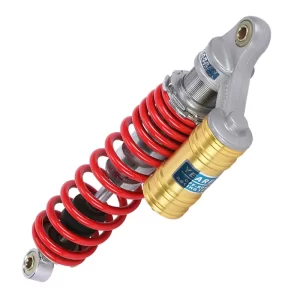
Yes, but only if its engineering workflow supports it. At Yearben, we start with a technical packet: travel targets, mounting style, spring rate, reservoir orientation, and damping priorities. Then we translate that into a CAD model, select the tube diameter and wall thickness, and build the first set of pistons and shim stacks on a small CNC cell. For instance, our triple-bypass remote reservoir shock uses a 6061 aluminum body, hardened chrome shaft, and a shim-stack configuration that we can adjust for rebound and two compression zones. That capability comes from having an engineer-driven process, not just an assembly line.
If your vehicle’s motion ratio demands a droop-limited damping curve that a standard off-the-shelf valve cannot deliver, it’s worth having a technical discussion before locking in a specification. We often see buyers send a competitor’s part number without the curve they actually need; sharing your vehicle’s frequency target helps us propose the right piston and stack combination. Contact our team at info@yearbenshocks.com with your travel and weight data, and we’ll check if a production slot aligns with your timeline.
How to Verify a Manufacturer’s Race-Building Capability
Ask directly about three things: dyno capability, material traceability, and failed-part analysis. A factory that cannot show you a dyno curve for a sample shock has no way to guarantee batch consistency. Material selection matters just as much: 7075 aluminum bodies, hard-chrome shafts with proper surface hardness, and PTFE-lined spherical bearings resist the grit and heat of a desert race. Our team routinely pressure-tests bypass tubes and remote reservoir hoses to failure points, so we know where the weak link is before a race team finds it. Requesting a sample shock with full documentation, including dyno sheets, seal material certification, and a weld-inspection report, separates a supplier who talks racing from one who builds for it.
Custom Ordering Race Bypass Shocks: Spec Sheet to Production
Custom orders move faster when the factory already stocks the right building blocks. We keep a range of piston bore sizes, reservoir canisters, and hose length configurations so that a custom build doesn’t always start from zero. What you need to provide: extended and compressed eye-to-eye lengths, upper and lower mount type (bearing or bushing), spring length and rate, reservoir mounting preference, and any specific valving targets. For a typical adjustable triple-bypass, we might produce a small prototype batch of six shocks for dyno confirmation before the full order. Minimum order quantities depend on the level of bespoke parts: a full custom piston design that requires new CNC fixturing may need 20–30 units, whereas adjusting a standard piston’s stack may require only 10. Our engineering team works through a pre-production checklist: material lot verification, tube concentricity measurement, seal gland sizing, and nitrogen charge validation. Each checkpoint prevents a variance from becoming a field failure.
Testing and Quality Control for Consistent Race Performance
The worst place to discover a damping inconsistency is 150 miles into a Baja race. That’s why every race-spec bypass shock we ship gets an individual dyno run across a speed sweep, from 0.5 in/sec to 25 in/sec. The curve must fall within a preset band, or it goes back for re-valving. We also conduct a 48-hour nitrogen pressure retention test, cycle the rod seal through hundreds of strokes under side load, and perform a salt spray test for bodies and hardware destined for coastal or sandy events. In our experience, seal blow-by in remote reservoir shocks often traces back to improper installation torque on the hose fittings, not a material defect, so assembly procedures are documented and audited on the production floor. A race team that receives 12 matched shocks will notice within a few practice laps if one is off, and that’s exactly what our testing prevents.
When shock fade means lost podium positions, sourcing from a factory that engineers for performance consistency is non-negotiable. If you’re evaluating a bypass shocks supplier for a desert racing, trophy truck, or short-course buggy build, share your target damping values with us. Send your extended and compressed dimensions and expected vehicle weight to info@yearbenshocks.com or call +86-523-86566899. We’ll walk through damping calibration, lead time, and how we document consistency so you move forward with a data-backed decision.
What Racing Teams Ask About Factory-Built Bypass Shocks
How do I know a factory can match the valving of high-end race shocks?
We start with your baseline dyno target, build a prototype stack, and run iterative dyno pulls until the curve sits within 5% of your reference. We keep shim libraries and piston families that span from light UTV settings to heavy truck compression profiles, so a ground-up new valve is rarely needed.
Is the minimum order quantity too high for a small race team?
It depends on the level of custom parts. For a standard-body bypass with tuned valving, an MOQ of 10–15 units per axle is common. When you need a one-off piston profile and dedicated CNC fixturing, that number rises because the setup cost must be amortized. We always prototype before full production, so you can test two dampers and then scale up.
What failure modes do you look for during factory testing?
We pressure-cycle to 1.5× working pressure, monitor nitrogen retention over 48 hours, check for seal blow-by at full rod extension under side load, and inspect weld integrity with dye penetrant. Any shock that leaves the line carries a signed-off test sheet.
Can I get a single set of bypass shocks for a one-off race build?
Yes, but it’s more time-intensive and the unit cost reflects the engineering time. We typically require a detailed technical packet—motion ratio, travel, spring corner weight, and desired damping profile—and then schedule a production slot. A prototype set often ships within 6–8 weeks.
How do remote reservoir hoses affect race durability?
Hose routing and fitting torque must be right. We leak-test each assembly to 600 psi and use bonded seal washers to prevent weepage at the banjo connector. In our experience, a chafed hose against a chassis tube will fail long before a fitting leak, so we advise robust abrasion sleeving. If your chassis has a tight reservoir packaging constraint, share the clearance dimensions at info@yearbenshocks.com and we’ll confirm a hose layout that holds pressure lap after lap.
If you’re interested, check out these related articles:
Customized Lawn Mower damper 24mm
Utv-Shocks-For-Off-Road
Best-Off-Road-Coilover