Coil suspension OEM sourcing fails when buyers compare unit prices before locking platform interfaces. A coilover is not a universal part. Spring rate, reservoir position, eyelet width, mounting angle, shaft stroke, and vehicle weight transfer all change from an ATV through a UTV to a 4×4. The practical path is to choose a supplier that can control the coil spring support function and the damper’s speed-related force in one design file, then adapt that system across platforms without losing traceability. This guide explains the platform differences, specification points, and factory checks that make multi-platform sourcing reliable.
What Should a Coil Suspension OEM Supplier Control?
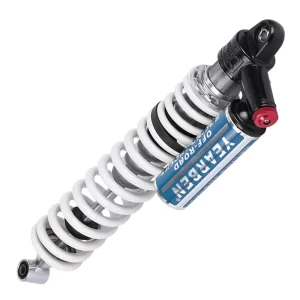
At the core of coil suspension, the spring carries the static chassis load and returns energy, while the damper controls how quickly the suspension compresses and rebounds. An OEM supplier must control more than the wire diameter. It should verify spring free length, installed height, spring rate tolerance, block height at full compression, and seat or perch design. It must also hold the damper force curve stable at low, medium, and high shaft speeds, because the same part number can feel correct at parking-lot speed and become harsh or soft at trail speed.
Off-road and multi-platform programs add another requirement. The coilover is a structural and thermal part, not only a comfort part. A supplier that treats every assembly as a catalog item will miss side-load, rod guide, or reservoir heat issues that only appear when the unit is installed in a longer travel or heavier vehicle.
Which Coilover Interfaces Change Across Platforms?
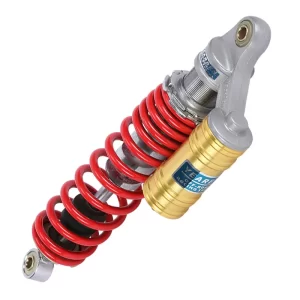
The same coil suspension architecture can exist across an ATV, UTV, 4×4, and desert buggy, but the dimensional and tuning priorities change. An ATV usually needs high compliance at low vehicle mass. A UTV adds passenger and cargo load shift, so the supplier must consider dual-rate springs or high-flow valving. A 4×4 crawler prioritizes large articulation and resistance to fade, while a desert buggy prioritizes heat rejection and consistency over repeated high-speed cycles.
| Platform | Main coil suspension job | Interface points to lock | Do not infer |
|---|---|---|---|
| Sport or utility ATV | Keep compliance high and control bottom-out | Eyelet width, spring preload, shaft travel, linkage angle | A 250cc setting transfers to a 450cc or heavy 4×4 ATV |
| UTV / side-by-side | Control body roll and dual-rider load shift | Tender spring, dual-rate stop, reservoir bracket | One spring rate suits all UTVs |
| 4×4 truck / crawler | Support high corner weight and long articulation | Spring free length, block height, reservoir hose length | Long travel means the same damping force |
| Desert buggy / race | Reject heat and keep force stable over long runs | Remote reservoir, bypass or piggyback zones, nitrogen charge | A trail tune is usable for sustained race heat |
Treat these platform differences as interface locks, not optional notes. A drawing that lacks eyelet width, bushing type, mounting angle, or spring seat location will produce a quotation that is easy to give and expensive to correct.
Coilover selection changes when the same part family moves from a trail UTV to a desert truck. <Best-Off-Road-Coilover> covers coilover selection for off-road applications.
How Are Spring Rate and Damping Specified Together?
Spring rate defines the force needed to compress the spring a given length. Its effect on the vehicle depends on the suspension linkage, known as the motion ratio. A spring with the correct wheel rate on one platform may be too stiff on another because the mount angle or shock lever changes. That is why a coil suspension RFQ should specify the vehicle corner weight and motion ratio range, not only a spring rate number.
Preload sets the installed height and the point where the spring begins to work. It does not add spring rate. A buyer who asks for more preload to fix bottoming is often masking an incorrect main spring rate or insufficient damping support. The preload collar must not create coil bind at full compression, and the supplier should check the available threads and lock method.
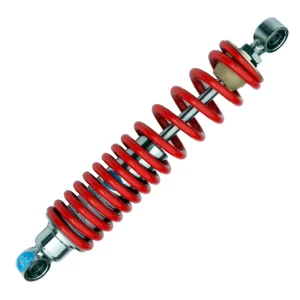
Damping force is the force produced at a given shaft velocity, usually separated into compression and rebound. Low-speed damping influences body control and steering feel; high-speed damping influences how the suspension responds to sharp impacts. The valve stack, piston port area, and adjuster circuit must be selected together with the spring, not after the spring rate is fixed.
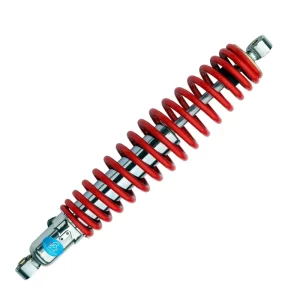
Damping force linearity depends on piston and valving design more than on a generic off-road label. <Monotube-Shock-For-Off-Road> covers the monotube shock platform for off-road applications.
What Does a Factory Acceptance Path Look Like?
A reliable OEM program moves from a locked drawing and sample specification to a first-article approval before volume production. The buyer and supplier should agree on the dimensional report, spring rate measurement at a defined stroke, damper force measurement at specified velocities, travel and seal leakage checks, finish and weld inspection where applicable, and any application durability test. Without these gates, the factory can build a part that fits the mounting points but does not perform.
One distinction matters in supplier review. A sample test verifies the sample part from that batch, against the checks that were actually performed. It does not automatically prove every future batch is identical. For cross-platform use, the qualification should be repeated or explicitly extended with changed dimensions, spring rates, valving, brackets, or reservoir hose routing. If the supplier cannot show which checks apply to which revision, the OEM program is not yet production-ready.
Supplier breadth matters here. A supplier running more than 200 active models and an annual production capacity around 1.5 million units is more likely to hold tooling, spring inventory, and test fixtures across product families.
Which RFQ Fields Prevent a Misquoted Coilover?
The clearest way to compare suppliers is to submit the same RFQ fields and see whether each quote returns an engineering question or a unit price. A detailed RFQ also protects against sources that can copy an outside shape but not the damping behavior.
| RFQ item | What to request | Why it matters |
|---|---|---|
| Platform and use | Vehicle family, target gross weight, terrain, speed range | Defines corner loads and heat load |
| Spring data | Free length, rate, block height or max travel, preload setting | Controls ride height and bottom-out |
| Damper force | Compression and rebound force at low, mid, high shaft speeds, plus tolerance | Prevents a soft or harsh tune |
| Interfaces | Eyelet size and width, bushing type, mount angle, reservoir hose routing | Avoids assembly rework |
| Performance target | Travel, reservoir type, adjuster count, temperature or fade limit, service interval | Separates cost from durability need |
| Quality evidence | Drawing revision, sample report, batch process controls, first-article approval criteria | Reduces hidden variability |
Request a drawing-controlled quotation, not a photo-based estimate. If a supplier accepts a weight range without asking for motion ratio, travel, or shaft speed points, the quote may hide assumptions that later become your rework.
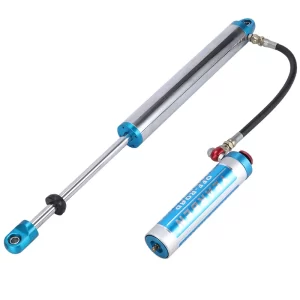
Reservoir packaging changes routing, heat capacity, and mounting stress. <Piggyback-2-0-Coilover-Shock> covers the piggyback coilover format for off-road builds.
Tell Us Your Platform and Performance Target
Send the vehicle platform, approximate corner weight, intended travel or lift, mounting dimensions, and the damping performance you expect. That allows our engineering team to return a coil suspension specification instead of a generic price.
Contact Yearben Shock Absorber Technology at info@yearbenshocks.com or +86-523-86566899.
FAQ
What is the difference between a coilover and a separate coil spring and damper?
A coilover integrates the coil spring over the damper body into one assembled module. A separate spring and damper arrangement keeps the components in different positions. The coilover often saves packaging space and simplifies aftermarket tuning, but the spring rate and damper valving still have to be matched to the vehicle’s motion ratio.
Does one coil suspension part work across ATV, UTV, and 4×4 platforms?
Not automatically. Spring rate, damping force, reservoir type, and mounting hardware usually differ. A factory can standardize part families, tooling, and quality processes across platforms, but a common part requires the buyer to confirm the load, travel, and interface requirements first.
What should I prepare before requesting a coil suspension OEM quotation?
Provide the platform family, approximate vehicle or corner weight, spring travel or lift target, mounting dimensions, current failure or performance complaint, and any preferred reservoir or adjuster type. A photo of the existing part helps, but a dimensioned drawing or sample is more useful.
How do we verify a coil suspension sample before volume production?
Request a first-article report covering the spring rate, damper force at specified speeds, free and compressed lengths, seal leakage, finish, and required durability checks. Confirm which revision the report belongs to, then repeat or extend the approval when any spring, valving, bracket, or reservoir detail changes.
If you’re interested, check out these related articles:
Coilover-Shock-Absorber
Oil-free lawn mower shock absorber 24mm
Gas Charged Dual Rate Coilover Shock Absorber
Ride-on Mower Shock Absorbers 38mm, Shock Absorber Manufacturer